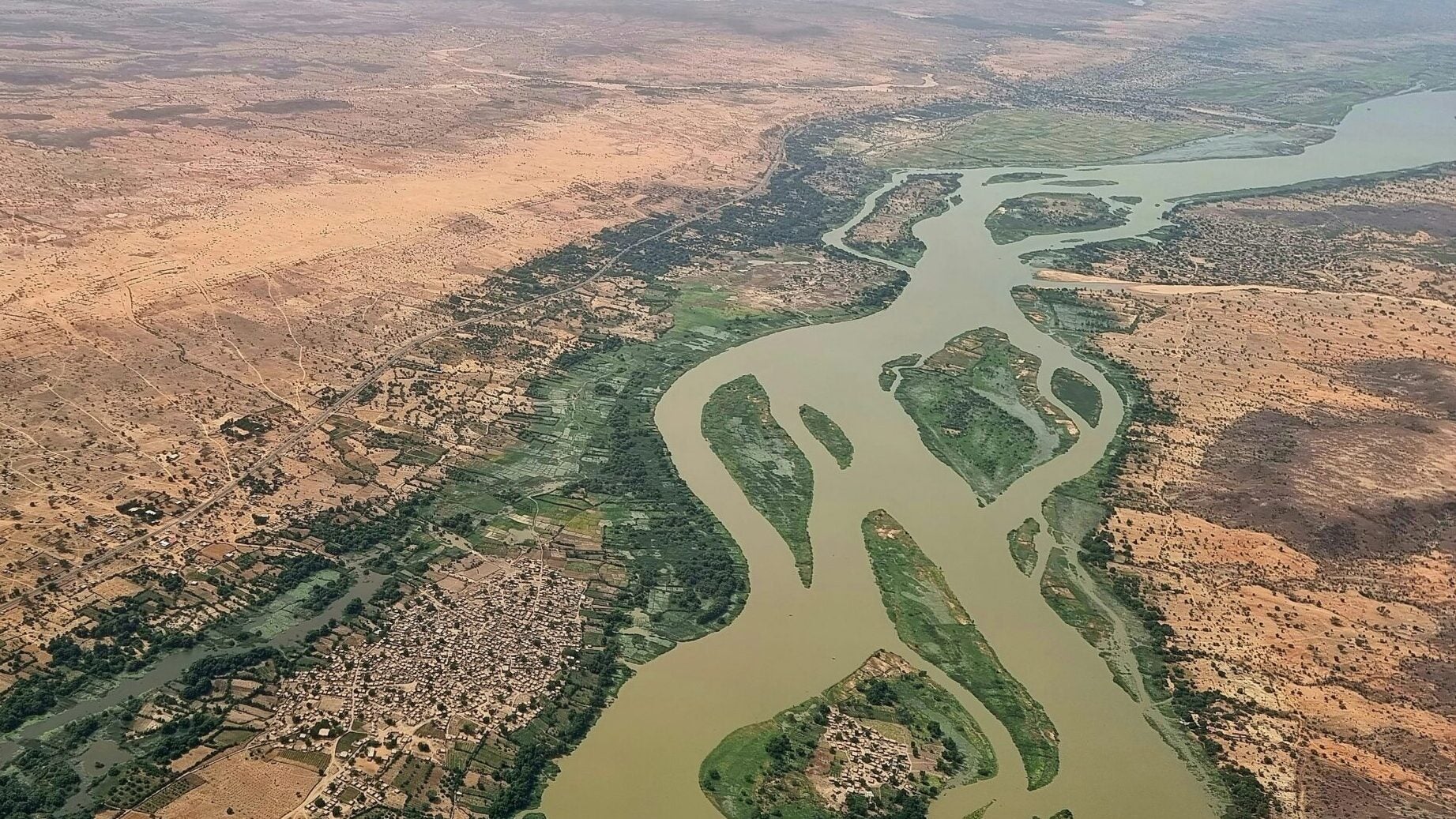
Every year, the Sahara Desert advances further south, consuming farmland, displacing families, and shrinking livelihoods.
From Senegal to Sudan, once-productive land is steadily becoming barren under the combined pressures of climate change, unsustainable land use, and population growth. According to the United Nations Convention to Combat Desertification (UNCCD), Africa loses millions of hectares of productive land every year to degradation, while nearly half of the continent’s land area is already degraded to some degree. The consequences are profound: declining harvests, rising food prices, forced migration, conflict over scarce natural resources, and deepening poverty.
Yet, unlike many of the world’s most difficult environmental problems, we already know one of the most effective ways to reverse it.
Fields dismissed as dead began producing crops again. Trees returned. So did hope.
In northern Burkina Faso, where rainfall is scarce and the soil had hardened into what many believed was lifeless ground, farmers faced a choice: abandon their land or reinvent how they farmed.
One farmer, the late Yacouba Sawadogo, chose to reinvent.
Rather than accepting desertification as inevitable, he revived an almost-forgotten indigenous farming practice known as the Zaï technique. During the dry season, he dug thousands of small pits across degraded fields. Into each pit he placed compost and organic matter. When the rains finally arrived, these small basins trapped water that would otherwise run off hardened ground. Termites attracted by the organic matter burrowed into the soil, naturally improving infiltration and soil fertility. Seeds planted inside the pits suddenly had moisture, nutrients, and life.
Fields dismissed as dead began producing crops again. Trees returned. So did hope.
The Zaï technique has demonstrated remarkable results across Burkina Faso, Niger, Mali, and other parts of the Sahel.
Studies have shown that farmers using Zaï pits can increase cereal yields by 50 to 100 percent, while restoring soils previously considered unusable. In some areas, degraded fields producing less than 500 kilograms of grain per hectare have increased production to well over one tonne per hectare after rehabilitation.
The uncomfortable truth is that climate finance overwhelmingly favours innovation over implementation.
Combined with contour stone bunds that help reduce erosion by run-off water and farmer-managed natural regeneration, the technique has restored hundreds of thousands of hectares of degraded land while improving groundwater recharge and encouraging natural tree regeneration.
Its genius lies in its simplicity: No expensive machinery; no imported technology; no sophisticated irrigation systems. Just human labor, local knowledge, organic matter, and patience. Few climate interventions deliver such extraordinary returns at such modest cost. Yet despite decades of evidence, Zaï remains the exception rather than the rule.
The Real Problem Is Not Innovation. It Is Investment.
Climate solutions that feature satellites, artificial intelligence, carbon markets, precision agriculture, or billion-dollar engineering projects certainly have their place. But the uncomfortable truth is that climate finance overwhelmingly favours innovation over implementation.
Billions of dollars flow into new pilot projects every year, while farmer-led restoration techniques that have already demonstrated success struggle to attract sustained investment. Development programs often celebrate successful demonstrations before moving on to the next innovation, leaving communities without the resources needed to replicate what already works. That is why desertification continues to advance despite decades of conferences, declarations, and international commitments.
Perhaps the greatest mistake policymakers make is viewing land restoration as an environmental program. They should think of it instead as economic infrastructure.
Africa already possesses one of the world’s most effective land restoration innovations. It was not invented in Silicon Valley. It did not emerge from a climate summit.
It came from generations of African farmers who understood their land long before the world began speaking about climate resilience. The challenge before us is no longer discovering solutions. It is financing and scaling them.
Perhaps the greatest mistake policymakers make is viewing land restoration as an environmental program. They should think of it instead as economic infrastructure. Healthy soils produce food. Food supports industries. Industries create jobs. Jobs reduce poverty. Stable rural economies strengthen national security.
Every hectare restored becomes a productive asset capable of generating food, income, employment, carbon sequestration, biodiversity, and climate resilience simultaneously.
Few public investments generate so many overlapping returns.
These compound gains are precisely why governments, climate funds, development finance institutions, philanthropic foundations, and impact investors should treat land restoration with the same seriousness they reserve for roads, energy, or digital infrastructure.
Because productive land is infrastructure. Without it, nothing else works.
The Sahara does not advance because Africa lacks answers. It advances because too many of those answers remain trapped inside pilot projects, research papers, and conference presentations.
To be sure, Zaï is not a silver bullet. No single farming technique will stop desertification across an entire continent. Zaï is labour-intensive. It works best in semi-arid environments. Farmers require training, access to organic matter, and supportive extension services. In many places, it performs best alongside complementary practices such as stone bunds, agroforestry, farmer-managed natural regeneration, irrigation, and improved market access.
Scaling restoration therefore requires more than promoting one technique. It requires coordinated investment in ecosystems of solutions.
Governments should make regenerative land restoration a national development priority. Climate funds should dedicate far more capital to scaling proven farmer-led restoration models. Development finance institutions should recognize restored land as productive infrastructure. Impact investors should see degraded landscapes not as liabilities but as opportunities to generate financial, social, and environmental returns simultaneously.
The Sahara does not advance because Africa lacks answers. It advances because too many of those answers remain trapped inside pilot projects, research papers, and conference presentations.
Every year we delay, another farmer abandons a field. Another family loses its livelihood. Another community edges closer to hunger.
Africa already knows how to stop the desert. The question is whether the rest of us are finally ready to invest in what its farmers have known all along.