In the summer of 2026, I visited Japan during a heat wave that set records for extreme temperatures. Even in the early morning, the air was already stifling. Tormented by the hot soil, earthworms would crawl above ground only to meet their end on the sun-baked pavement. The Japanese term for this weather, “kokushobi,” translates as cruel heat, which seemed accurate.
I had traveled to Japan as part of an anthropological research project exploring how people in the United States understand exposure to nuclear radiation. Japanese science on the topic — responding initially to the atomic bombing of Hiroshima and Nagasaki — has long influenced understandings of radiation safety in the U.S. and around the world.
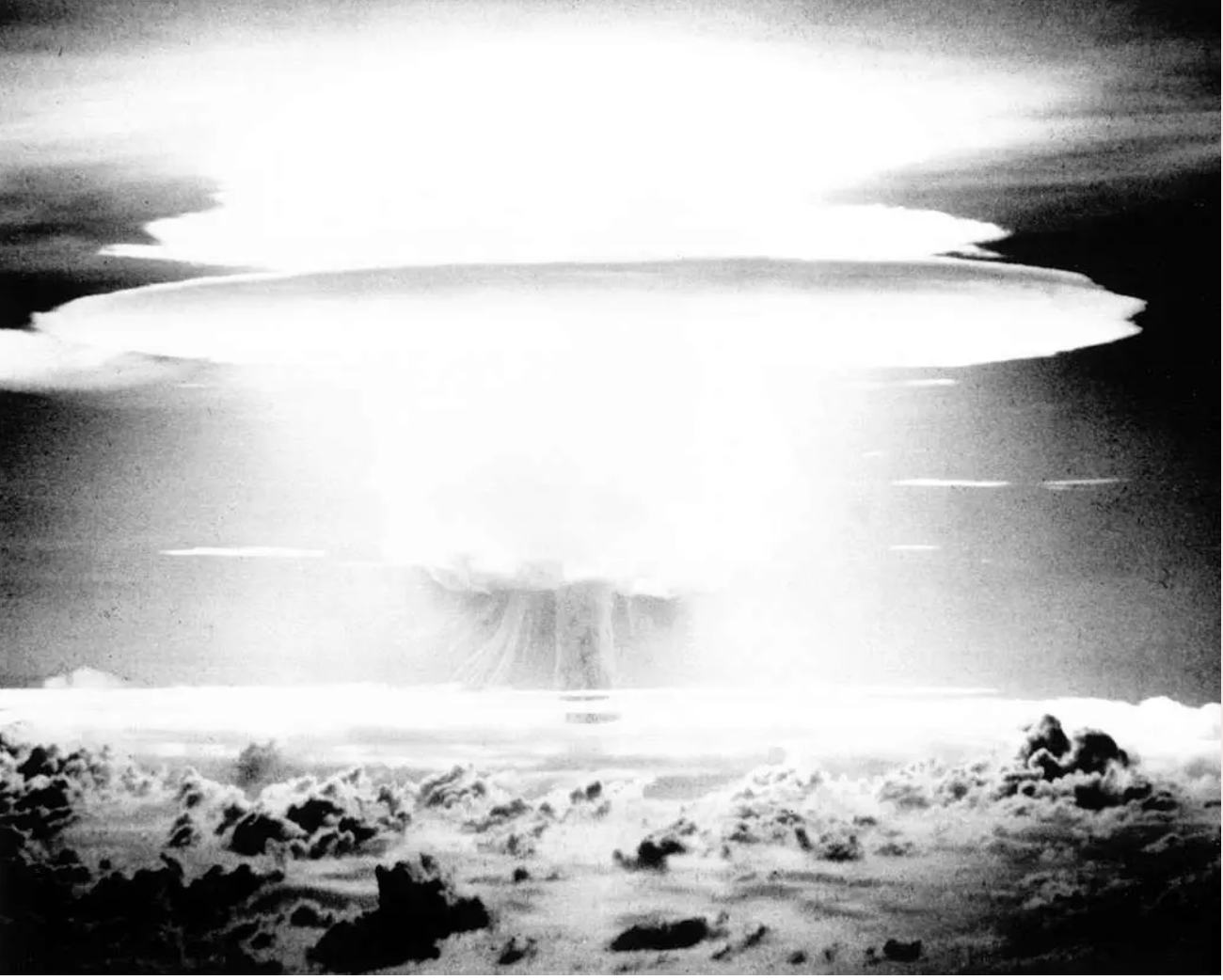
In 1954, international news coverage of the Castle Bravo nuclear bomb transformed Americans’ understanding of radiation, making the dangers of fallout visible and raising questions about whether government officials were misleading the public.
This essay — the latest installment in the column Situating Science — links the story of a Japanese tuna fishing vessel to contemporary efforts to weaken radiation protection standards. It illustrates how the stories told by scientists, journalists, and public activists reshaped nuclear policies in the past and why those lessons matter in a time of cruel heat.
Nuclear Fallouts
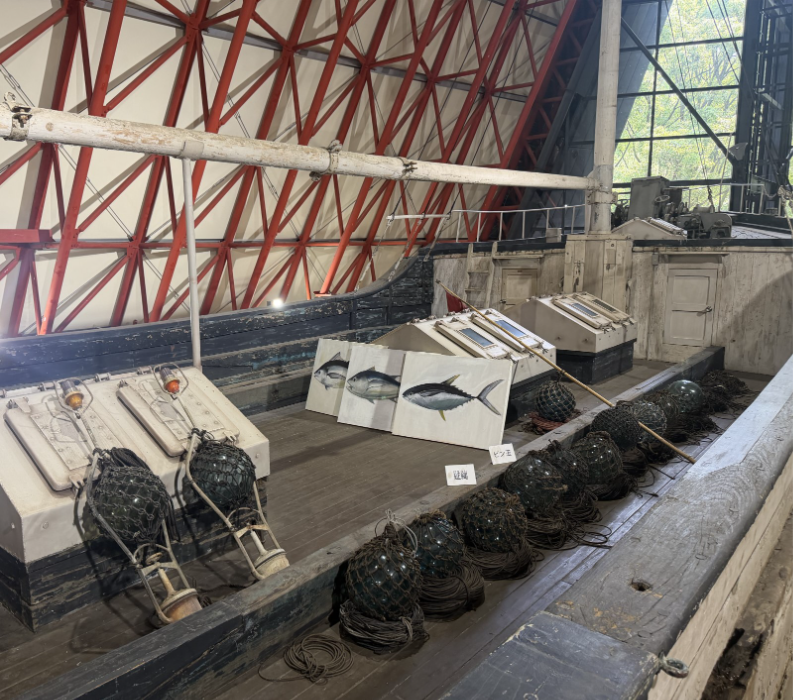
On my first day in Tokyo, I visited the Daigo Fukuryū Maru Exhibition Hall, which tells the story of the U.S. government’s use of experimental nuclear weapons in the Marshall Islands in the decade after World War II. Located in a ship-shaped building at the edge of a large public park, the hall is home to the Fukuryū Maru — Lucky Dragon #5 — a Japanese vessel that fished for tuna in the Pacific during the 1950s.
The ship was well outside the official danger zone at 6:45 a.m. on March 1, 1954, when the U.S. detonated the Castle Bravo hydrogen bomb on Bikini Atoll. But its crew saw the western sky blaze with the colors of the sunrise as white ash began to fall around them. According to the exhibition, ash covered everything: the crew’s heads, hands, feet, and hair.
Several of the crew on the Lucky Dragon developed radiation sickness. One who became urgently ill was Aikichi Kuboyama, the ship’s radio operator. According to the exhibition’s displays, the Japanese government reached out to the U.S. Atomic Energy Commission for information about Castle Bravo and for assistance treating the poisoned fishermen, but the Japanese officials “were stonewalled.”
This sentiment is echoed by historians of Cold War science, who show how the Atomic Energy Commission not only refused to cooperate, but covered up information so the U.S. government could control the narrative.
The story brought the concept of “fallout” into the U.S. public’s lexicon. With it came both fears of invisible contamination, and a growing suspicion that experts and officials were not being honest about what they knew.
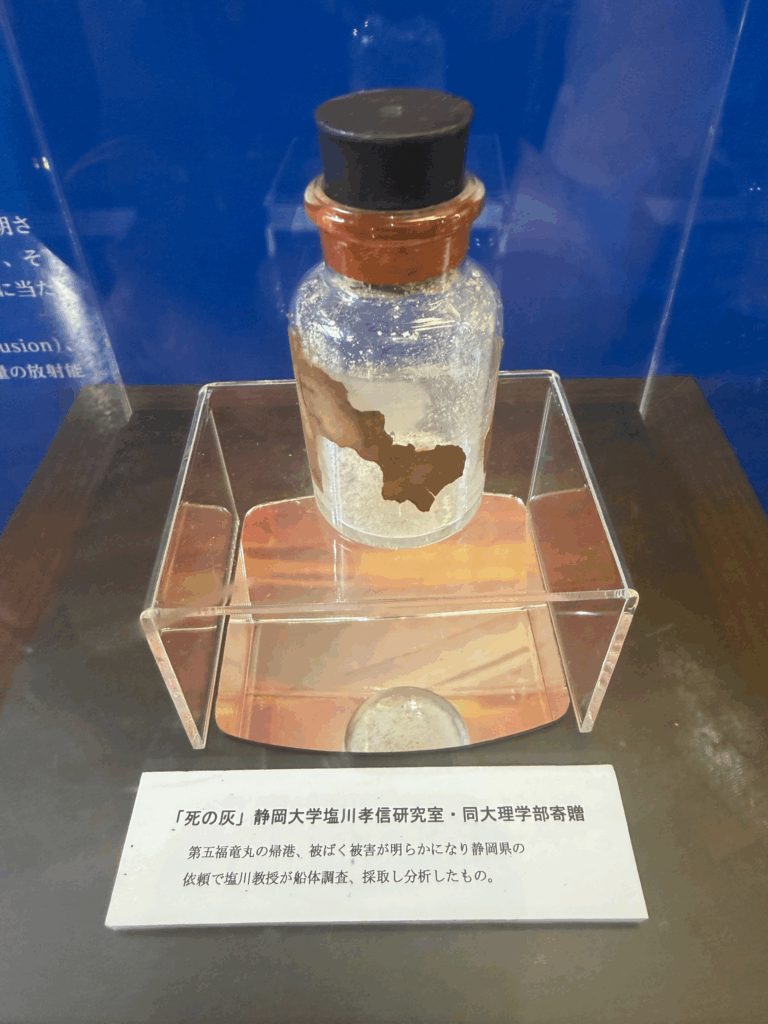
Seeking to understand the fishermen’s illnesses, scientists at the Tananobu Shiokawa Laboratory and Shizuoka University collected samples of ash from the ship’s wooden hull. They named the residue “shi no hai,” or ashes of death, understood most commonly now as radioactive fallout. Newspaper reports in Japan in the summer of 1954 described the ash as a “danger to life.”
Back in the U.S., there was understandable public confusion about what fallout was and whether it posed a danger. Apocalyptic warnings about the nuclear age appeared in the media alongside utopian promises. The public was cautioned that radiation was deadly, but also promised that an antidote to radiation exposure was close at hand.
Consider an Associated Press headline: “A scientist in Ireland says mice are protected from radiation by drinking alcohol” (Dec 7, 1953). Other reports that circulated in mainstream newspapers suggested that special clothing could shield people from the risks of radiation (May 27, 1952) or that protection would come in the form of a “big fat pill” (April 7, 1953).
On one hand, the public was told that “nuclear bombs could kill all” (Dec 10, 1950); on the other, they read “Atomic power is the key to many wonders” (Dec 20, 1953) and that “planes and ships may soon be Atom-Powered” (Oct 12, 1955).
Just one month before the Castle Bravo detonation a headline reported that doctors were “using atomic blasts to help with health — to help you live” (Jan 31, 1954).
The Story Japanese Media Told
Although Atomic Energy Commission officials had known that its weapon tests were dispersing dangerous radioactive isotopes, they concealed that information. But then the fishermen of the Lucky Dragon became sick. Wanting to know why, Japanese scientists began systematically studying the effects of fallout and the international media began to report on the story.
Over the summer of 1954, U.S. newspapers chronicled the fishermen’s plight. The following series of headlines from the spring of 1954 told the story:
March 24: “Naval Craft Showered with Radioactive H-Bomb Ashes”
March 31: “Catch of the Lucky Dragon Should Be Destroyed”
April 1: “Blood Count of the 23 Burned [Japanese] Falling”
April 8: “Another Fishing Boat Affected; Cargo of Tuna Contaminated”
In August of 1954, the U.S. public learned that Aikichi Kuboyama, the sickest of the fishermen, was “near death from atomic ash.”
Newspapers reported that Kuboyama’s condition had become a diplomatic issue, warning that U.S.-Japan relations were as strained as they had been since World War II and would likely deteriorate if the sailor died.
By mid-September 1954, attention turned toward reparations: Would the U.S. government have to pay Japan for the massive economic losses caused by contaminated fish, and for the sailor’s life?
During the following week, optimistic reports suggested that Kuboyama’s condition was improving. Then a front page headline on Sept. 23 announced that Kuboyama “Dies of Atom Burns.”
Readers were learning that nuclear weapons could harm people far beyond the moment and place of detonation. As one newspaper asked, “Has the death of a citizen ever been watched by so many eyes?”
When I told a Japanese friend about the attention generated by the Lucky Dragon, she shook her head at the idea that Americans would be moved to care about radiation by the media coverage of the death of a single fisherman. “The tens of thousands of people killed by radiation in the bombings of Hiroshima and Nagasaki weren’t enough?” she asked.
Yet before the Lucky Dragon disaster, the U.S. public was educated to understand nuclear weapons primarily as larger versions of conventional bombs. Castle Bravo and its aftermath upended this understanding. Scientific research and media coverage of the incident confronted the public with the fact that nuclear weapons were different in kind, not merely scale.
The story brought the concept of “fallout” into the U.S. public’s lexicon. With it came both fears of invisible contamination, and a growing suspicion that experts and officials were not being honest about what they knew.
What Science Propaganda Did
In the following years, confusion and uncertainty about fallout persisted as the Atomic Energy Commission continued to reassure the public that fallout posed “no danger.”
The manifesto helped to consolidate a coalition of scientists in opposition to nuclear weapons, prompting a broad social reaction against nuclear peril.
Japanese historian Okuaki Satoru notes that Lewis Strauss, Chairman of the Atomic Energy Commission, repeatedly insisted that radiation levels from the bombing in the Marshall Islands were “far too small to pose any risk to persons, animals or plants. Radioactivity dissipates rapidly after tests, and soon returns to normal levels of natural background radiation.”
Strauss’s claims appear to have carried considerable weight since the U.S. detonated 62 more nuclear bombs in the Marshall Islands over the next four years. But he was also increasingly finding his propaganda-filled messages in the cross-hairs of science.
At the back of the exhibition hall, underneath the bow of the Fukuryū Maru, a panel highlights the 1955 Russell-Einstein Manifesto, which called for the abolition of nuclear weapons. Signed by 10 Nobel Prize-winning scientists, the manifesto asserts that the dust that fell on the Japanese fishermen and their catch from the Castle Bravo denotation brought global attention to the danger of nuclear bombs. It continues:
No one knows how widely such lethal radioactive particles might be diffused, but the best authorities are unanimous in saying that a war with H-bombs might possibly put an end to the human race.
The manifesto helped to consolidate a coalition of scientists in opposition to nuclear weapons, prompting a broad social reaction against nuclear peril.
One of the final panels in the exhibition hall, next to a display of the signatories of the Russell-Einstein manifesto, was a 2021 video interview with Marshallese poet Kathy Jetn̄il-Kijiner. In the interview she reflects on how the entwined histories of nuclear testing and climate change are both displacing her people.
Historian Jacob Hamblin writes that in the late 1940s, when Truman first learned about the hydrogen bomb — the kind used in Castle Bravo — it was depicted as a “weapon of genocide.”
Jetn̄il-Kijiner’s testimony makes evident that genocide has been her people’s experience of the nuclear age. In the video, she describes contaminated islands now sinking under the rising sea and experts who respond with the recommendation to dredge the ocean floor and use landfill to rebuild. As she speaks, the frame shows sunny yellow bulldozers heaping garbage into an elevated mound.
“So much of our land has a story,” she explains. “This grove of trees has a story; this hill has a story. You change that and you lose that story.”
What the Trump Administration Is Doing
In 2025 the Trump Administration issued Executive Order 14300, which ordered the reform of the nuclear regulatory commission. On July 15, 2026 the U.S. Nuclear Regulatory Commission proposed a rule that would fundamentally reshape radiation protection standards in the U.S. If adopted, the rule would discard the principle known as ALARA (“as low as reasonably achievable”) and permit higher levels of radiation exposure than current regulations allow.
The regulatory framework that eventually became ALARA emerged from post-Castle Bravo debates over whether any radiation exposure could truly be considered safe. Before the summer of 1954, U.S. scientists spoke about radiation in terms of “tolerance dose,” implying that a threshold existed below which exposure could be safe. But after the death of Aikichi Kuboyama, growing public and scientific attention to the global spread of fallout began to trouble that logic.
The U.S. Advisory Committee on X-Ray and Radium Protection, now known as the National Council on Radiation Protection and Measurements, formally acknowledged that any radiation dose, however small, carried some risk. In response, it replaced the term “tolerance dose” with “maximum permissible dose.”
Although critics argued that the new phrase still implied that some level of radiation exposure could be considered safe, they welcomed the recognition that radiation carried risks at every dose. The change reflected a growing understanding that the question was no longer “Is radiation safe?” but “How much risk is society willing to accept?”
The Trump administration has moved to weaken radiation protections. The NRC proposal, not coincidentally, coincides with an uptick in the production of nuclear technologies, ranging from weapons, to power plants, to waste.
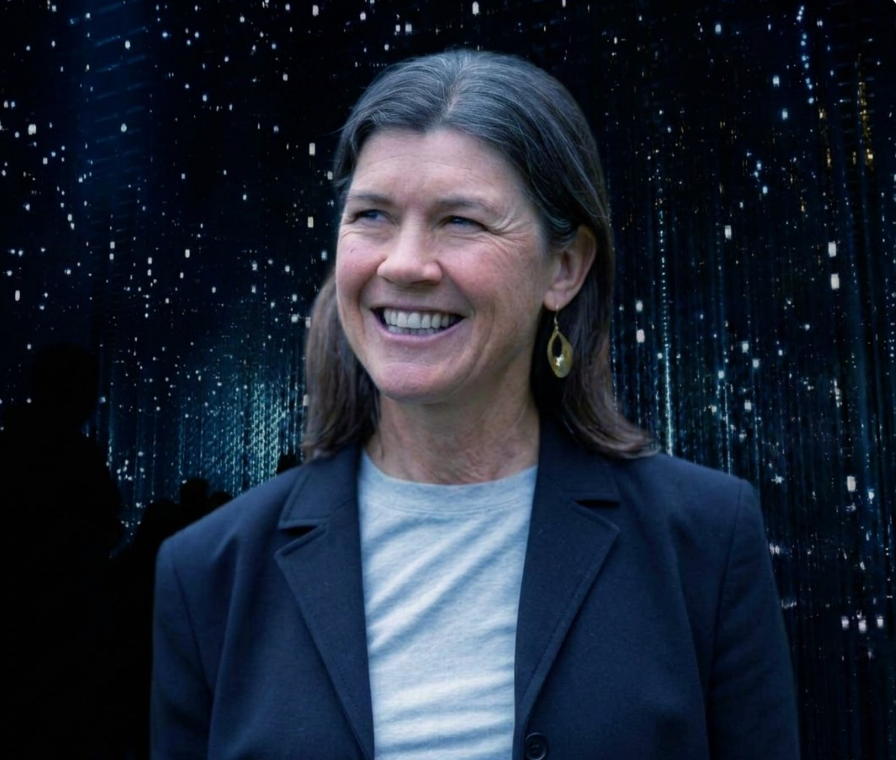
In the 1970s, this evolving approach to radiation protection was formally codified in the ALARA principle. As the current president of the National Council, Dr. Kathryn Higley, has explained, ALARA acknowledges that because all radiation exposure increases health risks, exposures should be kept “as low as reasonably achievable, taking into account social, economic, and environmental factors.”
According to the NRC’s 2026 proposal, the new rules would facilitate the safe use of nuclear technologies while maintaining adequate protection against the health effects of radiation exposure. Many scientists, however, remain skeptical.
Before his death last year, Dr. Dan Hirsch from the Program on Environment and Nuclear Policy at the University California, Santa Cruz, did not mince words. At a public meeting to discuss the NRC’s radiation protection standards, he pointed to the substantial body of evidence demonstrating that even low doses of radiation can cause harm.
“Radiation regulations should indeed be changed — but they should be significantly tightened, not weakened,” he said.
Instead, the administration has moved to weaken radiation protections. The NRC proposal, not coincidentally, coincides with an uptick in the production of nuclear technologies, ranging from weapons, to power plants, to waste. An acceleration of militarization and energy consumption driven by artificial intelligence is fueling interest in nuclear science at a speed and scale not seen since the Cold War.
Global warming is even invoked in defense of the NRC’s proposal. Proponents argue that nuclear power offers a carbon-friendly means of meeting a rising demand for energy. They cite deadly heat waves to justify relaxing the radiation protections that emerged from the concern about fallout in the 1950s.
Lessons from Castle Bravo
Looking back today, the summer of 1954 marked a critical juncture in perceptions of radiation. As the U.S. public grappled with “ashes of death” that blanketed the Lucky Dragon, they woke up to the connections between planetary destruction and human health, and, with this, to the fact that they were not immune to the actions of their government half a world away.
Scientific research on the Castle Bravo disaster gave the U.S. public a language for thinking about particulate contamination that would seed the public reception of Rachel Carson’s book “Silent Spring” nearly a decade later. Journalist David Ropeik notes that Carson herself made the connection, writing that “chemicals are the sinister and little-recognized partners of radiation in changing the very nature of the world — the very nature of its life.” Awareness of fallout helped to inspire environmental consciousness within the U.S. and beyond.
Today, in a time of cruel heat, the lesson of Castle Bravo is not only that environmental threats can travel great distances. It is that people can learn to tell and listen to stories about those connections — and then act upon them.
The world’s nuclear powers continued expanding their arsenals and conducting nuclear tests. Yet within a decade, growing outcry against radiation compelled the governments of the U.S., U.K., and Soviet Union to sign the 1963 Partial Test Ban Treaty, ending atmospheric nuclear testing. Historian Toshihiro Higuchi describes this as one of the first multinational treaties to address a global, human-induced environmental issue.
Revisiting the Lucky Dragon as temperatures around the globe are soaring and radiation protections are disappearing, I am reminded that there was a time before particulate contamination was part of public consciousness.
Then the work of scientists, journalists, and civil society helped mobilize awareness that health and wellbeing are connected to distant events. In addition to introducing people to fallout, the stories that emerged in response to Castle Bravo connected people to places they had not connected with before.
It strikes me that we may be approaching a similar watershed moment in how people view themselves in relation to seemingly distant places and events.
Jetn̄il-Kijiner’s observation that every place is also a story reminds us that environmental damage shapes the ways we know where and who we are, and how we are connected to others. This observation can, in turn, set us on a path for caring for the world through the stories we tell.
One story not told enough is about the success, however fleeting and fragile, of nuclear disarmament. While it took time, civil society eventually rose up in widespread protest against nuclear weapons. Atmospheric nuclear testing largely ended. Nuclear stockpiles have been reduced by 83% from their peak. Governments strengthened standards for radiation protection.
Today, in a time of cruel heat, the lesson of Castle Bravo is not only that environmental threats can travel great distances. It is that people can learn to tell and listen to stories about those connections — and then act upon them.