
In May, the secretary of Health and Human Services, Robert F. Kennedy Jr., announced a new MAHA Action Plan to curb what the agency calls psychiatric overprescribing.
The plan focuses heavily on antidepressants, including selective serotonin reuptake inhibitors, or SSRIs. It champions what the press release calls “deprescribing when clinically indicated,” more informed consent, and greater use of non-medication treatments.
HHS also says it wants to elevate prevention, psychotherapy, physical activity, nutrition, and social connection as alternatives or complements to psychiatric medication.
Deprescribing can be good medicine. In every field of health care, clinicians should ask whether a treatment is still helping, whether its risks now outweigh its benefits, and whether a patient wants to continue it. Psychiatric medications should not be prescribed casually, continued indefinitely without review, or offered as the only response to suffering rooted in poverty, violence, isolation, discrimination, trauma, or chronic stress.
But deprescribing works only when people have somewhere else to go. When policymakers look at who takes antidepressants in the United States and why, the central problem is obvious: SSRIs became so widespread partly because they are often the only treatment our health system makes accessible and affordable.
When people ask why antidepressants have proliferated, one answer is simple: Because our health system made medication easier to get than psychological care.
The danger in Kennedy’s plan is not the word “deprescribing” but rather the plan to build a national policy around fewer psychiatric medications while dismantling, defunding, or neglecting the very services that would make less reliance on medications possible. Under the current administration, psychotherapy is unaffordable for most Americans. Programs that deliver psychotherapy in the public sector have been weakened through Medicaid cuts and constricting of community mental health clinics.
Why Antidepressants Have Proliferated
Antidepressants are widely used in the U.S.. A recent 50-state survey found that 16.6 percent of American adults reported current antidepressant use and 17.3 percent reported past use. Some facts about antidepressants are not surprising: Women and white Americans have higher usage compared to other groups.
But other patterns may be surprising. Taking antidepressants is equally common in rural and urban areas. And poorer Americans are more likely to be taking antidepressants than wealthy Americans, with Americans making under $25,000 being 40% more likely to be taking antidepressants compared to those making over $100,000.
States ranking near the top for highest antidepressant use are West Virginia, Kentucky, Iowa, Idaho, Nebraska, and Vermont. In West Virginia and Iowa, more than 50% of those surveyed were against restrictions on antidepressant use.
In brief, poor, rural, white Americans are likely to be the hard hit by a deprescribing wave.
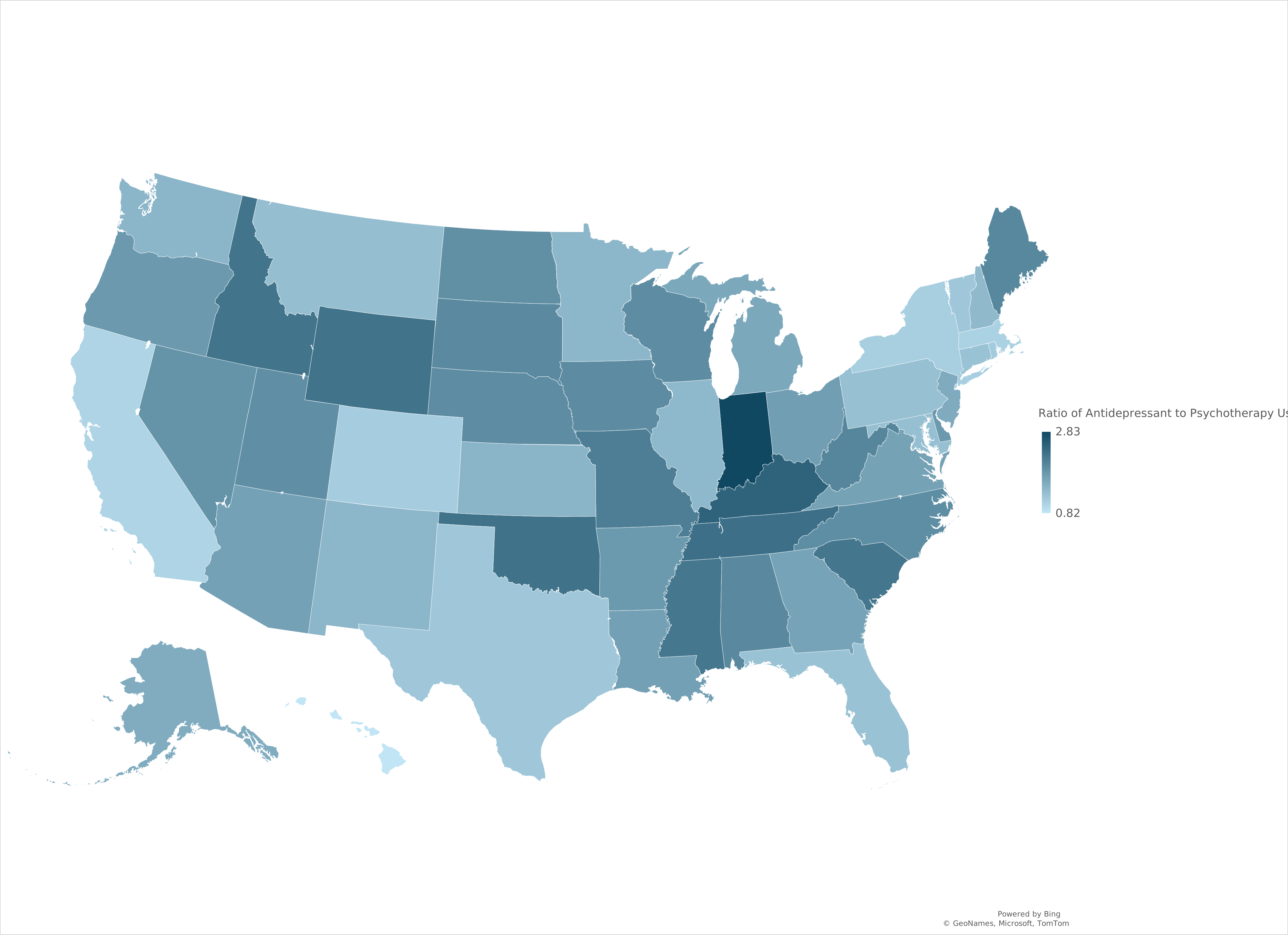
Most antidepressants and anxiety medications are prescribed by primary care clinicians. One recent analysis of employer-sponsored insurance claims found that primary care providers prescribed nearly 75% of antidepressants. For many primary care doctors, an SSRI is one of the few treatments within reach for their patients. A generic SSRI can cost only a few dollars a month through pharmacy discount programs. Insured patients have low monthly copays for these medicines.
In contrast, psychotherapy often requires weekly visits, time off work, transportation or broadband access, and a clinician who is accepting new patients and taking the patient’s insurance. Despite these barriers and lack of investment to make psychotherapy available, the evidence base is strong. Major meta-analyses in leading journals including World Psychiatry and the British Medical Journal demonstrate that evidence-based psychotherapies such as cognitive behavioral therapy produce depression outcomes comparable to antidepressant medication on average, and combined treatment often works better than either alone. The problem is not that psychotherapy is unproven; it is that our health system makes medication far easier to obtain than therapy.
Pushing people off psychiatric medications without the infrastructure and workforce for affordable psychological and social supports risks repeating the same mistake in a new form.
One national study of psychotherapy markets found an average cash-pay session price of about $147. Private therapy commonly runs far higher in many areas. Many therapists have left insurance networks because of low reimbursement, administrative burden, delayed payments, and insurer interference with care. In addition, more than 50% of US psychologists in the U.S. are not taking new patients, and those that do have months-long waiting lists.
Timing matters in mental health care: An antidepressant can be started within a few days of a primary care visit.
So when people ask why antidepressants have proliferated, one answer is simple: Because our health system made medication easier to get than psychological care. This does not mean that everyone currently taking or considering taking SSRIs should all be switched to psychotherapy. What we need is a realistic choice where psychotherapy options are as accessible and affordable as SSRIs.
Why Mental Health Infrastructure Matters
Kennedy’s plan gestures toward the right idea when it talks about prevention, shared decision-making, and non-medication treatments. But at the same time, President Donald Trump’s administration has weakened core parts of the mental health infrastructure.
HHS announced a major restructuring in 2025 that included large workforce reductions. The Substance Abuse and Mental Health Service Administration (SAMHSA), had lost more than half its staff, with major grant programs terminated or cut. That loss matters because SAMHSA has been central to the national community behavioral health infrastructure, including Certified Community Behavioral Health Clinics (CCBHCs).
CCBHCs are precisely the kind of model Kennedy should be expanding if he is serious about reducing unnecessary medication use. They are designed to provide comprehensive, person-centered behavioral health care regardless of ability to pay, including crisis response, substance use treatment, care coordination, peer support, and links to social services.
SAMHSA’s CCBHC model emphasizes coordination with physical health care, behavioral health care, housing, education, and other social supports.
Deprescribing should be the result of a stronger whole-of-society approach to mental health, not the death knell of a battered system.
CCBHCs now serve an estimated 3 million people nationwide, and the wider network of community-based behavioral health organizations represented by the National Council of Wellbeing reaches more than 15 million adults, children, and families.
These are the services that make deprescribing possible. They connect people to counseling, crisis care, job training, housing support, peer support, and substance use treatment. They address the conditions that often drive distress in the first place. Cutting or destabilizing this infrastructure while encouraging fewer prescriptions gets the sequence backward.
Medicaid is another crucial piece. Medicaid is the single largest payer for mental health services in the U.S. It covers nearly one-third of adults with mental health conditions and nearly one-quarter of adults with a substance use condition. The 2025 federal reconciliation law and related Medicaid changes will increase the uninsured population by 7.8 million in 2034, with $911 billion in federal Medicaid reductions over 10 years.
These combined mental health infrastructure reductions means that while RFK Jr. is advocating for less use of antidepressant medication, already stretched alternatives such as psychotherapy are rapidly becoming less available.
The Country Has Seen This Story Before, with RFK Jr.’s Uncle
In 1963, President John F. Kennedy signed the Community Mental Health Act. Heralded as “deinstitutionalization,” the landmark law intended to replace large custodial institutions with community-based mental health centers.
The vision for deinstitutionalization was humane and absolutely the direction needed for ethical and effective mental health care: People should not be warehoused for decades in psychiatric hospitals when they could live with support in their communities. Kennedy said the law would help replace “custodial mental institutions” with therapeutic centers and could reduce the number of people in mental institutions by 50 percent or more.
But community services were not built at the scale needed to care for the number of people leaving institutions combined with those already living in communities. For many people with serious mental illness, it was a shift from hospitals to homelessness, jails, prisons, nursing homes, and emergency rooms. Unfortunately in many states, it was not de-institutionalization, it was trans-institutionalization, just shifting people from one imperfect solution to an even worse situation.
The measure of success should not be fewer pills. Success is more people with real options, real support, and real care.
Today, community-based programs are struggling more than ever for funding, and when psychiatric beds are appropriate and necessary, their shortages remain severe. Children and adolescents in crisis can wait for days or weeks in emergency departments because no appropriate psychiatric hospital service is available.
That history should be a warning. Good intentions are not enough.
Closing institutions without building and sustainably funding community care produced suffering. Pushing people off psychiatric medications without the infrastructure and workforce for affordable psychological and social supports risks repeating the same mistake in a new form.
In places like West Virginia and Kentucky, it is not hard to imagine what the replacement for antidepressants might be. In these settings where the opiate epidemic has claimed so many lives, less access to antidepressants and other mental health services risks reversing the gains on controlling substance abuse.
There Is a Better Path
My work in global mental health has focused on what is often called task-sharing: training non-specialists — including community health workers, peers, and lay counselors — to deliver structured, evidence-based psychological interventions under supervision. This is not second-class care.
Task-shifting is a practical response to a universal problem: There will never be enough psychiatrists, psychologists, and social workers to meet all mental health needs if only licensed specialists are allowed to provide care.
Randomized trials have shown that lay health workers can deliver effective psychological interventions. In Zimbabwe, the Friendship Bench model trained lay health workers to deliver problem-solving therapy in primary care settings and showed benefits for common mental disorders.
If Kennedy is sincere about moving beyond a medication-first model, he should begin by building the alternatives.
In many countries, the World Health Organization’s Problem Management Plus (PM+) intervention can be delivered in five sessions by trained people who are not mental health clinicians.
High-income countries have lessons to learn here, too. England’s NHS Talking Therapies program offers free, evidence-based psychological therapies, including low-intensity interventions delivered by trained psychological wellbeing practitioners. Last year, the program received 1.81 million referrals, and more than 90 percent of people who entered treatment did so within six weeks.
Many places in the U.S. are trying to expand access to psychological treatments with models developed in low-resource settings around the world.
A recent randomized clinical trial of PM+ in 42 organizations throughout New York City enrolled more than a thousand New Yorkers and trained a hundred non-clinical community-based staff to provide structured psychological support. Its premise is simple: People already turn to trusted community organizations for help with housing, job training, food, family stress, violence, and financial insecurity. Mental health care should be available through community organizations too.
If Kennedy is sincere about moving beyond a medication-first model, he should begin by building the alternatives. Promote programs that enhance choices people have for mental health care like making psychotherapy affordable. Make community-based care universal. Pay for the workforce that can deliver psychological care at scale. Then clinicians and patients can decide together whether medication is appropriate to start and for how long it is needed. Deprescribing should be the result of a stronger whole-of-society approach to mental health, not the death knell of a battered system.
Until then, a national campaign against psychiatric medication risks repeating one of the great mistakes of U.S. mental health policy: tearing down one form of care before building the next.
The measure of success should not be fewer pills. Success is more people with real options, real support, and real care.