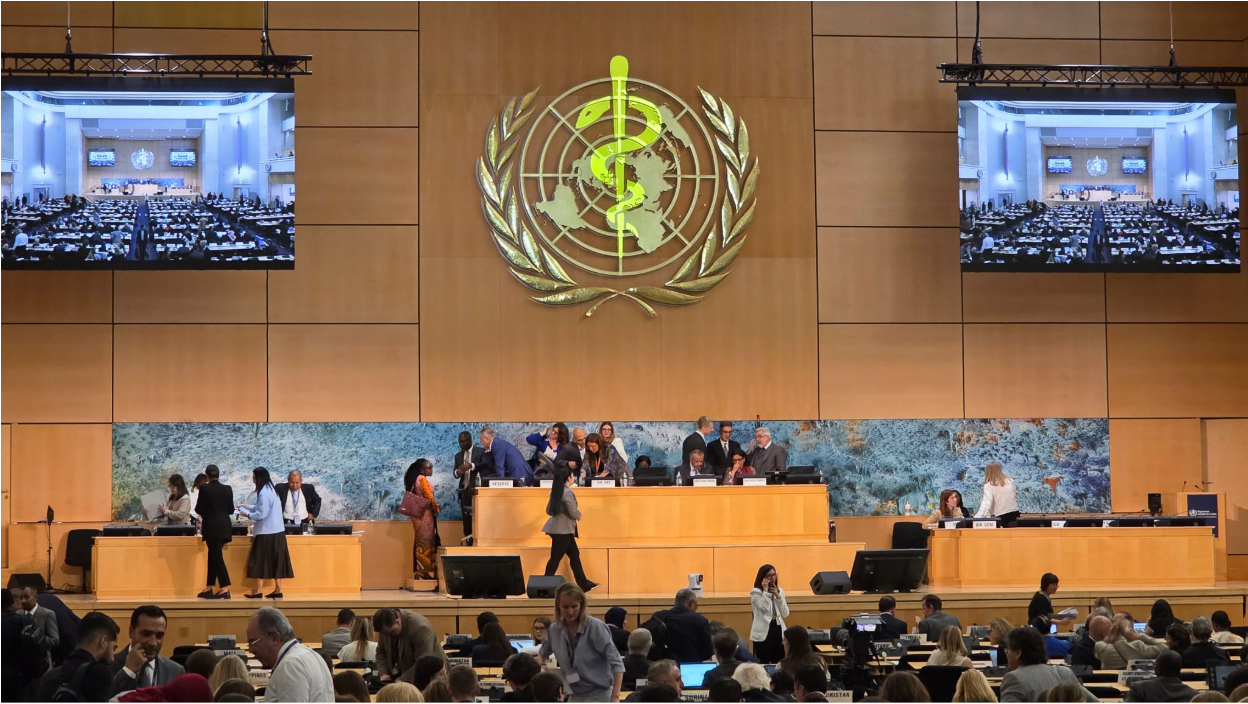
The annual World Health Assembly in Geneva unfolded the week of May 18 under the shadow of an Ebola outbreak, a financial crisis and the absence of the United States. Above the stage, a bold neon yellow snake coiled around the Rod of Asclepius contrasted with the subdued tone of the gathering. Shuttle buses carried diplomats and delegates between sessions split across the Palais des Nations and World Health Organization (WHO) headquarters.
Despite the emphasis on international cooperation, much of the plenary agenda turned political, with extended debates over Gaza, Lebanon, Iran and Ukraine. At the same time, delegates still approved dozens of technical resolutions on antimicrobial resistance, workforce recruitment, radiation protection and health financing. Ministers and health officials moved between committee sessions and emergency briefings on the spread of a vaccine-resistant Bundibugyo strain of Ebola in central Africa.
Meanwhile, WHO itself was restructuring operations after deep funding losses and large-scale staff reductions. Inside the assembly halls, the atmosphere was less one of collapse than of an institution learning to function under permanent constraint.
“I don’t think that people are talking about it. To be honest, you’re the first one that raised the U.S. since the assembly started,” Momodou M. Mbenga, first secretary at The Gambia’s U.N. mission in Geneva, said when asked about the American absence. “I don’t feel also that someone else is stepping in,” he added. “It just feels like a normal assembly that is ongoing.”
No country appears fully prepared to replace the U.S. politically inside the organization.
As American journalists based in Europe covering science and science diplomacy, one reporting from Geneva and the other from Vienna, we have spent the past year watching a broader shift unfold across international institutions. From climate research to public health, the U.S. has been stepping back from parts of the global scientific system it helped build after World War II.
What is unfolding around WHO increasingly resembles a broader pattern across international organizations during and after the Trump era: an initial political shock followed by bureaucratic adaptation. Systems absorb the disruption. Technical networks continue operating. What once would have been treated as an extraordinary rupture gradually becomes routine.
Global Health Cooperation Is Flying Under the Radar, Not Disappearing
For decades, it was assumed that the point of global health cooperation was to prevent infectious disease outbreaks; governments invested in international systems to detect and contain them. The U.S. played a central role in WHO’s creation in 1948, nurturing it to become a leading institution through which countries exchange surveillance data, coordinate emergency response, and negotiate health rules across borders.
In his first term, President Donald Trump’s administration on July 6, 2020, sent a formal one-year notice of U.S. withdrawal from WHO, but former President Joe Biden overturned that decision on his first day in office on January 20, 2021.
Trump spent his second inauguration day on January 20, 2025, signing as many as 100 executive orders that included U.S. withdrawal from WHO. Two days later, his administration again sent notice to the UN of the planned U.S. withdrawal. On January 22, 2026, that withdrawal became effective, severing U.S. ties and ending a role as the organization’s largest donor and dominant political force.
In practice, the architecture of global health cooperation, like other multilateral institutions, is increasingly flying under the radar rather than simply disappearing.
The Trump administration, however, maintains its membership in the Pan American Health Organization, which serves as WHO’s regional office but has its own constitution, budget, and governing body. PAHO also is headquartered in Washington, where it is seen as a more direct and transparent partner for regional health security.
On January 8, 2026, Trump moved to further dismantle many of the foundations of the postwar international order, signing a sweeping presidential memorandum to withdraw the U.S. from 66 international organizations and treaties. The “sovereignty audit” that led to the withdrawals was initiated by Executive Order 14199 on February 18, 2025, which directed Secretary of State Marco Rubio to identify organizations and treaties deemed contrary to U.S. national interests or captured by progressive agendas.
The decision to pull the U.S. out of dozens more international groups and agreements represents one of the biggest breaks in global science cooperation in decades. The U.S. is departing from global frameworks that create shared scientific facts, organize global evidence, and turn research into real-world rules. European governments are also reducing aid and health spending. WHO has lost roughly a quarter of its workforce even as outbreaks and humanitarian crises multiply. In practice, the architecture of global health cooperation, like other multilateral institutions, is increasingly flying under the radar rather than simply disappearing.
The latest Ebola outbreak itself illustrated the shift. By the time WHO Director-General Tedros Adhanom Ghebreyesus formally declared an Ebola outbreak in Congo and Uganda a global health emergency on May 17, African CDC and national health agencies, including those in the U.S., China and Canada, were already coordinating surveillance and response measures. Tedros said he based the decision on “information provided by” Congo and Uganda, and would convene an emergency committee “as soon as possible.”
There is no national substitute for global outbreak surveillance. Viruses move through systems of trade, migration and travel regardless of politics.
On May 15, the Africa CDC moved first to sound the alarm, acting as the primary early warning system before WHO’s global declaration. U.S. institutions remain partly embedded in the system they were stepping away from, according to the U.S. Centers for Disease Control and Prevention. China had funded and constructed the Africa CDC headquarters in Addis Ababa, which served as the command center for the May response. As early as May 1, the Public Health Agency of Canada (PHAC) was already monitoring the situation in Congo as part of its infectious disease risk assessment for the upcoming FIFA World Cup 2026.
Tedros bypassed the standard protocol of convening a committee of experts before the declaration, in a historic first for WHO, and replaced that process with direct consultation with the two most important partners, the health ministries of Congo and Uganda. By using Article 12 of the International Health Regulations, which allows the director-general to act alone in urgent cases, he cut the timeline for unlocking global funds.
U.S. officials keep coordinating with their African counterparts; the State Department said on May 19 it was providing $23 million to Congo and Uganda for “surveillance, laboratory capacity, risk communication, safe burials, entry and exit screening, and clinical case management.”
Trying to Do More With Less
At the same time, governments continue expecting WHO to oversee surveillance, emergency coordination and outbreak reporting even while reducing the organization’s resources and political backing. There is no national substitute for global outbreak surveillance. Viruses move through systems of trade, migration and travel regardless of politics.
“Every resolution you adopt, every agreement you reach, only has value when it changes what happens in a clinic, in a community, or in a household,” Tedros emphasized before the assembly in his closing remarks on May 23. “When a health worker has what they need to do their job; when a child is vaccinated; when a mother survives childbirth; when an outbreak is contained before it spreads.”
At a May 22 press briefing, Sigrid Kranawetter, WHO’s director of governing bodies, acknowledged the tension directly when asked whether governments were retreating from multilateral institutions while still depending on the systems they provide.
The postwar system of global health cooperation had not collapsed. But in Geneva, it increasingly appeared to be operating under conditions it was never designed for.
“Multilateralism can only work when it’s multilateral,” she said, warning that member states may eventually question arrangements in which countries continue benefiting from the system while reducing cooperation and support.
Later, Mbenga described WHO as “trying to do more with less” while confronting simultaneous health emergencies and financial pressures.
The assembly also exposed how geopolitical conflict is bleeding into global health governance. Delegates spent hours debating resolutions linked to Gaza, Lebanon, Iran and Ukraine. Meanwhile, ministers and diplomats quietly maneuvered around the 2027 race to succeed Tedros as director-general. Some delegates argued WHO needs a leader capable of rebuilding relations with Washington. Others said the organization now requires a crisis manager prepared for a more fragmented international system.
No country appears fully prepared to replace the U.S. politically inside the organization. While Chinese delegations pledged high levels of activity, their presence in the assembly was marked by caution and procedural maneuvering rather than overt leadership. China generally emphasizes oral interventions; it submitted not a single written statement. That strategic restraint suggests that while China wants a seat at the head of the table, it is not yet willing to assume the financial or political liabilities that come with being WHO’s primary architect.
By the assembly’s close, the postwar system of global health cooperation had not collapsed. But in Geneva, it increasingly appeared to be operating under conditions it was never designed for: weaker political consensus, tighter funding and fewer assumptions that major powers will sustain the institutions they built.