The field of global health is undoubtedly at a crossroads.
In January 2025, United States funding for projects around the world dissolved in a blink of an eye, and the U.S. withdrew from dozens of multi-lateral initiatives.
Funding cuts by other Western nations followed. People lost jobs. Patients lost medicines. Wars, conflicts, climate crisis, and rising authoritarianism have compounded the polycrisis, leading students of global health and development– especially those in Western countries– to question their mission.
To cultivate the next generation of global health leaders, we need an honest assessment of the current realities. We have to discuss the current state of geopolitics in order to encourage the next generation of health professionals to think creatively and without restraint when it comes to reimagining and rebuilding global health.
Reorienting how students think about global and local crises, encouraging them to see the connections between local and global, and recognizing their power to engage in a response to them, are all critical steps.
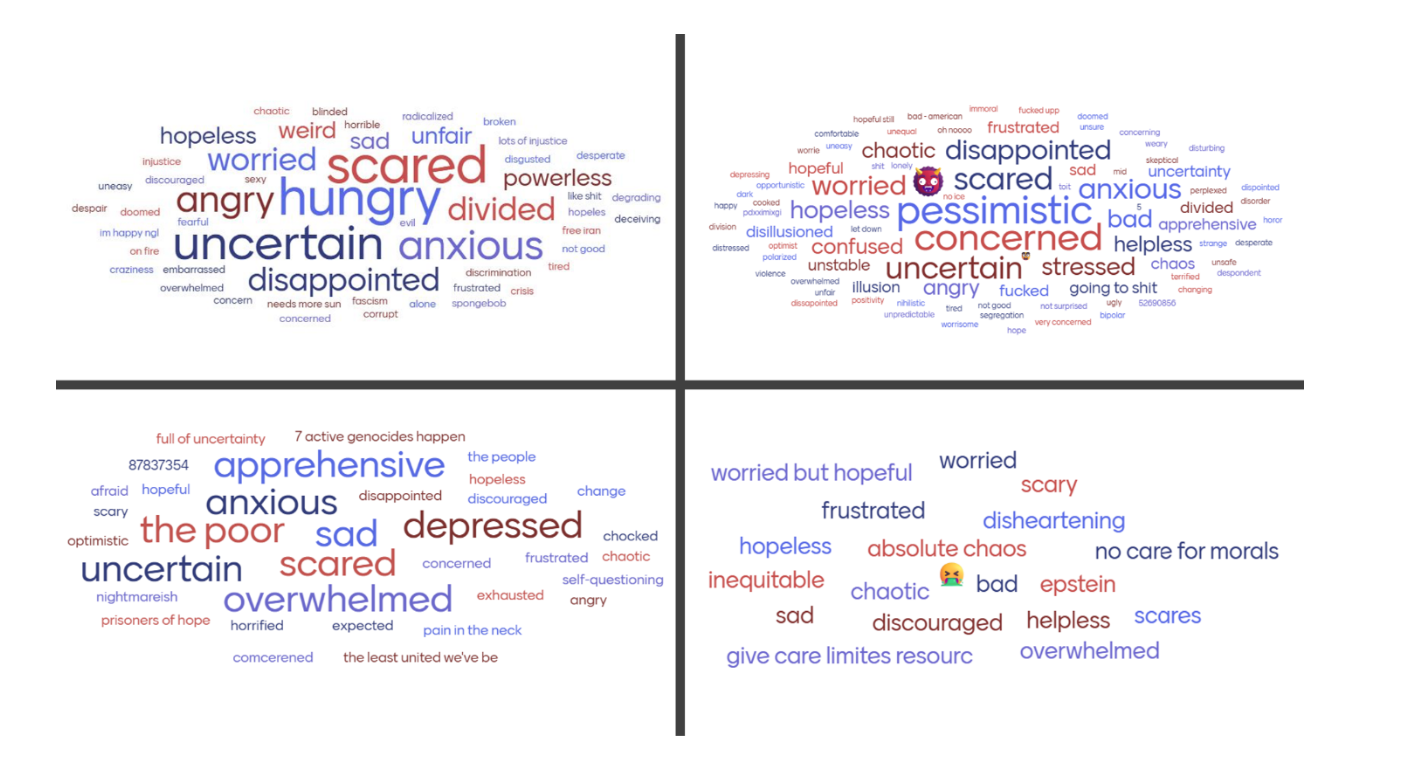
I am the Inaugural Chair of the Department of Global and Public Health in the McGill School of Population and Global Health. In the past few months, in every global health and development course I’ve lectured in, I’ve begun my lectures by asking students to respond to a menti poll question: “How are you feeling about the state of the world these days?”
Most students express feelings at the intersection of sad, scared, anxious, overwhelmed, and hopeless.
One student told me, “For many of us, young people, right now the world feels extremely confusing. We are constantly confronted with violent and overwhelming news, and it often creates a sense of disconnection or powerlessness.”
Others described feeling “grief” and “no point in fighting anymore,” saying the battle is already lost.
In times like these, students want to hear their professors talk about what’s happening and why things are the way they are. Students want to understand how power and politics permeate health and health systems. They want frank discussions about the ways politics affect health, and what possible tools we have to uplift the fields they are passionate about studying.
Despite frustration, many students are pragmatic about what comes next. One student said, “Faced with our sick world, I cannot resign myself to despair.”
Young people today, as they did in the past, are organizing and engaging in movements of resistance.
How to Handle Hard Conversations About Global Futures
I’ve taken away many lessons from teaching global health in this moment of global crisis in geopolitics, rising authoritarianism, attacks on science, and widespread violations of human rights.
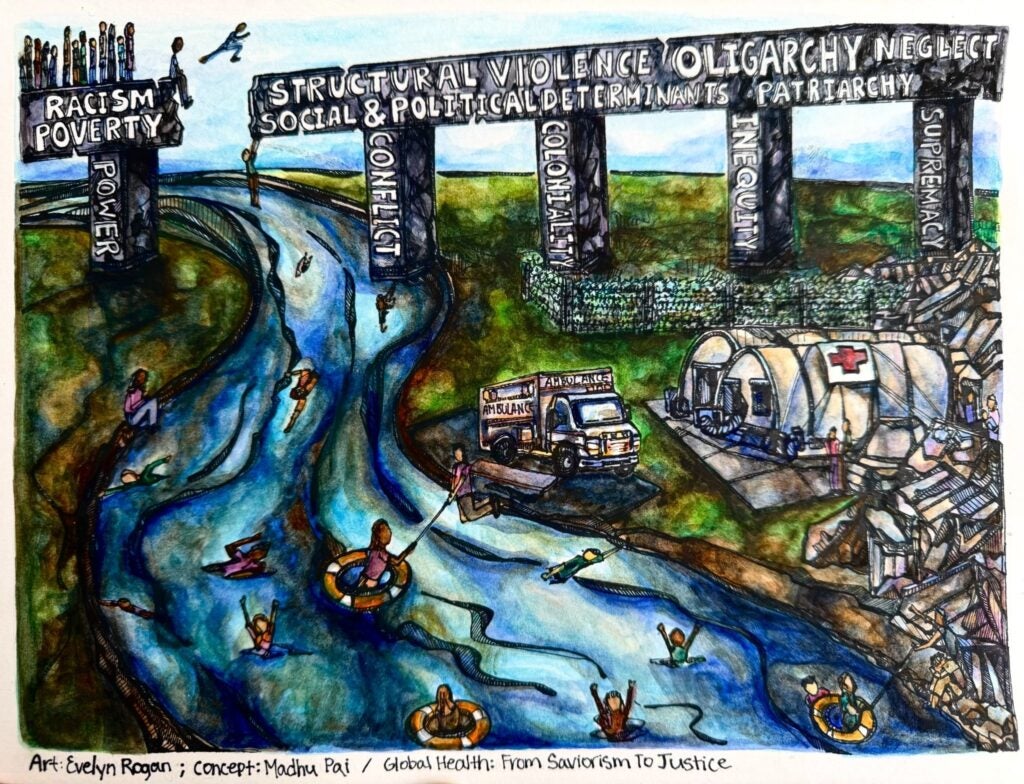
First, we must help students understand the bigger context of how power and politics shape everything that we see, so that their solutions are informed by a deeper understanding of power. Part of these lessons requires revisiting our history, helping students understand how various crises are inter-related through overlapping systemic factors such as colonialism, racism, patriarchy, power asymmetry, inequities, structural violence, and poverty.
To make this point, I’ve used the upstream-downstream metaphor, illustrated in the image below. The artist tries to capture a savioristic model of global health or development, which involves rescuing drowning kids without confronting deeper questions about why kids are being pushed into the river.
It also shows what upstream, structural factors are making kids vulnerable in the first place. As the image suggests, focusing on justice and solidarity requires us to dismantle systemic sources of oppression and vulnerability.
Once students get to see and appreciate the realities and the underlying drivers, they invariably ask what they can do to help mitigate the damage and bring about a positive change in the world.
To bring hope, one helpful approach is to discuss historical social and peoples movements, from civil rights and anti-apartheid to women’s suffrage and AIDS activism. Successful movements are about organizing, growing communities, and building power among people to effect change.
Reading personal accounts of leaders can inform how students think about the current moment. These accounts might include those from well-known resistance leaders such as Mahatma Gandhi, Martin Luther King, Jr., Audre Lorde, Nelson Mandela, and Malala Yousafzai, as well as Frantz Fanon, Marshall Ganz, Sarah Schulman, David France, Rebecca Solnit, Ben Phillips, and Maria Ressa. I also curate lists of inspiring global health books and films.
Conveying what is possible by providing successful examples of what people have done collectively and individually to overcome great challenges and achieve meaningful change is essential to bring hope.
Encouraging students to revisit universal human rights as a foundation concept is also critical for students interested in global health conversations and work. Having students revisit these original concepts and put them into historical context is a critical learning tool.
Building on social movements of the past can be instructive for young people interested in ongoing movements such as anti-war protests, climate justice activism, Stand Up for Science, and anti-ICE, No Kings protests. This approach shifts young people’s passion away from “saving” other people and instead encourages students to think about how to engage in pro-democracy movements.
Reorienting how students think about global and local crises, encouraging them to see the connections between local and global, and recognizing their power to engage in a response to them, are all critical steps.
Finally, conveying what is possible by providing successful examples of what people have done collectively and individually to overcome great challenges and achieve meaningful change is essential to bring hope. In doing so, we can remind young people that the future is yet to be determined; that it is not too late or inevitable; and they have a crucial role in defining the future.
As Rebecca Solnit put it, “The future is not yet decided, because we are deciding it now.”