
This July 4, I stood with a small crowd near the National Cathedral in Washington, DC, gazing out at the National Mall. A handful of fighter jets whirled in a darkening sky, then flitted away to the west.
Suddenly, lightning forked down to the mall, seemingly from midair. President Donald Trump’s celebration of the United States’ 250th anniversary was, temporarily, evacuated.
For historians, national anniversaries provide an occasion to reflect on what we consider the most important moments in a country’s history. To tell the story of the U.S., many historians focus on wars, laws, social movements, economic trends, or technological breakthroughs. Relatively few consider the natural world — not just how it was shaped by human ideas and actions, but how it shaped humans in turn.
As I watched lightning smite the Great American State Fair, I wondered: How does a focus on the environment change our view of U.S. history? How might it transform our view of its future?
These are big questions. But if we focus on the environment as a whole, the answers seem straightforward.
Environmental Histories of Conquest and Capitalism
U.S. environmental history is deeply tied to the concepts of the Columbian Exchange and ecological imperialism, which reimagine European colonialism as a team effort in which organisms other than humans — from single-celled protozoans to horses — played critical, historically overlooked roles.
The environmental history of the U.S. is also rooted in capitalism, with its commodification of nature, and industrialization, the second or (at worst) third great energy transition in human history.
As of this writing, no country has polluted the atmosphere with more carbon dioxide than the U.S. The country is still the world’s second-largest contributor to global warming.
Together, capitalism and industrialization remade environments not only from the Atlantic to the Pacific, but wherever Americans hunted, mined, and traded. Americans also invented the National Park, a place where a certain kind of nature could be preserved, while expelling its longtime Indigenous stewards.
The country’s environmental history is also tightly bound to common definitions of the Anthropocene, the proposed (but, by geologists, recently rejected) epoch distinguished by human interference in the flows of energy and matter that shape the Earth. A distinctly American application of technological innovation to war — the Trinity nuclear test on July 16, 1945 — marks a proposed starting point of the Anthropocene. After World War II, U.S. governments, institutes, and businesses spearheaded a “great acceleration” in humanity’s consumption of the Earth, visible in everything from population to energy use to paper production, that in many respects continues to define our time.
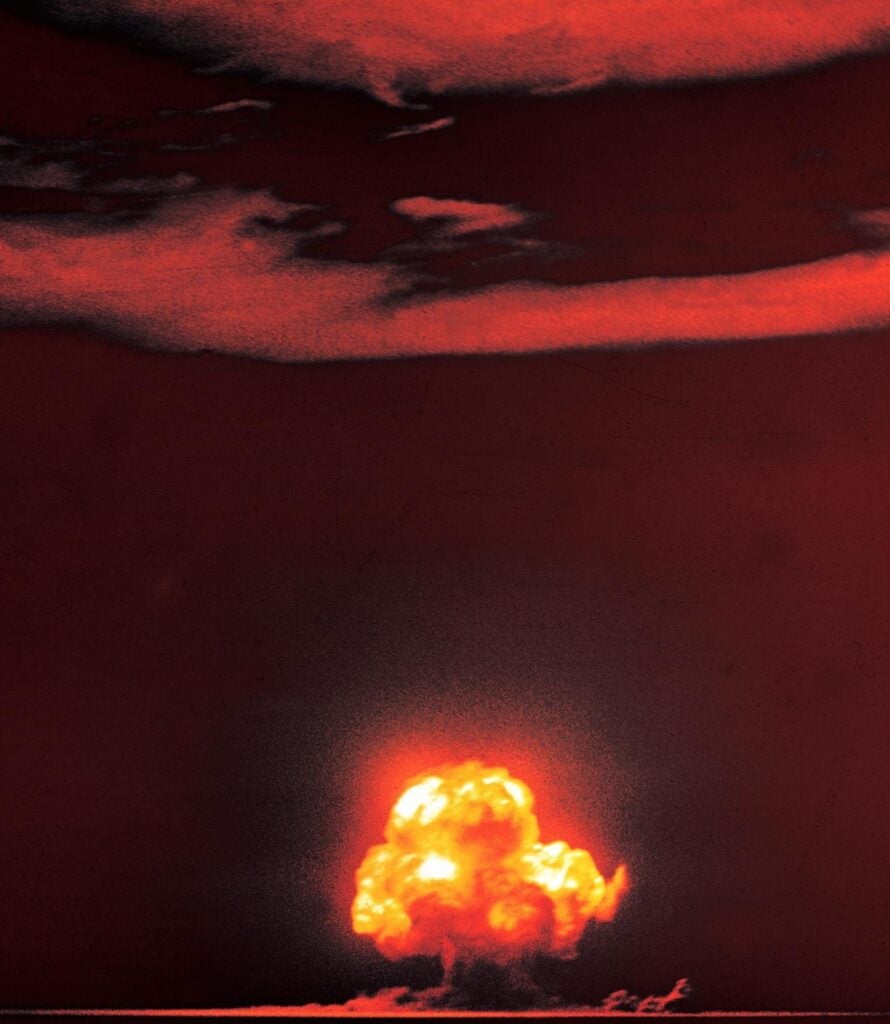
Jack W. Aeby | Wikimedia Commons
Among environmental historians, these histories of species exchange, capitalist extraction, environmental conservation, and unsustainable growth are well-worn stories — in fact, together they might constitute the dominant narratives of the field.
But what if we both narrow and broaden our focus to consider just the climate? Have weather extremes shaped American history in meaningful ways that historians — even environmental historians — rarely consider?
The Little Ice Age and the Birth of the United States
One way to tell a climate history of the U.S. concisely is to trace both the influence of weather on inflection points in the country’s history, and the impacts on history of weather’s worst extremes. We can then consider whether individual events registered long-term trends in climate that — perhaps — helped bend the arc of the U.S.’s 250-year history.
So, where should this climate history of the U.S. begin?
There are many places we could start. Some are so far in the past that they are impossible to date; they can be associated with a distant climate, not a distinct weather event. The migration of the first peoples across Beringia — in the Pleistocene, the geological epoch distinguished by the repeated advance of continent-straddling ice sheets — is the most obvious example.
But if we view the U.S. above all as a settler state — which we probably should — then we can begin its climate history with the arrival of Europeans during a period of climatic cooling known as the Little Ice Age.
Weather that we can now associate with the Little Ice Age both hampered and aided a critical turning point in the U.S. struggle for independence.
This period is deceptively named; it was not comparable to the glaciations of the Pleistocene, which are colloquially called ice ages, but it was also far from small. It endured for perhaps six centuries, from the 13th (or perhaps 14th) century through the 19th, but its cooling came in multidecadal waves that affected different places with different severity — or not at all.
Lower temperatures across the northern hemisphere, then eventually much of the world, altered global patterns of atmospheric circulation, shaping where, when, and how much rain (or snow) could fall.
Clusters of explosive volcanic eruptions seem at least partly responsible for the Little Ice Age, owing to the sulfuric gases they launched into the atmosphere, but other forces — like a slight dip in solar activity — might have been responsible, too.
In any case, the first European settlers to the future U.S. seem to have arrived at an inauspicious time. In the 16th and 17th centuries, cold snaps and droughts shocked Spanish, French, and English colonists who had wrongly assumed that latitude predicted climate. Some colonies disintegrated when droughts and bitterly cold winters caused famine; some military campaigns faltered amid torrential rains, freezing winds, and outbreaks of epidemic disease.
In general, Indigenous peoples were more adaptive in the face of climatic extremes, and more capable of exploiting them in war.
Overall, the Little Ice Age might have slowed the colonization of North America, but it also prompted new ideas about the circulation of air and water across the Earth — ideas that helped lay the foundation for the development of climate science.
Precipitation trends in the Civil War enhanced the strategic position of the north relative to the south, but undermined the Union’s military operations at the tactical level of conflict.
In the 1740s — when the Thirteen Colonies were firmly established — some of the coldest winters of the Little Ice Age swept across Europe and North America. In Philadelphia, now a burgeoning city with some 15,000 inhabitants, Benjamin Franklin responded to frigid winter weather and soaring fuel prices by developing a new technology, the Franklin Stove, that could generate more heat with less firewood.
The stove was a hit. When Franklin eventually refined his stove so it could burn coal, the invention helped normalize the use of fossil fuels in U.S. cities. It also helped create a new expectation of a comfortable, indoor microclimate that eventually transformed human life.
The Thirteen Colonies kept growing — at the expense of Indigenous nations they displaced, and partly through the labor of enslaved Africans — up to that fateful afternoon on July 4, 1776 when the Second Continental Congress adopted the Declaration of Independence.
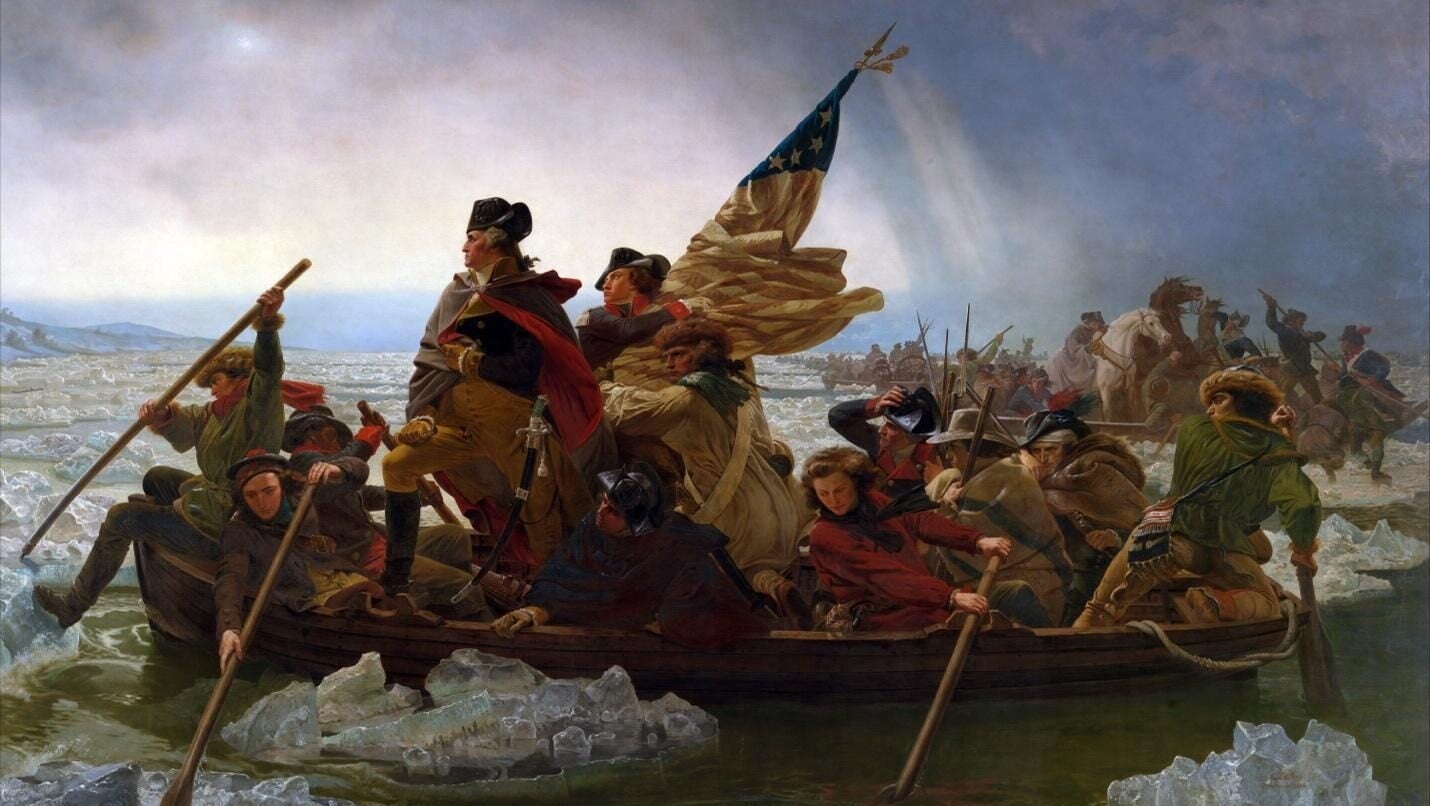
But the War of Independence had started poorly for the new Continental Army. By December 1776, General George Washington’s forces had retreated from New York and New Jersey, and the army seemed like it was beginning to melt away.
Washington needed a win, and any American will tell you that he got it by crossing the Delaware on Christmas night to attack an unsuspecting garrison at Trenton, N.J.
Across much of the world, the Little Ice Age was not as cold as it had been earlier in the 18th century, or as cold as it would be decades later. Still, the U.S. climate was much chillier than it is now. Washington’s main force forded the Delaware River in a blizzard, dodging floating ice in darkness, but two other planned crossings failed. After they landed, Washington’s troops braved the storm and seized Trenton because its commander, Colonel Johann Rall, had not expected an attack.
Weather that we can now associate with the Little Ice Age both hampered and aided a critical turning point in the U.S. struggle for independence.
The growth of the U.S. had also pushed millions into regions that were precariously exposed to extreme weather.
Across much of the world, the Little Ice Age reached its coldest point after the calamitous eruption of Indonesia’s Mount Tambora in 1815. Its vast plumes of sulfuric gases created a global volcanic dust veil, lowering temperatures across much of the world to such an extent that 1816 was remembered as a year without summer.
Unseasonal frosts repeatedly damaged crops in the Northeastern U.S., especially in New England. Rising food and fodder prices encouraged farmers to move their families west in search of cheap land and rich soils. Cold but erratic weather also slashed populations of river fish, such as alewives, just as high grain prices encouraged New Englanders to seek new food sources.
But chilly weather also seems to have increased the population of ocean fish, such as mackerel. Surging demand for these fish forever transformed U.S. fisheries, as well as ocean ecosystems along the country’s east coast.
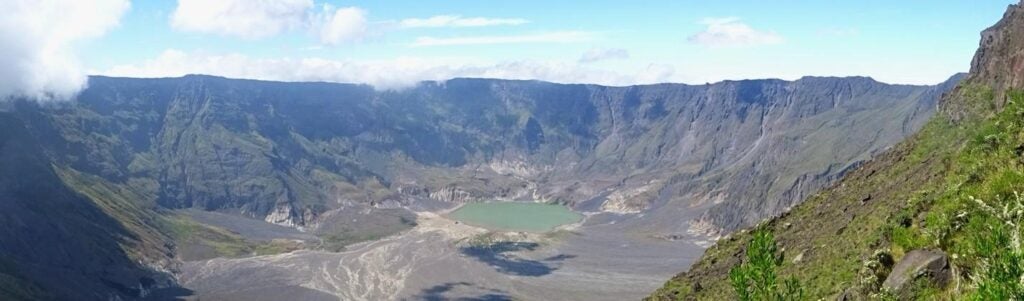
Tisquesusa | Wikimedia Commons
A Growing Country, a Changing Climate
The cooling of the Little Ice Age had receded by the middle of the 19th century, when the spread of industrialization was, perhaps, just beginning to alter the chemistry of the atmosphere. Nevertheless, precipitation extremes appear to have influenced the course of the 1861-65 Civil War between the southern Confederate states and the northern Union states.
Prolonged drought across much of the Confederacy ruined harvests, leading to starvation and outbreaks of disease among southern troops and horses. In the Union, by contrast, wet weather created ideal conditions for agriculture — just as mechanization was starting to increase harvests.
Between 1940 and 1942, the war’s outcome might have been shaped, in part, by a climatic anomaly: a sustained warming of the tropical Pacific Ocean, known as an El Niño.
Northern troops were therefore among the best fed in military history, and that seems to have improved their performance in the field. At the same time, torrential winter rains compromised the roads on which Union armies depended for supplies, slowing the pace and increasing the cost (in men and morale, not to mention money) of Union offensives.
Precipitation trends in the Civil War therefore enhanced the strategic position of the north relative to the south, but undermined the Union’s military operations at the tactical level of conflict.
By the end of the 19th century, the U.S. had become a leading producer and consumer of both coal and oil. Carbon dioxide concentrations in the atmosphere were beginning to inch above the maximum level they seem to have reached in 300,000 years of human history.
Owing in part to those emissions, the climate had already started to warm ever so slightly, and heatwaves were more dangerous in U.S. cities than they are now. Brick, concrete, and asphalt environments amplified heat; cramped homes had little air circulation; employers expected manual laborers to keep working; and cities didn’t coordinate a public health response.
In August 1896, a 10-day heatwave seems to have killed over 1,500 people in New York City alone. Many New Yorkers tried to keep cool by sleeping outdoors on roofs or fire escapes.
The late 20th century saw three severe El Niño events of escalating intensity: in 1972-73, 1982-83, and 1997-98. The droughts, torrential rains, and heatwaves associated with each El Niño spurred revolutions in oceanography, meteorology, and climatology.
By the 1920s, the U.S. had a population double that of Germany, and thrice that of Britain or France. It had, by far, the world’s largest economy, and it was, at worst, the world’s second-largest food producer.
Severe weather now simply had more to destroy, and few events showed that more clearly than the Tri-State Tornado that churned a path of destruction across Missouri, Illinois, and Indiana for nearly four hours in 1925. Likely an F5 on the Fujita scale that measures tornado intensity, the tornado wiped out the town of Griffin, Indiana, killed nearly 700 people, and injured some 2,000.
The growth of the U.S. had also pushed millions into regions that were precariously exposed to extreme weather.
Two years after the Tri-State Tornado, months of heavy rain broke levels along the lower Mississippi, flooding tens of thousands of square miles from Illinois to Louisiana. Hundreds of thousands of people were forced to flee the Great Mississippi Flood of 1927. Many of them were Black sharecroppers and laborers; their displacement contributed to the Great Migration of Black Americans from the rural south to the burgeoning cities of the North, Midwest, and West.
The changes in atmospheric circulation associated with El Niño also tend to suppress hurricane formation, and hurricanes are usually the most damaging weather events that affect the U.S. and its territories.
Growth in an industrial age also came with intentional devastation of environments that unwittingly created danger, with many of the country’s poorest again left precariously exposed.
The relentless expansion of mechanized, market-driven farming across the Great Plains, for example, had disturbed the sod — the upper layer of earth, anchored by roots — that once protected the region from dust storms. Beginning in 1930, scorching temperatures and persistent drought allowed wind to strip away topsoil in vast, pitch-black dust storms that repeatedly overwhelmed farming communities.
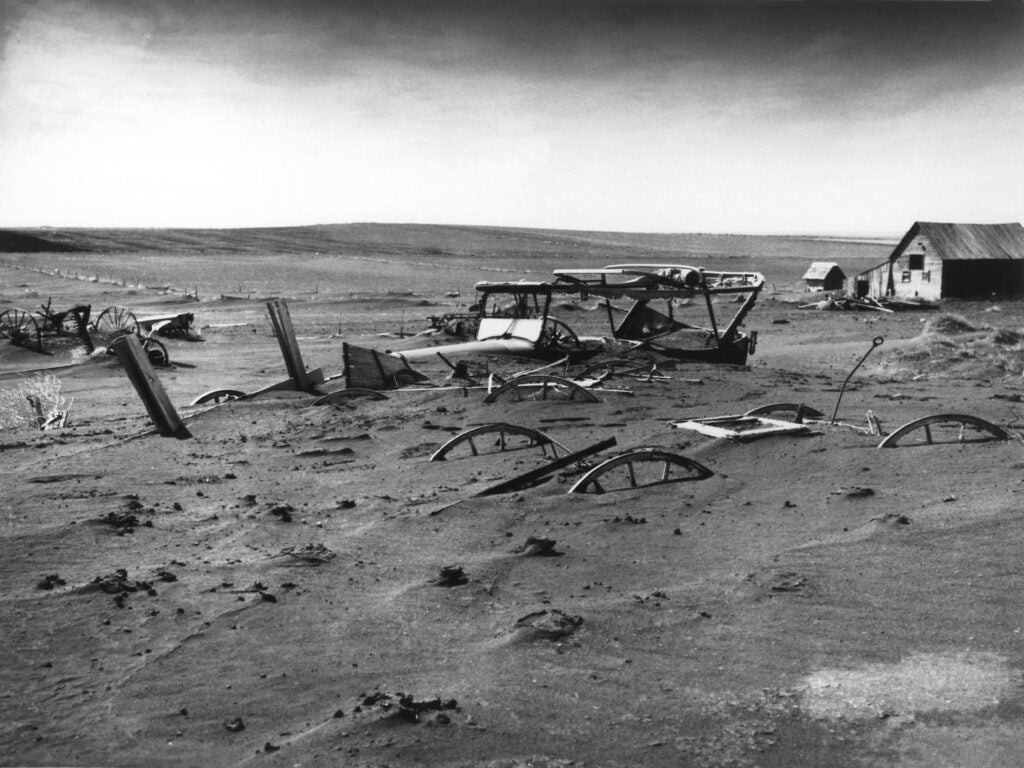
United States Department of Agriculture | Wikimedia Commons
The Dust Bowl, as it was called, devastated farmland on such a scale that some 2.5 million people migrated out of the southwest: by some counts, the worst environmental disaster in U.S. history. From its ashes came a new federal responsibility to oversee soil conservation, not to mention a new expectation — enshrined in New Deal legislation — that the nation’s government would intervene in environmental and economic crises.
A Superpower in a Warming World
The 1930s closed with World War II, a geopolitical disaster that upended American life and established the U.S. as a global hegemon.
Between 1940 and 1942, the war’s outcome might have been shaped, in part, by a climatic anomaly: a sustained warming of the tropical Pacific Ocean, known as an El Niño, that coincided with and perhaps helped cause a bizarre airflow across the Northern Hemisphere. Among other things, the anomalous circulation of the atmosphere brought very cold air and bouts of torrential rain to Adolf Hitler’s eastern front, hampering the Nazi invasion of the Soviet Union.
No hurricane matches Katrina, which in 2005 made landfall in Louisiana as a category 3 storm. Katrina killed nearly 1,400 people and inflicted more damage than any hurricane in U.S. history.
Relations between the U.S. and Soviet Union steadily deteriorated in the war’s wake, until both embarked on a global battle for supremacy that repeatedly teetered on the brink of nuclear Armageddon.
Beginning in 1957, scientists from both superpowers participated in the International Geophysical Year (IGY), a campaign to monitor the Earth that became an arena for scientific and technological competition. The IGY coincided with an El Niño. Scientists learned that warming water affected more of the Pacific than previously imagined, and they began to piece together how this warming scrambled global weather.
The late 20th century saw three severe El Niño events of escalating intensity: in 1972-73, 1982-83, and 1997-98. The droughts, torrential rains, and heatwaves associated with each El Niño spurred revolutions in oceanography, meteorology, and climatology.
Extreme El Niño weather also had complex influences on U.S. history.
In 1972, for example, warming waters helped bring about the collapse of Peru’s anchovy fishery, depriving American poultry producers of fishmeal. But other farmers profited by planting soy, a ready substitute.
Each El Niño brought deadly rainstorms to U.S. southern states. But overall, each benefitted the U.S. economy, owing in part to the mild winter weather that a strong El Niño can bring to the Midwest and Northeast.
There is, now, far more that can be destroyed in places that are more likely to suffer harm, and that is partly why the economic costs of hurricanes or wildfires continue to rise.
The changes in atmospheric circulation associated with El Niño also tend to suppress hurricane formation, and hurricanes are usually the most damaging weather events that affect the U.S. and its territories. In 1899, for example, the devastation caused by the category 4 San Ciriaco hurricane in Puerto Rico helped spur the Foraker Act of 1900, which recast the island’s political and economic relationship with the U.S.
In 1900, another category 4 storm killed at least 8,000 people in Galveston, Texas. In its aftermath, Houston — not Galveston — emerged as the Gulf of Mexico’s dominant metropolis.
In 1926, the Great Miami Hurricane devastated Florida, puncturing a speculative real-estate boom.
Nine years later, the Labor Day Hurricane damaged railroads across the Florida Keys, encouraging a new transportation infrastructure centered on roads.
Hurricane Andrew in 1992 transformed Florida’s building codes and insurance markets.
But no hurricane matches Katrina, which in 2005 made landfall in Louisiana as a category 3 storm. Katrina killed nearly 1,400 people and inflicted more damage — over $214 billion in 2026 USD — than any hurricane in U.S. history.
One of the great continuities in U.S. history has been the unequal toll of extreme weather on racially and economically marginalized communities.
Katrina continues to resonate in U.S. culture for reasons that extend beyond the immediate devastation it caused. It showed with unique clarity that the impacts of climatic disasters were divided by race and class, and — by lowering the population and economic output of New Orleans — it demonstrated how long-lasting those impacts could be.
Katrina also struck when carbon dioxide levels in the atmosphere were starting to approach 400 parts per million (PPM); that number is up from about 280 PPM when the Declaration of Independence was adopted in 1776. The disaster revealed how the warming caused by the changing chemistry of the atmosphere was beginning to increase the danger of powerful hurricanes, causing them to intensify with unexpected speed and increasing the height of their storm surges.
It also exposed how infrastructure designed to cope with the worst extremes of the 20th-century climate — the famous levees around New Orleans — could fail amid the wilder weather of a hotter planet.
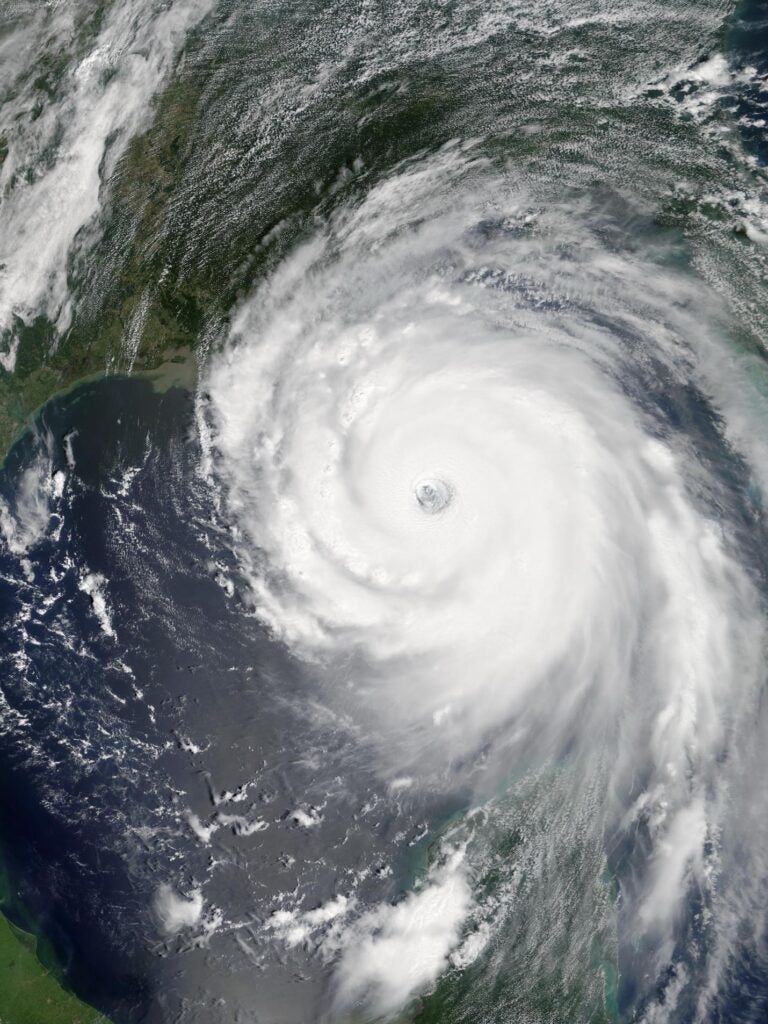
NASA | Wikimedia Commons
Fewer Deaths, More Damage
The timeline demonstrates that three broad trends distinguish 250 years of U.S. climate history.
The first is a trend toward declining vulnerability in the face of extreme weather. It’s not easy to determine how many people die during today’s severe weather events, let alone in events decades or even centuries in the past. Still, available data suggest that far fewer people die now than in the past, even in heat waves that can be far more intense today than they once were.
Reasons for the reduced comparative mortality include technological breakthroughs and government policies that now provide millions with — among other things — weather forecasting; quick and reliable information; indoor microclimates; secure buildings; refrigeration; emergency medicine; and easy access to movement through, for example, cars and buses.
These benefits are not evenly distributed, of course. One of the great continuities in U.S. history has been the unequal toll of extreme weather on racially and economically marginalized communities.
Warming will intensify droughts, floods, heatwaves, and severe hurricanes until the U.S. rejoins today’s energy transition. Unless it does, our 300th anniversary could be grim indeed.
Indigenous nations lost land as colonists adapted to unfamiliar climates. Enslaved and later Black laborers bore the brunt of southern floods, heat, and disease. Puerto Ricans endured hurricanes within an unequal imperial relationship. Poor residents of New Orleans suffered most when Katrina overwhelmed the levees that should have protected them.
Second — and perhaps paradoxically — there’s been a trend toward greater economic damage amid extreme weather events. The most important reason is that the country’s built environment has expanded by leaps and bounds, perhaps especially in places like floodplains or forests that are especially vulnerable to severe weather.
There is, now, far more that can be destroyed in places that are more likely to suffer harm, and that is partly why the economic costs of hurricanes or wildfires continue to rise.
But third, the climate itself is changing. Early in U.S. history, it was much colder than it is now, with the worst cooling coming in the wake of violent volcanic eruptions. Warming had begun as early as the middle of the 19th century, and it seems to have stalled around World War II. But it resumed with a vengeance in the 1970s, and it may be accelerating today.
As of this writing, no country has polluted the atmosphere with more carbon dioxide than the U.S. The country is still the world’s second-largest contributor to global warming. But today, the federal government is repealing plans to roll back emissions.
Globally, the green economy, created by renewable energy sources and electric vehicles, is still growing by leaps and bounds. Yet it may not be able to stop global warming if it excludes the world’s biggest economy.
Warming will intensify droughts, floods, heatwaves, and severe hurricanes — with all the hardship they inflict on Americans — until the U.S. rejoins today’s energy transition. Unless it does, our 300th anniversary could be grim indeed.





#/media/File:Trinity_shot_color.jpg)


