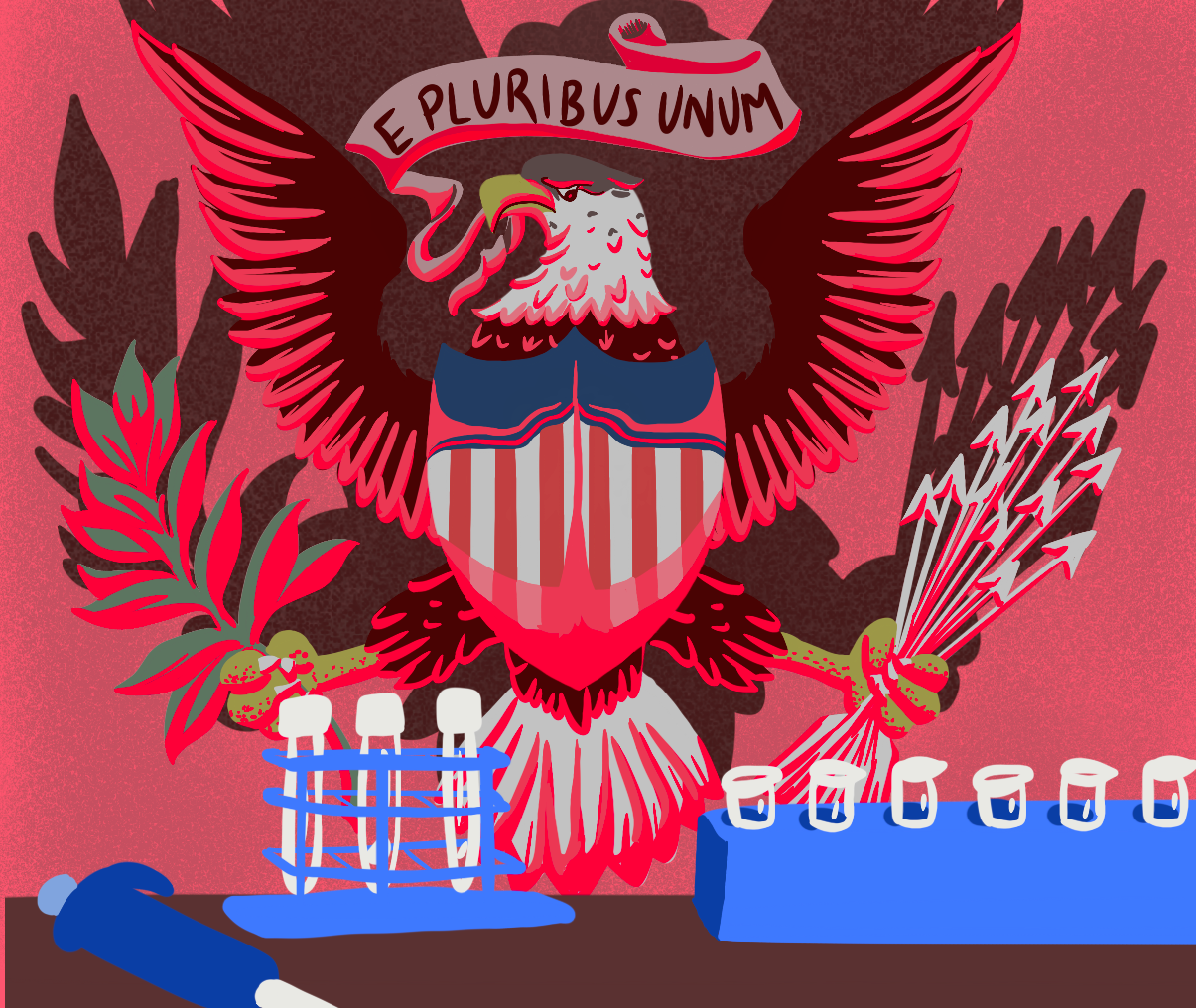
The United States built the world’s most productive scientific enterprise on the promise that a scientist who proposed a novel concept and passed that idea through rigorous peer review could expect a fair shot at receiving the funding to pursue it. That promise is now at risk.
Buried within a 412-page proposed overhaul of federal grant regulations released by the Office of Management and Budget (OMB) on May 29 is a provision that would give federal agencies expanded authority to terminate or suspend research grants, regardless of the recommendation of peer review panels. It allows political appointees to align science funding with agency priorities or what the order calls “the Federal interest,” which includes policies expressed in executive orders.
Under an administration that promotes Gold Standard Science, which espouses transparency and reviewing all available evidence, scientists would be effectively muzzled.
The provision also bars research on subjects the administration deems related to divisive ideologies such as climate science, public health and equity; and it bars scientists from using federal funds to present the results of their work without agency approval.
For scientists, especially early-career researchers like ourselves, the message confirms our worst fears: Our funding, and by extension, our careers, may soon be placed in the hands of politicians rather than our peers.
If enacted, this rule would codify politically-motivated distortions to how scientists can ask questions, test hypotheses, and disseminate findings to the public.
When politicians limit the topics that scientists are allowed to study or discuss, especially through federal funding mechanisms, the government funds science that reinforces narratives and ideals held by a powerful few, rather than breakthrough treatments or new technologies that serve many. This rule would promote the pursuit of science according to a president’s beliefs and political priorities instead of science by and for broad constituencies across the nation.
It would also undermine the free-flow of ideas to such a degree that the pipeline of research and researchers would fall apart.
In this Vision, the Future of Science Looks Bleak
More than 10,000 STEM PhD-trained employees left federal agencies last year, taking with them decades of expertise and institutional knowledge. Well-established, experienced scientists at our nation’s top health agencies left their long careers in public service, not always voluntarily, citing unprecedented censorship and disruptions to their workflow.
Graduate students have watched as their mentors and universities contort their language and programmatic scopes to comply with anti-diversity and gender-related executive orders. This OMB-proposed rule confirms fears that the U.S. scientific ecosystem was, and still is, changing to place political control above scientific merit in the federal research process.
But political control over what science can be studied is only one part of the problem. Another part is disseminating scientific knowledge.
As scientists, we are duty-bound to share our work with the public. But one of the proposed changes would ban the use of federal funds for journal publishing fees. Another proposed change would ban sharing research findings paid for by the public with the press and other media outlets.
Members of the public should rightly question what research their tax dollars are paying for, but with these proposed changes, they may not receive an answer. Under an administration that promotes Gold Standard Science, which espouses transparency and reviewing all available evidence, scientists would be effectively muzzled.
To be sure, accountability matters. Taxpayer dollars should be spent responsibly, and federal agencies should have mechanisms to address fraud, misconduct or projects that fail to meet their obligations.
For example, the National Institutes of Health (NIH) requires grantees to submit annual Research and Performance Progress Reports along with Federal Financial Reports to ensure Americans’ tax dollars are spent appropriately. Similarly, the National Science Foundation (NSF) requires its investigators to submit annual and final reports of how tax funds were utilized for their projects.
The apolitical nature of grant reviews is not an arbitrary norm; it is a necessity. Scientific research is not a quarterly business plan that can adjust to changing markets. Basic research, the foundation of all major discoveries, is built on big ideas that take decades to develop, even as administrations change and presidential priorities shift.
Introducing heavy-handed political oversight directly to grant funding schemes doesn’t just restrict those big ideas to ones that happen to align with current political priorities, it makes any research endeavor with a longer time horizon than the next presidential election a far riskier pursuit. It is incredibly destabilizing, and can only act as a tool to slow science down.
When politicians destabilize training pathways, they are not merely reducing today’s research output. They are weakening the workforce that will fuel discoveries for decades to come.
Funding stability is especially important for graduate students, who already face growing uncertainty about their futures. A federal grant does not simply fund an experiment or research project. It funds the training and professional development of the people doing the experiments — the next generation of scientists, physicians, engineers, and innovators.
Universities across the country have already reduced or paused doctoral admissions in response to funding instability. Many university departments expect smaller incoming cohorts or have cut graduate programs entirely, while researchers warn that fewer trainees today will mean fewer scientific discoveries tomorrow.
Now imagine being a prospective graduate student deciding whether to dedicate five or six years of your life to research.
Would you choose a career path where your paycheck can be reconsidered whenever political priorities change?
Would you uproot your life, move across the country, postpone financial stability and commit to years of specialized training if the support structure underneath you could crumble at any moment?
Many talented young scientists are already asking themselves these questions.
The consequences extend far beyond academia. Nearly half of the researchers supported by federal grants are students and trainees. These individuals become the scientists, physicians, engineers, entrepreneurs, and educators who drive U.S. innovation.
When politicians destabilize training pathways, they are not merely reducing today’s research output. They are weakening the workforce that will fuel discoveries for decades to come.
A scientific enterprise governed by shifting political priorities is no enterprise at all. We must ask ourselves: Does every good research idea deserve its fair shot at funding? The OMB has said no.
If, as a country, we make science less predictable and less fair, fewer people will choose to build their lives around it. When that happens, America risks losing far more than a generation of researchers.
It risks losing the discoveries they would have made.
Amanda Finn is a Ph.D. candidate in Nutrition Sciences at the University of Alabama at Birmingham and member of the Scientist Network for Advancing Policy (SNAP).
Brendon Davis is a Ph.D. candidate in Molecular Biology at Johns Hopkins University, president of the Science Policy and Diplomacy Group at Johns Hopkins, and a member of the Scientist Network for Advancing Policy (SNAP).
Brandon Emanuel León is a Ph.D. candidate in Cancer Biology at the University of Miami Miller School of Medicine, and a member of the Scientist Network for Advancing Policy (SNAP).
Cael Dant is an M.S. student in plant biology and conservation at Northwestern University and the Chicago Botanic Garden, and a member of the Scientist Network for Advancing Policy (SNAP).
Hannah Kubinski is a Ph.D. candidate in Molecular Genetics and Microbiology at Duke University and a member of the Scientist Network for Advancing Policy (SNAP).
Jordan Williams is a Ph.D. candidate in Pharmacology at the University of Pennsylvania, a contributing writer with Unbiased Science, and a member of the Scientist Network for Advancing Policy (SNAP).
JP Flores, Ph.D., is a co-founder of Science For Good, a member of the Scientist Network for Advancing Policy (SNAP), and a Public Voices Fellow on Technology in the Public Interest with The OpEd Project.
Kassandra Fernandez is a Ph.D. candidate in Engineering Education at the University of Florida, the founding President of the Policy Advocacy in Science and Engineering (PASE) student organization at the University of Florida, and a member of the Scientist Network for Advancing Policy (SNAP).
Mikayla Smith-Craven is a recent doctoral graduate with a Ph.D. in Pharmaceutical Chemistry from the University of Kansas and a member of the Scientist Network for Advancing Policy (SNAP).
Miles Arnett is a Ph.D. candidate in Bioengineering at the University of Pennsylvania, president of the Penn Science Policy and Diplomacy Group, and a member of the Scientist Network for Advancing Policy (SNAP).
Sneha Rao is a Ph.D. candidate in Developmental and Stem Cell Biology at the University of California, San Francisco (UCSF), leader of the Science Policy Group at UCSF, and a member of the Scientist Network for Advancing Policy (SNAP).