
When global health and development professionals discuss a healthy diet, they often focus on individual habits. Whether their concern is chronic illness, sustainable development, or the mitigation of climate change, they emphasize the need for people to retrain their taste preferences and daily dietary routines.
We can see concern for habits reflected in the recent EAT-Lancet Commission’s overview of healthy food systems, which lists healthy diets as its foremost target of change.
As the authors write, “Dietary habits and taste preferences are developed in early childhood, and children should become familiar with healthy foods that form the foundation for a healthy life.”
Placing attention on habits — which evokes a slow, social patterning of behavior — may seem like a reasonable route to health; however, it is not only misplaced, but harmful.
Locating responsibility for health in individual behavior leaves people isolated, obscures the communal power of food, and ultimately undermines the kinds of dietary change that global health experts say they want.
Nutritionists’ Advice Focuses on Habit
I first became concerned about the global health community’s use of the word “habit” twenty years ago, during anthropological fieldwork studying obesity prevention programs. At the time, health experts were becoming alarmed by the global rise in obesity and devising ways to teach people to eat well. During fieldwork, I noticed that “dietary habits” were at the heart of the health curriculum being developed and promoted to treat obesity.
Take, for example, the following advice offered by a Guatemalan nutritionist to her patient:
“It’s important to begin to change your dietary habits [los hábitos alimentícios]. The first days will be the hardest. But if you stick with it, it will get easier. At first it will take considerable effort, but it will not always be so difficult. You should be aware that this is a slow, slow process. Results do not happen overnight.”
The focus on changing dietary habits is seductive because it seems these changes should be achievable, but there are numerous obstacles to following health habits that individuals cannot change on their own.
The nutritionist is here evoking an idea advanced by sociologist Edward Sapir’s theory of the unconscious patterning of social behavior in 1927. She envisioned nutritional training as a set of embodied practices. Activities that start as difficult would become easier as people acclimate to new routines of eating and exercise.
Eventually, people would not need to make conscious choices. Their responses were supposed to become automatic as patients patterned so-called healthy habits into their lives.
The focus on habit circulated widely across newspapers and television, where experts were quoted as saying that healthy eating was a matter of learning the right habits.
For example, on a Guatemalan television program called “100 Steps for a Practical Life,” a local nutritionist told the audience: “Eat slowly and enjoy it. The stress and the busy pace of life obligate us to rush through our food quickly, causing us to not pay attention to the taste of what we are eating.”
The nutritionist suggested that inattention to food causes overeating, and that experts suggest slowing down and reducing what you eat.
I observed a similar emphasis on choosing to change habits in a conversation between a health educator and a woman seeking counseling for diabetes. The educator advised the woman to try walking for exercise. The woman responded:
“But Ma’am, for the job I have, well, all I do is walk. I walk from one place to another. Sometimes it seems like I spend my whole day walking.”
The educator then clarified that walking for work was not the same as walking for exercise:
“When we are working we are often busy and anxious. But when we walk for exercise it should be a time to let our minds clear. So what you should try to do is take a half an hour—”
“A half an hour?” the woman asked.
“Yes, a half an hour, separate from work. It’s important to do this separately from work. You should take this time just to walk, to relax from your day…You see, you must change your habits. You have to relearn this.”
Despite the inclination among policymakers to treat food as an object for individual consumption, many social movements have recognized that food is a source of communal power.
The educator encourages the woman to exercise because she wants to, not because she has to. When the woman explains that she walks as part of her work, the educator reframes exercise as intentional movement, not just physical activity. While the educator is encouraging only gentle changes in movement, the advice also implies the woman is individually responsible for what she eats and how she moves.
The promise nutritionists are offering is that small and minute adjustments in behaviors can build over time, having a significant cumulative, structural effect, ultimately transforming the broader world in which their patients live. After all, how hard can it be to cut back a little at a single meal, and for this small change to accumulate?
Yet one of Sapir’s key observations is that habit is structured by social forces, and that the repatterning of culture is not, in fact, within the realm of individual control. The focus on changing dietary habits is seductive because it seems these changes should be achievable, but there are numerous obstacles to following health habits that individuals cannot change on their own.
The recommended habit changes — eating vitamin-rich foods, packing a homemade snack, eating slowly, walking instead of relying on motor vehicles — were constrained by material conditions. Some people could not afford the recommended foods, could not take time from work, and could not change their habits through intention alone.
The pattern I observed was clear both to me and many of the health professionals with whom I worked: People would usually try to follow the advice they were given. Possibly, the recommended changes would even stick for a little while. But eventually the changes would become too difficult to sustain. People would withdraw from the effort, feeling they had failed.
Food Is a Source of Communal Power
The treatment of a healthy diet as the outcome of individual habit not only left patients isolated and anxious about making bad decisions; it also obscured the central role that food plays in organizing social life.
Anthropologists have shown that scientists and development experts in Guatemala have worked hard to turn food into a self-contained product subject to consumer choice. But this is not what food is for most Guatemalan people.
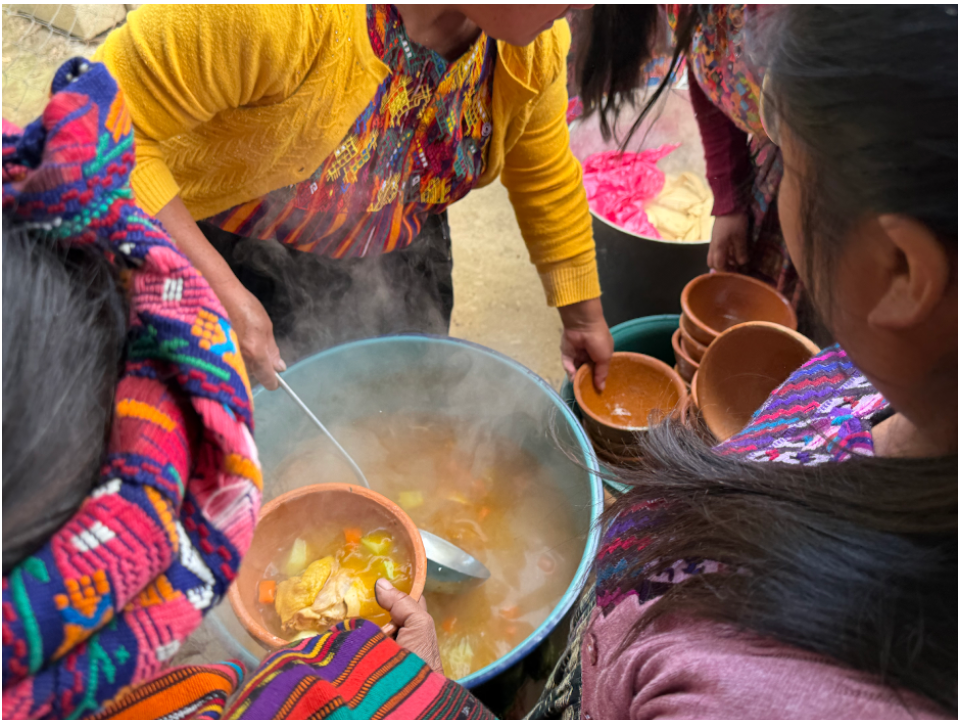
Staple foods in Guatemala are soups and porridges prepared for many people at once — these are not served as individual portions to be managed by healthy habits. Eating is done with others.
Food is important because it is foundational to community life.
Western guidelines directed at healthy diets tend to emphasize the importance of managing individual behavior. Did you eat too much? Can you exercise more?
But in daily life, food functions as social fascia — connective tissue that creates and sustains relationships.
The word “companionship” itself comes from the Latin words for com (with) and panis (bread), reminding us that community is made by eating together.
Despite the inclination among policymakers to treat food as an object for individual consumption, many social movements have recognized that food is a source of communal power.
Consider how the Black Panther Party put children’s breakfasts at the heart of their social activism. American Studies scholar Mary Portorti writes that “free breakfast” became a means of creating alliances across Black, white, liberal, and conservative communities, tying the Panthers’ “revolutionary struggle to bread-and-butter issues of daily survival” in a way that helped broaden the movement’s goals. Breakfast was at once a method and an objective of the party.
Similarly, the farmworker-led Coalition of Immokalee Workers used food to advocate for better working conditions and unionization of food laborers. As food studies scholars Laura-Anne Minkoff-Zern and Teresa Mares show, “fair food” became a vehicle for producing solidarity across laborers and consumers, creating the strong campaigns necessary to change social and political structures to recognize farmworkers’ rights.
We can leverage the communal power of food to sustain social movements that have the capacity to bring about change in community and planetary health.
At my university, graduate students drew on this same logic during a 2024 strike for a living wage, using food to help organize their movement. In addition to potlucks and shared meals, students initiated a pop-up campus food pantry to sustain the striking workers through lost wages that included food alongside other basic goods. They saw food as a scaffolding for providing care, while also creating solidarity among students.
Several weeks after the months-long strike was settled — with students successfully securing a raise — the pantry was still in operation. Though the food on display was both free and publicly accessible, it was not depleted.
The persistence of the food pantry became symbolic of a lesson from the strike: As far as overall resources went, there was more than enough; it was resource distribution — and the university’s spending priorities — that needed to be rethought.

Food and the Struggle for Social Change
Politicians have long understood food’s centrality to communal life, waging wars through the control of food and weaponizing food to undermine collective action.
In Guatemala, the Human Rights Commission documenting the armed conflict from 1960 to 1996 noted that during the height of the violence, “whole villages were burnt, properties were destroyed and the collectively worked fields and harvests were also burnt, leaving the communities without food.”
These scorched earth campaigns aimed not only to starve people, but to dismantle the social relations that made resistance and social change possible. In fact, meal-makers — roles often relegated to women — were routinely targets of violence precisely because their skill in feeding their communities made them powerful social organizers.
As policymakers look toward the role that food can play in addressing global challenges of climate change and rising global inequity, they should heed the lessons from the shortcomings of obesity prevention programs.
Contemporary warfare also operates through hunger. In Gaza, the destruction of agricultural land and food infrastructures has produced mass starvation, and, again, meal-makers have been persecuted and killed.
On multiple occasions in 2024, Israeli airstrikes killed aid workers from World Central Kitchen as they were delivering food.
Just prior to one of the strikes, World Central Kitchen had shared a photo of a refugee family in the city gathering over a meal, reporting that its Gaza-based chefs had prepared stewed okra for families sheltering in makeshift camps. The caption reported, “The dish is a local favorite that provides comfort and a taste of home for countless people.”
Destroying food supplies is a well-known tactic of community destabilization.
As policymakers look toward the role that food can play in addressing global challenges of climate change and rising global inequity, they should heed the lessons from the shortcomings of obesity prevention programs. Food is important, but not because it’s critical for individuals to manage and maintain healthy dietary habits.
Food is important because it is foundational to community life. Social change happens through collective action, and we can leverage the communal power of food to sustain social movements that have the capacity to bring about change in community and planetary health. For example, meal-makers could use food to connect people across differences. Likewise, food could create the camaraderie and pleasure needed to sustain the work of companionship.
This shift in thinking would enable us to shift away from the question, “How do I change my habits?” and instead ask, “How do I eat in community?”