
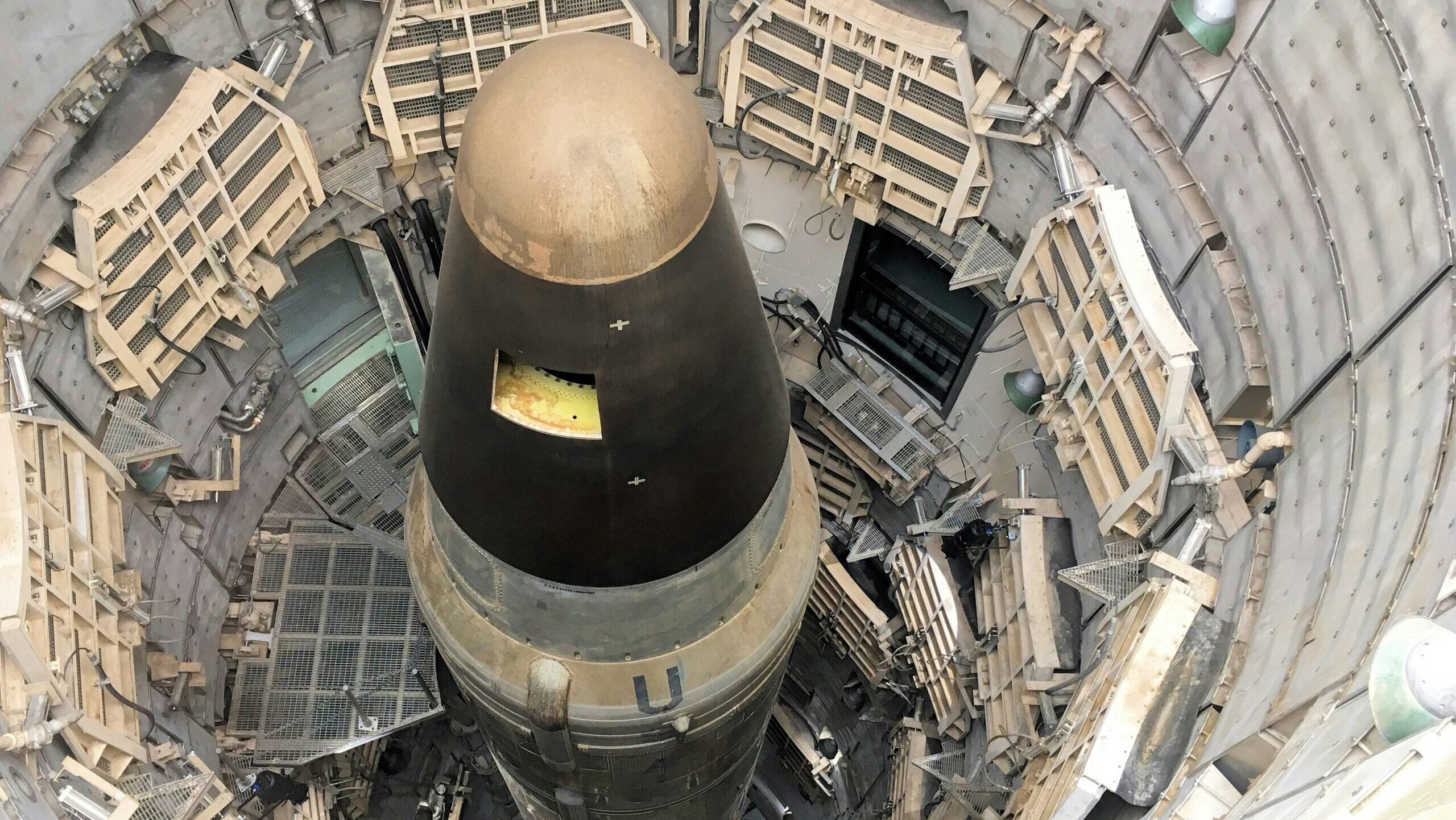
Whenever United States military strikes make headlines, the $2.5 million price tag of a Tomahawk cruise missile tends to dominate the conversation.
But focusing on how much missiles and other precise, effective weapons cost to buy misses the more consequential cost: how long it takes to make more once they’re gone.
That timeline is measured not in weeks or months but in years. And it is governed not by defense budgets or procurement contracts, but by geology, processing infrastructure, and semiconductor supply chains that the U.S. does not command.
That lack of control over production risks putting real stress on U.S. weapons inventories, especially as the 2026 conflict in Iran extends beyond a few weeks.
The more sophisticated a weapon, the more it depends on materials that are scarce, difficult to process, and impossible to improvise.
To its credit, President Donald Trump’s administration anticipated the problem.
Several executive orders, including one in March 2025, correctly framed critical mineral independence as a national security priority. However, an executive order does not mine neodymium, build processing infrastructure, or shorten the decade required to establish a meaningful domestic rare earth supply chain.
Military planners work with a concept called the replacement gap — the mismatch between how fast a high-intensity conflict consumes advanced weapons and how slowly the defense industrial base can regenerate them.
In earlier eras, this gap could be narrowed quickly with capital and labor. Today, narrowing it takes years to execute and requires sustained political will across administrations.
To be sure, the Iran conflict, by itself, is not exhausting American military capacity. But the ongoing fighting is widening a gap that already existed, at a moment when strategic competition demands that the gap close rather than grow.
Precision Warfare’s Hidden Tax
The defining feature of American military power since the Gulf War has been precision — the ability to strike specific targets with minimal collateral damage and high reliability. It dramatically demonstrated that capability in 1991 through the large-scale operational use and visibility of precision-guided munitions such as laser-guided bombs.
The ability to be so precise is genuinely remarkable. It has also quietly created a structural liability that blunt-force arsenals do not carry.
The more sophisticated a weapon, the more it depends on materials that are scarce, difficult to process, and impossible to improvise.
Different parts of the system are handled by different organizations, but no one is tasked with seeing how these risks connect across the entire supply chain.
For example, inside a Tomahawk’s guidance system are rare earth magnets — neodymium, dysprosium, terbium. These rare metals keep the weapon on target under extremes of heat and vibration. HIMARS rocket artillery relies on GPS-guided munitions whose semiconductor components carry production lead times of 18 to 24 months even under surge conditions.
Excalibur artillery rounds, standoff munitions, and smart bombs all share the same underlying dependency: miniaturized, high-performance components that take a long time to make and cannot simply be sourced elsewhere.
Every major conflict in the industrial age has eventually come down to a war of production. What has changed is where the bottleneck now sits. It is no longer in steel mills or shipyards. It is in rare earth processing plants, specialty metal refiners, and the handful of advanced semiconductor fabrication facilities — most of them outside the U.S. — that manufacture components precision weapons cannot function without.
Defense Is No Safer Than Offense
If offensive precision weapons expose one set of supply chain vulnerabilities, missile defense systems expose exactly the same ones — and arguably more, because defensive interceptors are consumed reactively, at a pace dictated by the adversary rather than by the planner.
A single Patriot PAC-3 interceptor costs between $4 and $6 million. Its guidance electronics depend on advanced semiconductors and rare earth components engineered to function under extreme thermal and mechanical stress. THAAD interceptors use specialized infrared seekers and high-performance rare earth materials to track and destroy incoming threats at altitude. Neither system can be accelerated off a production line in response to an urgent operational need — the upstream materials simply do not allow it.
Radar — the sensing layer that makes all of this possible — presents its own fragilities. Military-grade systems rely on specialized semiconductors for the sensitivity required to detect small, fast-moving threats at range. Submarine sonar depends on magnetostrictive alloys composed of terbium and dysprosium. Electronic warfare platforms require high-performance compound semiconductors.
Taken together, these dependencies create a web of vulnerabilities that no single authority is responsible for managing as a whole. Different parts of the system are handled by different organizations, but no one is tasked with seeing how these risks connect across the entire supply chain.
An Arsenal Without a Secure Foundation
Viewed individually, each weapons system’s supply chain fragility looks like a procurement problem. Viewed collectively, they form something more serious: a structural gap between the technological sophistication of American military power and the material independence required to sustain it.
The rare earth elements that steer fins, stabilize guidance, and energize propulsion magnets are overwhelmingly mined and processed in places the U.S. does not control.
The specialized metals that allow interceptors to survive the stresses of combat — same story. The semiconductor supply chain underpinning radar, communications, targeting, and electronic warfare is concentrated in a handful of facilities, most of them in East Asia, some of them in countries whose relationship with the U.S. government is actively adversarial.
This is not a hypothetical concern. In 2023, China imposed export controls on gallium and germanium — critical inputs for semiconductors, radar systems, and advanced military electronics. In 2024, China tightened these restrictions further, extending them to graphite and other materials essential to both energy and defense supply chains.
The U.S. carries a structural vulnerability that its formidable weapons inventory cannot obscure indefinitely.
The measures were partially eased following diplomatic engagement between U.S. and Chinese officials, but only temporarily and with important limits. While some commercial flows resumed, restrictions tied to military end-use remained firmly in place, effectively preventing these materials from entering U.S. defense supply chains.
Currently, the arrangement functions less as a resolution than as a pause — one that is widely understood to be contingent and reversible, with key provisions set to expire in late 2026.
What this episode demonstrates is that the pressure point is real, known, and available for use again. The warning has been delivered. The window to act on it is narrower than it appears.
When Even Helium Becomes a Vulnerability
The abstraction of rare earth supply chains can feel remote from operational reality. Helium does not.
Roughly a third of global helium supply originates in Qatar and is exported through the Strait of Hormuz — the same waterway that military planners are watching most closely in the Iran context.
Helium is indispensable to semiconductor manufacturing. Disrupt its flow, and you do not merely affect commodity prices; you constrain the production of every chip inside every radar array, interceptor and precision-guided munition in the U.S. inventory.
The U.S. Federal Helium Reserve was designed as a buffer against exactly this kind of supply shock. It has since been drawn down and partially privatized, leaving the country more exposed than at any point in recent memory — at precisely the moment when the Strait of Hormuz has become a live operational variable rather than a background concern.
The Missile Is the Easy Part
Budgets count missiles. Intelligence assessments count warheads. Defense debates count delivery platforms. What rarely gets counted — because it is harder to quantify and harder to explain — is the depth and reliability of the supply chain behind each of those weapons.
That is the actual measure of military staying power: the resilience of what a country can sustain in a conflict through months two, six, and twelve.
On that measure, the U.S. carries a structural vulnerability that its formidable weapons inventory cannot obscure indefinitely. The Iran conflict will not expose this vulnerability fully, but it offers the chance for the U.S. to start answering critical questions now, before the next conflict: How will we ensure the stockpiles do not run thin and the industrial system moves fast enough to replenish them?