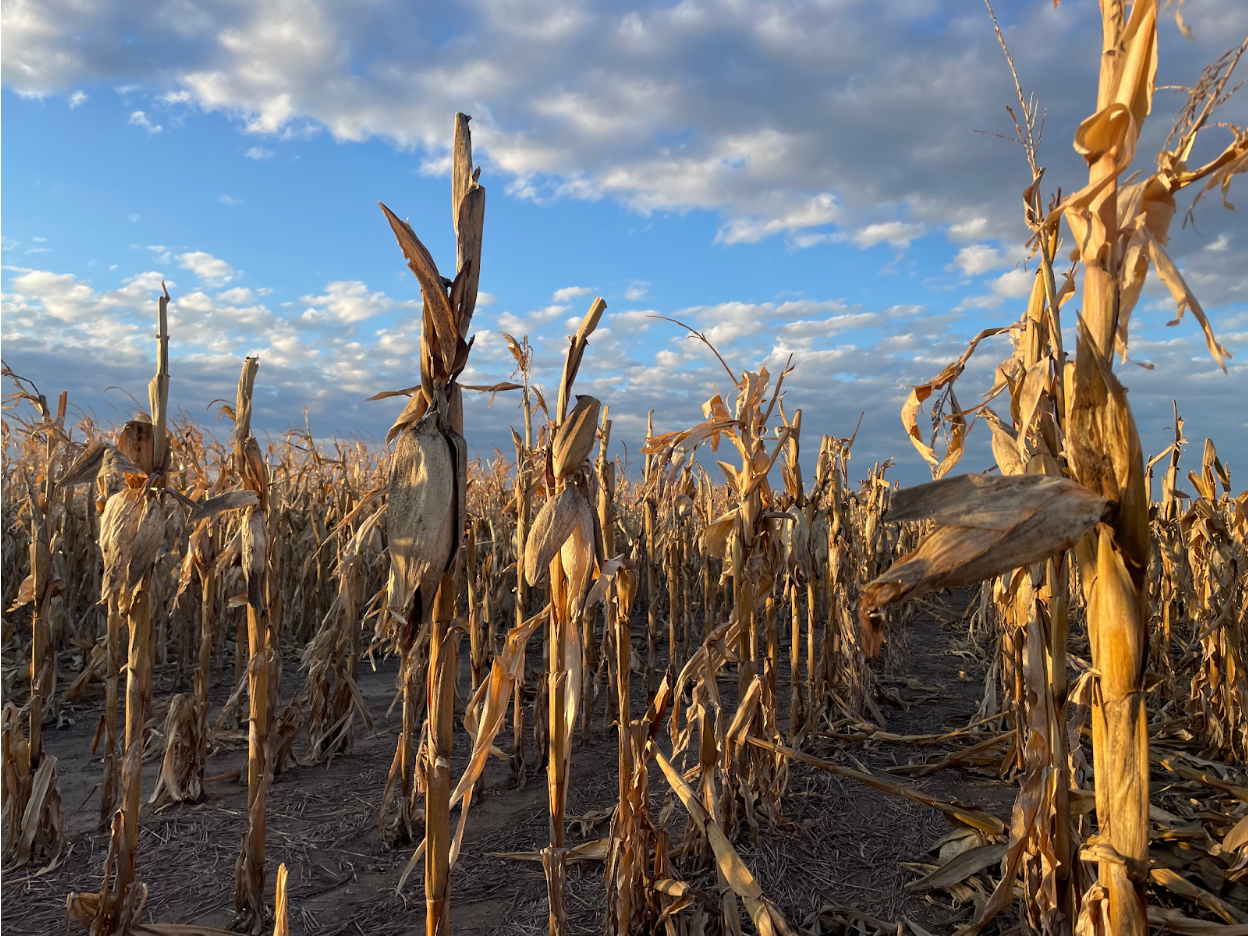
“Mother Nature shuts you down,” wrote Kristi Noem in 2024 shortly before becoming the U.S. Secretary of Homeland Security. That description of how harsh and unpredictable weather can devastate a crop opened Noem’s now-infamous story about shooting her young dog, but the reference to Mother Nature is one she has offered throughout her career.
In 2012, while working as a congressional representative, Noem cited Mother Nature as the driving force behind one of the worst droughts the Midwest had seen in decades. “Farmers can’t control Mother Nature,” she explained when advocating for a bill to expand crop insurance. In 2020, having assumed the role of South Dakota’s governor, she again invoked the will of Mother Nature when tornadoes ravaged the U.S. South but spared her home state. Mother Nature had not hurt them, this time, but She was something to fear.
As an anthropologist who studies diverse cultural practices of motherhood, I am interested in Noem’s rhetoric. Talking about Mother Nature may seem innocuous, but tracing the turn of phrase in everyday life shows how it supports politics that harm families and the climate, while stripping mothers of full autonomy over their activities and lives.
Figures of speech influence science
In a hallmark essay The Egg and the Sperm, anthropologist Emily Martin illustrated how culturally conditioned beliefs about differences between men and women have shaped reproductive science. Medical textbooks routinely anthropomorphized eggs and sperm behaving in stereotypically gendered ways: Eggs were docile and submissive, waiting to be penetrated by active, virile sperm.
Not only were these metaphors clearly sexist, but they also obscured biological realities. They prevented scientists from recognizing that sperm mobility is relatively weak and that eggs actively select and guide sperm during fertilization. These highly gendered metaphors led to “bad science” while also holding women responsible for infertility and congenital anomalies that were not their fault.
Martin’s essay was a call to wake up the “sleeping metaphors” of science by paying attention to how the language we use creates patterns in our thoughts and actions. She was in the company of other feminist scholars showing how our figures of speech operate as a powerful vehicle for embedding gendered and hierarchical assumptions into how science and culture work.
For example, Carolyn Merchant, Catherine Roach, and Banu Subramaniam have examined how the turn of phrase “Mother Nature,” when used in a patriarchal society, frequently ties women more closely to nature than men, with dangerous consequences. One concern was that the image of a maternal earthly figure naturalizes the idea that responsibility for childrearing should lie with mothers. They also pointed out how an alternative image of a chaotic and unruly nature – personified as a mother – helped authorize the exploitation of environmental resources: As women were dominated by men, so could the earth be dominated, too.
What’s the harm in “Mother Nature”?
To wake up the “sleeping metaphors” surrounding Mother Nature, I consider three ways that Noem’s rhetoric epitomizes the dangers that feminist scholars warned us of many years ago: 1) it actively undermines climate action, 2) it reinforces essentialist gender binaries, and 3) it legitimizes state separation of mothers from their children. Examining how she deploys maternal metaphors can help us to see how language becomes an infrastructure for harm, particularly against the women she claims to represent.
First, attributing climate catastrophes to Mother Nature becomes a way to deny human responsibility for climatic events. With “Mother Nature” in charge of climate, we would be disobedient children to work to mitigate the effects of climate change. As the South Dakota Searchlight reports, when Noem was Governor of South Dakota, she turned down more than $70 million in funds to support energy efficiency and the mitigation of climate pollution. As she said at the time, “The science has been varied on it, and it hasn’t been proven to me that what we’re doing is affecting the climate.”
Shortly after her nomination to be the head of the Department of Homeland Security (DHS), several media outlets reported that she sent a memo to senior officials at the department to “eliminate all climate change activities and the use of climate change terminology in DHS policies and programs, to the maximum extent permitted by law.”
This willingness to ignore responsibility for climatic events is particularly concerning given her authority over the Federal Emergency Management Agency, which responds to environmental disasters.
The idea that climate change is inevitable counters the widespread consensus of scientists, who recognize that climate change is driven by human activity and can be mitigated through human action as well.
Second, feminist scholars have argued that presenting nature as maternal can have the corollary effect of presenting women as having an inherent nature. In Noem’s case, references to Mother Nature have gone hand in glove with her presentation of gender as fixed, biological, and resistant to human intervention. “God made men and women different”, she has written, as if gender were naturally binary.
Her use of Mother Nature must be understood alongside her insistence that differences between men and women are naturally rigid. In 2023, as South Dakota’s governor, she signed a bill banning gender affirming care for minors. This year, after Trump issued the executive order “Restoring Biological Truth to the Federal Government,” she affirmed that the DHS would recognize only two immutable biological sexes – male and female – and that it would not promote “gender ideology,” defined as the idea that gender identities fall along a spectrum.
“Trust the science on human biology,” she has said in defense of her position, despite the fact that scientists studying human biology have drawn attention to a vast human diversity in the expression of sex and gender (see Fuentes for an overview). In an especially Orwellian move, the policy against gender ideology advances a pernicious ideology of gender in the name of science.
A third dangerous effect of Noem’s use of Mother Nature can be seen in her reference to how Mother Nature will devastate the harvest. This image of a mother to be feared has animated her role as the secretary of DHS. Shortly after Noem became the head of DHS, the department posted two maternal images on social media. One depicted a white settler family in a covered wagon, the mother protectively holding the vulnerable child; “Remember your Homeland’s heritage” the caption read. The second image, a painting by John Gast titled “American Progress,” showed a white motherly figure floating above white settlers, who were driving Native people off the frame; DHS captioned this image, “A Heritage to be proud of, a Homeland worth Defending.” As political philosopher Patricia Owens illustrates, the vision of the nation-state as a metaphoric “homeland” is built on a related vision of the patriarchal frontier family, in which the father is responsible for protecting his property while the mother must secure the internal, domestic, workings of her home.
At the beginning of her tenure at DHS, Noem argued that her identity as a mother made her a good fit for the department. She would harness the same fierce and controllable energy as Mother Nature when deporting people from the U.S. As she explained in a media interview, “You’re going to have to have someone who is tough enough to actually do it. I think it’s also extremely helpful to have someone who is a wife, and a mom, and a grandma, because it will impact families.” Her identity as a “proud mother and grandmother” is listed on her short official government profile.
Meanwhile, under Noem’s leadership, the news has been filled with images of family separations and countless stories describing mothers deported from the United States: an Indigenous woman whose claim to asylum was denied, along with her teenage daughter who had spent most of her life in the US; a mother born in Mexico who has lived in the US for three decades; two mothers who were deported to Honduras along with their U.S.-born children; a mother of three born in Guatemala whose children were “left abandoned”; a Venezuelan mother who has not seen her son in six months– tragically, the list goes on.
The contradiction seems stark: a self-proclaimed champion of motherhood presiding over policies that so explicitly tear mothers and children apart.
The way that Owens helps us make sense of this dissonance is that Noem’s identity is not that of a mother who is in solidarity with mothers everywhere, but of a mother defending her own home.
“Mother Nature shuts you down,” presents us with a mother who will unforgivingly tear through an annual harvest without hesitation or remorse.
This vision of motherhood naturalizes exclusion and justifies violence by claiming to protect her vision of family.
Waking the sleeping metaphors of science
I do not detail these three effects of Noem’s invocation of Mother Nature to argue that maternal metaphors are inherently dangerous. The symbolic associations of motherhood are, in fact, as diverse as mothers themselves, connoting power, vulnerability, protection, authority, and so on.
The trick to waking up the sleeping metaphors of science is to ask how they are used in the routines of everyday life.
Consider that Sahnish people, whose ancestors lived in the Missouri River-region that Noem now calls home, centered their spiritual and agricultural life around a figure they called Mother Corn. They held Mother Corn in deep respect, crediting her for their survival and the endurance of their crops and their people. Granted, Mother Corn was a sacred being – not merely metaphorical – but with this figure as the guiding image of harvest, Sahnish people also understood harvest and eating to be sacred acts. Sahnish anthropologist Loren Yellow Bird cites an elder from her community who explained that her people did not fight over territory and, following the teachings and laws from Mother Corn, were careful to use only those resources that they needed.
Comparing the Sahnish “Mother Corn” with Noem’s “Mother Nature” helps us to see how a similar symbolic vocabulary can function in diametrically opposed ways. Whereas Mother Corn teaches restraint and reciprocity, Noem’s Mother Nature justifies extraction and exclusion. Whereas Sahnish people associate maternal figures with stewardship and care, Noem deploys the maternal metaphor of Mother Nature to imply that environmental devastation is beyond human control. The key question is not whether motherhood appears in our political speech, but what it enables and whose power it serves.
Noem is not shy about referencing “the science” to defend her policies. “The science is varied,” she says when dismissing concerns about global warming. We should “trust the science,” to advance her belief in binary gender differences. She positions science as natural – outside of culture.
Yet feminist scholars have shown us for decades how “the science” is a practice negotiated by values, which we can discern by paying attention to the metaphors we use.
In Noem’s case, her reference to Mother Nature is connected to patterns of practice that systematically depoliticize climate catastrophe, entrench biological essentialism, and weaponize maternal identity against women. These rhetorical maneuvers have material consequences for real mothers: those left hungry by climatic events that devastate their food supplies; those whose realities are suppressed by laws enforcing gender binaries; those deported, whose children are taken from their care.
There is nothing natural about any of this. Maternal metaphors, as feminist scholars have long insisted, are political practice.