As an anthropologist, I have spent decades studying how people move around the globe, and how their health and foodways change as a result. My research resulted in a book called Eating NAFTA, published in 2018, that criticized the North American Free Trade Agreement. I argued that, in its first quarter-century, the agreement failed to lower poverty and increase cross-border collaboration, failed to bring the three countries of North America into a new era of shared prosperity and friendship, and failed to bring peace and tri-lateral innovation.
But I never thought the deal would or should just be torn up with nothing in its place. Yet, today, the terms of NAFTA have been ruptured so profoundly that there effectively is no deal.
What we’re seeing now is the worst of all worlds: Stagnant labor markets, gaping income inequality and widening poverty rates.
Winning has become exclusively for giant conglomerates dealing in ultra-processed foods and other products that are more likely to cause harm than to bring upward mobility or promote well-being. Perhaps worst of all, our neighbors to the South and North, who are our most logical friends and partners, no longer trust the United States.
Now, as we’ve passed the three-decade mark of the trade deal, it may be the right time to think about what an inverse of NAFTA, an anti-NAFTA, could look like, reimagining how we might do better. After spending more than two decades as a scholar of migration, food and health in conversation with members of diasporic Mexican communities and folks in their communities of origin, I have come away with a few ideas.
I. Human Mobility
First, the biggest error of NAFTA was its failure to account for human mobility. There really was no way to seriously think that goods and capital could be liberated to move freely throughout the continent without people also needing to move in new ways. Or even in old ways. After all, the border has been a border for only a blip in human history. For millennia, people have moved freely around the Americas.
When NAFTA linked up the economies of Mexico, the U.S. and Canada, the citizens of all three countries should have gained the ability to work anywhere in the region without a visa. Instead, they found some of their older ways of moving around were halted. For all the problems associated with the European Union (painfully nicknamed Fortress Europe by immigration advocates), at least that unification of economies anticipated and made policy for human mobility in labor and residence.
Unfortunately, human mobility was never on the NAFTA negotiating table. It was considered a non-starter to the U.S., so it was never deliberated. Instead, the U.S. has invested more every year in militarized border enforcement, even making previously routine border crossings for work, religious practice, social gatherings, medical care, education, and more, complicated, fraught and sometimes impossible.
One in ten Mexicans, 10 million people, were displaced in the first decade after NAFTA took effect. Most of them came to the U.S. and many of them stayed, but only a rare few have had any pathway at all to be able to regularize their status or travel back and forth freely. This situation has created large, undocumented and disenfranchised –but trapped – communities north of the border, and harrowingly prolonged family separation. Had people been able to move to where the jobs were, go back home and check in, invest, care for a loved one, or retire in peace, a lot of harm could have been avoided.
Failing to account for human mobility was a massive error, but it’s not too late to do something better. A visa-free model of labor and residential mobility in the North American Free Trade Zone could still be implemented and might even assuage anti-immigrant voices who are rightly concerned by the ways human mobility has been criminalized and folded into organized crime, a target for extortion and violence, and invisible to mechanisms of bureaucratic control.
II. Biodiversity
Second, we need a NAFTA that puts a premium on biodiversity.
One of NAFTA’s basic operating principles is comparative advantage: the idea that each economic zone should do what it does most efficiently and competitively, while purchasing the remainder of its needs from elsewhere.
This principle has led to the U.S. Midwestern states going from being the nation’s breadbasket comprised of family farm after family farm, to being the world’s breadbasket, made up of consolidated massive factory farms that have displaced small growers. These large industrial farms grow a few commodity crops with maximal technical and chemical inputs: herbicides, pesticides, technology, and equipment that practically make farmers themselves obsolete. To name only one disturbing consequence: We now see massive coral die-offs and algal blooms in the Gulf of Mexico from the runoff of the chemicals, threatening the biodiversity across the Plain states and all the way into the oceans.
The current system cannot guarantee protection against hunger. We saw in the pandemic shutdown how quickly supermarket shelves became empty as global supply chains broke down faster than alternatives could be revved up.
It has also been devastating for many Mexican families to compete with the US corn markets, causing many small family farmers to leave their farms to work on larger farms in the U.S. Mexico should not stop growing corn just because Iowa can grow more of it per hectare. The issue is not just family separation, but sustainability, especially in times of crisis.
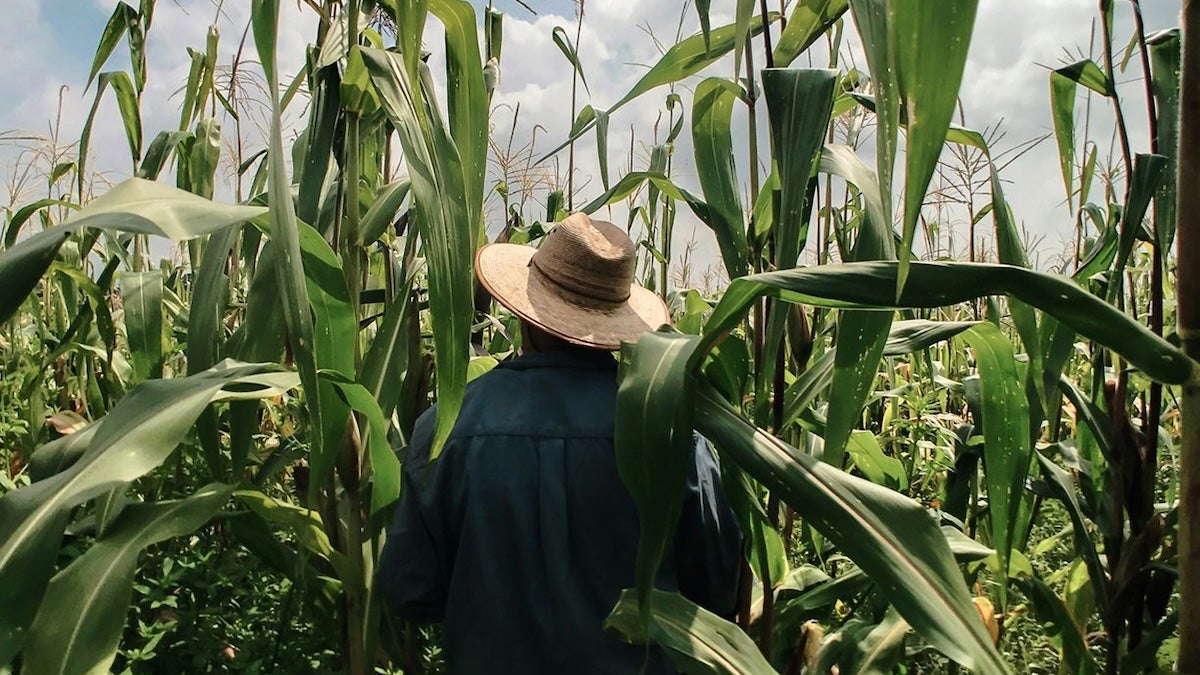
Most corn-growers in Mexico are small-scale producers who save seeds and specialize in heirloom varieties that have shown themselves to be incredibly adaptive and resilient over millennia. Some varieties have micro-adapted to drought, others to aridity; some grow tall in areas with less intense sunlight, while others are squat in areas with high winds.
Maize is historically intercropped, with today’s farmers’ ancestors developing strategies for crop success based on multispecies collaboration. Pollinators, corn, nitrate-fixing legumes, wild greens, squash, and other plants co-evolved in Mesoamerica, providing abundant nutrition and delicious seasonal variety. But now our idea of “corn” is a single species of Round-Up Ready industrial seed that is vulnerable to pathogens, greedy for chemical inputs, and harmful to pollinators and other species. Possibly as important, this corn does not even taste good.
A new NAFTA, or the inverse of NAFTA, would prioritize biodiversity.
Investing in biodiversity would involve subsidizing the work of farmers who utilize ancestral knowledge and seedbanks to address climate change, pathogens and pests. Not only would our food system be stronger, more resilient, multi-nodal and adaptive, what we eat would taste much, much better.
III. A People-Centered NAFTA
Finally, an anti-NAFTA would be human-scaled. Just as one might not notice the accessibility features of a building well-constructed using universal design, a human-scaled NAFTA would place everyday people, rather than corporations, at its heart.
Currently, most citizens of the three NAFTA-zone countries would be hard pressed to name one single way NAFTA has affected them, even as they eat, drink, and wear NAFTA while riding around in NAFTA cars or relaxing with NAFTA TVs.
The reason people are largely unaware of what NAFTA is and what it does is because NAFTA was deliberated behind closed doors 30 years ago and has never been fully opened to debate since. Corporations wrote many of its provisions to order, favoring their own industries at the expense of competitors. Your average mom-and-pop business in any of the three countries has zero access to participation in NAFTA and sees only downside, while the large corporations constantly threatening to put them out of business benefit from and dominate global commerce.
A people-oriented NAFTA would be open to everybody. It would prioritize indigenous food producers and systems to bolster sustainability and resilience of people and our more-than-human neighbors. With the global internet marketplace, there is no reason we should not all be able to consume the products of and support small-scale food producers, artisanal liquor distilleries, family-owned shoe design firms, or weavers of hand-loomed textiles.
Having access to the NAFTA economic zone without having to cross a border (but being able to) would bring greater sustainability, opportunity and social mobility to post-industrial towns across the U.S. and Canada, as well as towns in Mexico emptied out by migration. The right to migrate coupled with the right to stay – and the means to do so – could actually bring that era of mutual prosperity promised back in 1994.
The U.S. is at a critical moment to rethink our agreements and relationships. Mexico and Canada have shown time and again a willingness to be friends with us. Their amiability is surprising given how many times we have burned them. But we could benefit greatly from accepting their offers of friendship, with a new, radically revised NAFTA that prioritizes the well-being of regular people, rather than the profits of big business. Building respect and a more interdependent relationship would be transformative for people, plants, and the planet.