The future is always murky.
But every so often, trends coalesce to dramatically increase the likelihood of future events. Sometimes, those trends involve very different parts of society or the environment. That can make it difficult to see their pending convergence. But, at least in theory, identifying the trends makes it possible to discern probable events in the near future – and, hopefully, to prepare for them.
Today, an event could be approaching quickly. It might happen next year. And it may be the worst global food crisis in over 50 years.
It’s a scenario that might seem alarmist – like something from a frightening future. But an eerily similar crisis already happened in the 1970s.
It’s the convergence of these trends that could soon spark a global good crisis next year.
In the United States and India, retail food prices increased by about a third between 1972 and 1974. In the United Kingdom, they rose by over 70% from 1973 to 1976. And in Bangladesh, the price of rice soared by 100% in 1974 alone. Across the drought-stricken Sahel and in Ethiopia, grain disappeared from rural markets. Hundreds of thousands starved to death.
The consequences were diverse, but often catastrophic. Protests and strikes swept across Europe and North America. Governments collapsed in South America and Africa. Developing countries grew dangerously dependent on food aid and borrowed heavily from U.S.-led financial institutions, setting the stage for a debt crisis that still impoverishes the Global South.
Some of the trends that helped cause the 1970s food crisis are visible again today. These involved the sudden reduction of energy and fertilizer exports from the Middle East, and the dramatic warming of the tropical Pacific Ocean.
Other trends are new, or further along than they were in the 1970s. They include the greater interconnectedness of the world’s food system, the continuation of global warming, and the democratization of precision, long-range strike capabilities in war.
It’s the convergence of these trends that could soon spark a global good crisis next year. Let’s break it down.
Trend 1: The Creation of the Global Food System
The trends that seem to make a food crisis more likely are unfolding across very different scales in time and space. Two have swept across the whole world for at least a century. And the first of those is the globalization of food production and consumption.
Before the emergence and spread of efficient, reliable, and speedy regional and global trade networks, most people harvested, hunted, or gathered their own food. For most of human history, food production usually occurred near food consumption. Urban centers that siphoned grains from distant fields were the exception, not the rule.
But as early as the sixteenth century, mutually reinforcing improvements in technology, science, and the power of European and Asian states created unprecedented opportunities for hunters and especially farmers to supply new foods to distant markets. By the nineteenth century, industrialization and imperialism had combined to create hotbeds for food production that supplied exports to global markets.
The new, worldwide food system gained efficiency over the course of the twentieth century. Another series of technological breakthroughs – most importantly, the debut of the Haber–Bosch process, by which hydrogen and atmospheric nitrogen are converted into ammonia, then fertilizer – dramatically increased harvests in the world’s agricultural hubs, or in other words, its breadbaskets. New transportation technologies and infrastructure enabled grains to travel ever more efficiently out of those bread baskets, towards supermarkets and in turn to families.
After the Second World War, the global economic and military dominance of the United States created a relatively stable environment for trade networks to strengthen. New financial institutions – led by the United States – funneled investments to food producers. These producers were increasingly agricultural companies that grew as food production and distribution required ever more technology, capital, infrastructure, and expertise.
The modern food system prioritizes efficiency over redundancy.
Today, the world’s food system is a vast, efficient machine. Giant corporations develop and deploy cutting-edge technology to harvest the world’s most important staple crops – maize, rice, and wheat – where soils, transportation infrastructure, and government subsidies make it most cost efficient.
Grain reserves are enormous, but concentrated. China alone has nearly half of global wheat stocks. In the United States and Europe, public reserves have shrunk since the 1980s. The vast majority of grains aren’t located in major exporting countries.
Overall, the modern food system prioritizes efficiency over redundancy.
Trend 2: Worldwide Warming
The creation of the world’s food system is the first trend. The second is the warming of the world through the greenhouse gas pollution released into the atmosphere since the nineteenth century, primarily by the planet’s most powerful countries and companies.
The concentration of carbon dioxide in Earth’s atmosphere has now increased by more than 50% since the late nineteenth century. Atmospheric concentrations of methane have soared by well over 100%.
These and other greenhouse gases absorb and re-emit infrared radiation that would have escaped into space. As a result, their accumulation in the atmosphere warmed the Earth – as of this writing, by about 1.4 °C since the late nineteenth century. And average global temperatures are now rising at about 0.2 °C per decade.
Global temperature change (1850-2025)
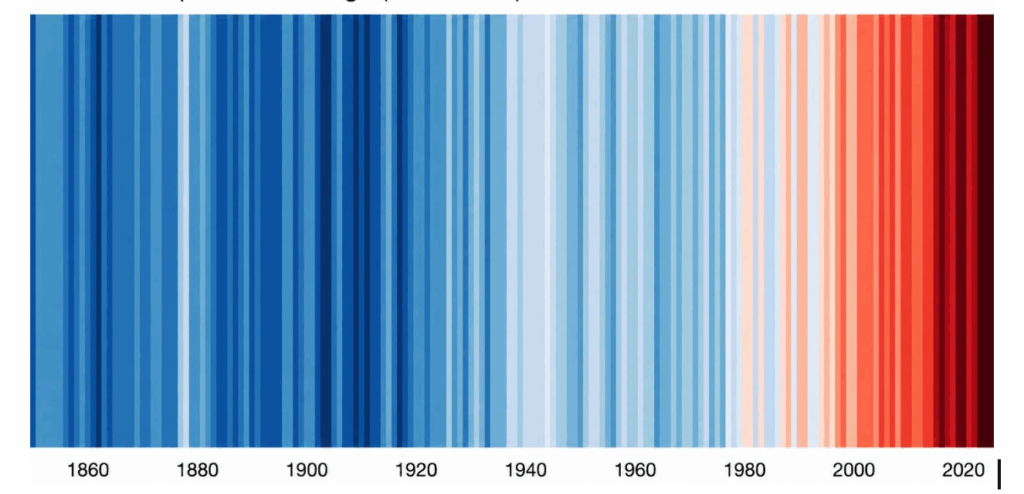
Global warming is the outcome of the same technological, economic, and political forces that concentrated and dramatically increased food production. And in one respect, the first trend – the creation of the global food system – has mitigated the effects of the second.
Trends in average global temperature, after all, impacted people primarily by increasing the severity and likelihood of relatively brief, regional weather extremes. A landmark drought, for instance, or a torrential downpour, or a dangerous heatwave.
But pesticides, fertilizers, groundwater exploitation, and the continual development of crop varieties that tolerate extreme weather have all mitigated the impact of drought or heat on regional harvests. And even when these harvests did disappoint, the world’s food system could compensate for shortfalls in one region with continued or even increased production in another.
As a result, extreme regional weather has rarely caused worldwide surges in food prices.
If extreme weather strikes multiple breadbaskets, the efficiency of the global food system could become its greatest weakness.
Take this year’s summer in Europe. Owing in large part to unprecedented heatwaves and droughts that could not have occurred in the cooler climate of the twentieth century, plants have struggled to grow in fields across Europe. Overall, European farmers are currently expected to harvest about 263 million tons of cereals – a huge number, but down nearly 10% over last year’s harvest.
Still, modern agricultural technologies and practices limited the decline in harvests, while grain reserves and worldwide trade could, in theory, temper price increases for European consumers.
Now, what if extreme weather affects many breadbaskets at once, for weeks at a time?
Simulations suggest both that the odds of regionally synchronous droughts and heatwaves are rising as the world’s average temperature warms, and that these extremes could lead to very low harvests in multiple breadbaskets.
If extreme weather strikes multiple breadbaskets, the efficiency of the global food system could become its greatest weakness. Concentrated food-growing regions mean that a large share of the world’s harvest could fail at once. Small reserves in exporting countries mean that harvest shortfalls could quickly lead to global price increases.
So, even though the world’s food system has reduced human sensitivity to human-caused warming, continued warming may turn parts of that system into new vulnerabilities.
Trend 3: The Democratization of Precision Warfare
The next three trends are unfolding across somewhat smaller scales in time and space. Still, all have profound global implications.
The democratization of precision strike capabilities, for example, has transformed not just the conduct of war, but also the extent to which great powers can coerce smaller states.
It’s a democratization partly enabled by new forms of drone warfare.
Remote-controlled vehicles with some similarities to today’s drones admittedly have a long history on the battlefield. Between the 1960s and the 1980s, the United States and then Israel developed reconnaissance drones for use over Vietnam and Lebanon, respectively. Then, during its so-called “War on Terror,” the United States deployed drones that could loiter at high altitude, identifying and following targets before striking them.
Drones could now complete missions that would otherwise require more costly aircraft. Still, they seemed to have limited uses in war until a 44-day conflict between Azerbaijan and Armenia in 2020.
American technologies and infrastructure seem to be foreclosing the era of American military dominance.
Azerbaijan deployed Turkish and Israeli surveillance drones alongside Israeli strike drones to establish a new kind of kill chain: an integrated, remotely operated system of target identification and destruction. Drones quickly crippled Armenian air defense systems tailored to fast, high-altitude targets, then devastated armored vehicles and trenches.
What had changed was not just that military leaders had found new ways to use machines together. It was also that the machines themselves were now broadly accessible. Smartphones and other consumer electronics slashed the size and cost of guidance hardware, such as accelerometers, gyroscopes, radios, and digital cameras. Smartphones also helped turn satellite navigation from a high-end military technology to a part of everyday life. Now, drones could be small, cheap, and precise.
Two years after Azerbaijan debuted its new way of war, Russia invaded Ukraine.
When the invasion deteriorated into a grueling war of attrition, Russia inadvertently created a twenty-first century version of the sixteenth-century “school of war” in Europe’s Low Countries. Facing invasion by Spanish-led forces in a landscape that resisted easy conquest, the Dutch had found revolutionary new ways to use firearms.
In a similar context, today’s Ukrainians discovered novel applications for ever more diverse drones. On the Ukrainian battlefield, remotely operated drones and, increasingly, fully autonomous systems deliver supplies, monitor the enemy, and attack distant targets with precision in the air, at sea, and on land.
The revolution in drone warfare coincided with a similar transformation in guided missile technology and proliferation.
Once again, part of the reason was that guidance technology was cheap, ubiquitous, and easy to incorporate within existing weapons. Another part was that countries and militias sought asymmetric ways to counter American military dominance. At least in theory, cheap but precise missiles could endanger American bases and fleets as American forces prepared to intervene in regional affairs.
At the turn of the twenty-first century, the capacity to launch precise, long-range attacks was still unique to great powers, especially the United States. It required expensive, cutting-edge technology and exceptionally well-trained personnel.
Costly technology and training allowed the United States and, to some extent, other powers to impose costs on smaller countries without fearing retaliation. But today, even paramilitary organizations can threaten the military and economic infrastructure of the world’s most powerful states.
The irony is obvious: American technologies and infrastructure seem to be foreclosing the era of American military dominance.
In November 2023, for example, the Ansar Allah organization — also known as the Houthis — used drones alongside missiles and attack boats to disrupt shipping in the Red Sea, ostensibly to protest the Israeli invasion of Gaza. After braving years of aerial bombardment from Saudi Arabia, the Houthis showed that they could wreak havoc in one of the world’s most important shipping lanes. That despite controlling only a third of Yemen, one of the world’s poorest countries.
And, in 2024 and 2025, the Houthis demonstrated that they could continue to disrupt shipping in the face of an American aircraft carrier battlegroup: arguably, the world’s most formidable concentration of conventional military might.
The Houthis had revealed that relatively weak actors could use new technologies to threaten key nodes in the global system that circulates commodities from sites of production to sites of consumption. That meant that any actor with enough drones or missiles could, in theory, force concessions from the most powerful states in the world.
Trend 4: Pretensions to Regional Hegemony
The new capacity for the weak to challenge the strong might not have been urgently important without the next trend: the emergence and escalation of conflicts by states with revisionist, indeed hegemonic regional ambitions. The Russian invasion of Ukraine is one example; the on-again, off-again wars between Israel and United States, on the one hand, and Iran and its proxies, on the other, provide a second example.
In each war, inexpensive and precise drones and missiles allowed the weaker party to gain previously unimaginable leverage over the stronger.
The ambitions of would-be regional hegemons have complex and diverse origins, rooted in everything from the decline of American economic dominance to the emergence of leaders with messianic pretensions.
In the summer of 2026, Ukraine destroyed or damaged oil refineries, factories, and warehouses across Russia that were previously believed safe from enemy attack. Recently, Ukrainian drones have even crippled the Russian grain trade through the Sea of Azov, which splits Russia from Ukraine and empties into the Black Sea. These attacks respond to years of Russian strikes on Ukrainian ports and ships, many of which were and are used to export grain.
Iran has now deployed drones, missiles, and mines to suffocate shipping through the Persian Gulf. Closing the Strait of Hormuz, the Gulf’s narrow exit, stopped countless shipments of oil and natural gas. It also stopped shipments of urea and ammonia — both fertilizers — and sulphur, a chemical used to make fertilizer, from ports in Bahrain, Kuwait, Iraq, Saudi Arabia, Qatar, the United Arab Emirates . . . and Iran.
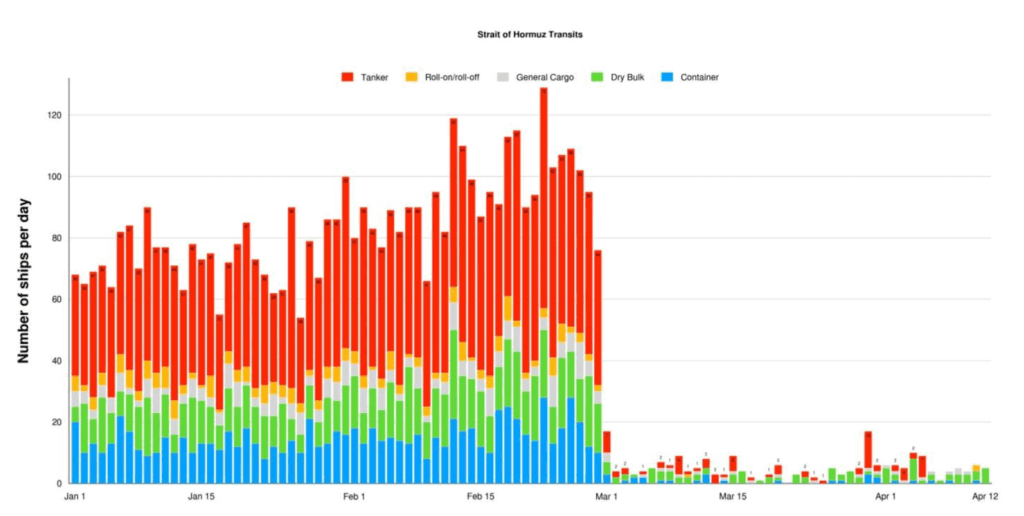
Since Iran strangled shipping in the Gulf, some 1.3 million tons of fertilizer have failed to reach the world’s farmers, every month. Meanwhile, rising energy costs have made it more expensive to operate machinery and create pesticides. And renewed strikes by the Houthis in the Red Sea raise the prospect of still more severe disruptions in worldwide shipping.
The ambitions of would-be regional hegemons have complex and diverse origins, rooted in everything from the decline of American economic dominance to the emergence of leaders with messianic pretensions.
But increasingly, they have a common consequence: the weakening of the global food system.
Trend Five: The Warming of the Tropical Pacific
We’ve considered four trends, each unfolding across different scales in time and space. An economic and environmental trend, forging a global food system across at least five centuries. A climatic trend, warming the Earth for just under two centuries. A worldwide trend in the technology and practice of war, gathering pace over the last decade. And a trend towards warfare as a way of realizing the ambitions of aspiring regional hegemons.
These trends all have some links to each other, some more tenuous than others. But what is poised to bind them firmly together is a fifth trend: the ongoing warming of surface waters across the tropical Pacific Ocean.
The name for this warming is, of course, El Niño.
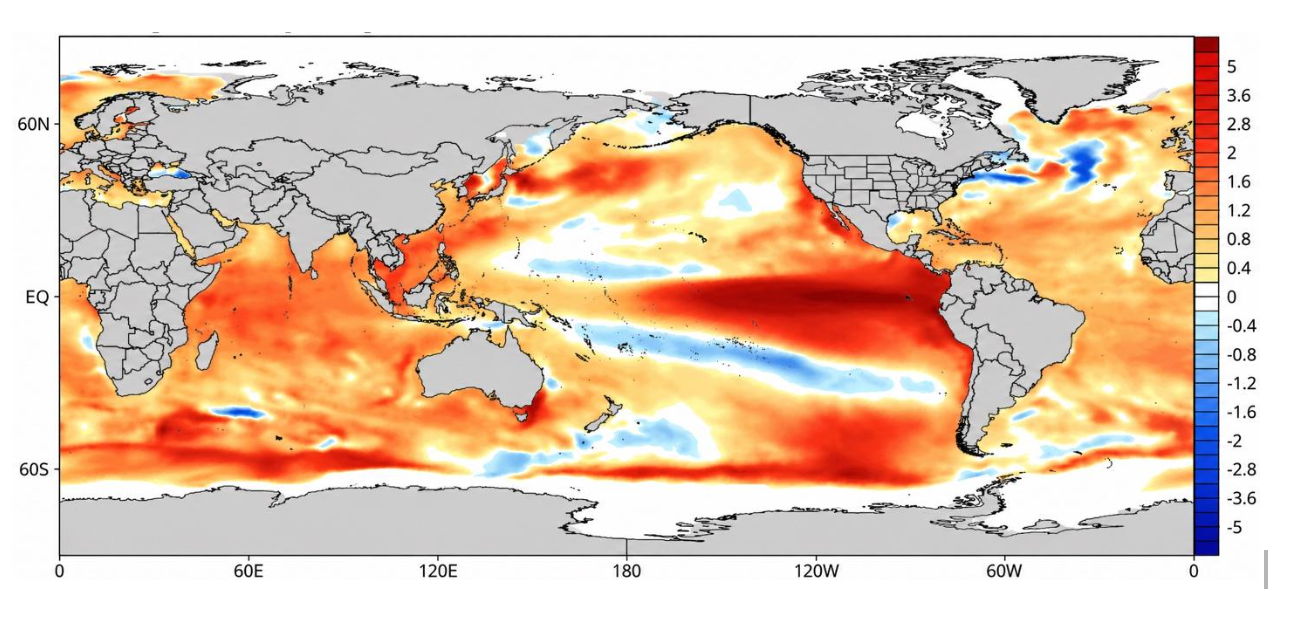
Last January, satellite radar detected a swell of warm water surging through Oceania, in the western Pacific, at about two meters per second. In March, instruments picked up another, similar pulse of warm water as it pushed east across the Pacific.
Observations of these Kelvin waves sparked widespread concern, because they seemed like sure signs of a pending El Niño. And indeed, computer models of Earth’s climate began to forecast not just any El Niño, but a monster event that seemed poised to dramatically amplify global warming.
Midway through June, the National Oceanic and Atmospheric Administration (NOAA) announced that El Niño had officially begun. Since then, model simulations have converged around a record-breaking El Niño, one that could warm the Pacific far more than any event in recent history.
It is, therefore, virtually certain that El Niño will briefly supercharge global warming. Heating will intensify around the world for the rest of 2026. And 2027 is increasingly likely to be the hottest year, by far, in recorded history.
Every El Niño transfers heat and moisture into the atmosphere on an almost unimaginable scale. The tropical jet stream, a rushing current of air in the upper atmosphere, exports this energy and water out of the Pacific, and that reshuffles worldwide weather patterns.
But the impacts of El Niño on weather – or in other words, the teleconnections that form between the warming of the equatorial Pacific and droughts, floods, storms, or heatwaves around the world – are stubbornly hard to forecast.
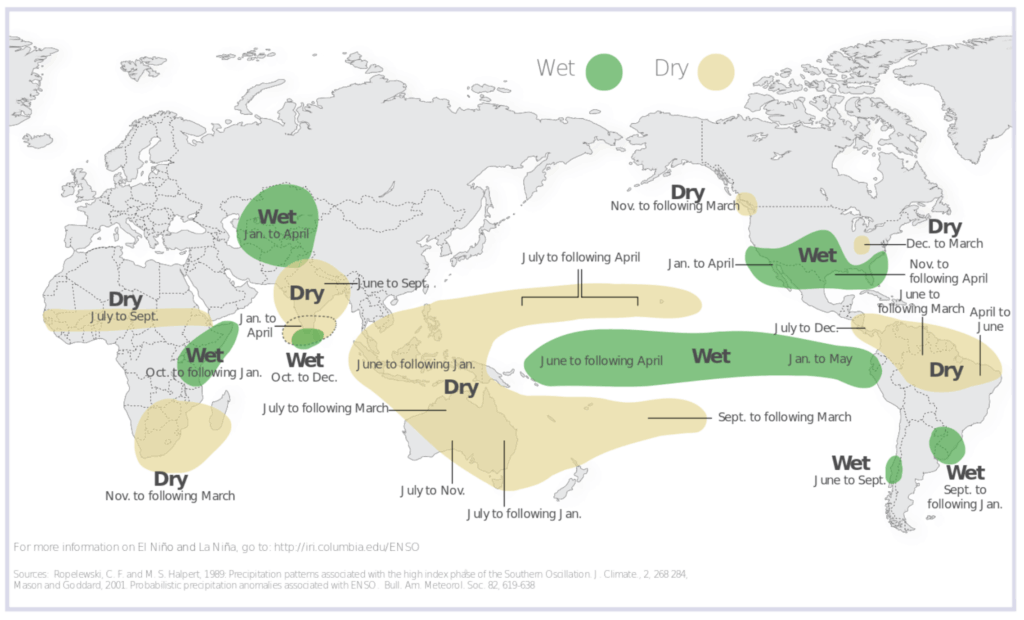
One reason is that each El Niño warms the tropical Pacific in a different pattern, to a different degree, and for a different amount of time. Another is that there are many influences on regional weather, and El Niño is always just one of them. Its influence also tends to weaken with distance from the tropical Pacific.
It is, therefore, virtually certain that El Niño will briefly supercharge global warming. Heating will intensify around the world for the rest of 2026. And 2027 is increasingly likely to be the hottest year, by far, in recorded history.
It’s also likely that El Niño will bring torrential downpours to parts of the western hemisphere, including the southern United States, owing to the regional proximity of warm, evaporating water.
El Niño is already reducing precipitation in others. Monsoon rainfall in India, for example, is well below average, and drought is taking hold across Indonesia – all a partial result of the eastward displacement of warm water.
But exactly when, where, to what extent, and with what consequences will different communities and environments continue to experience extremes in temperature or precipitation?
Past El Niño events have shown that detailed forecasts are all but impossible to make in advance.
A Food Crisis in 2027?
Still, let us imagine a scenario for the coming year. It may not be the most likely scenario — not yet — but it’s growing disturbingly plausible.
In this scenario, Europe’s harvest comes in well below average. Wars continue in Iran and Ukraine. On opposite sides of the Iran war, Saudi Arabia and the Houthis trade escalating attacks. Grain can’t leave Russia or Ukraine in anything approaching its usual volume. Fossil fuels and fertilizer can’t get through the Persian Gulf — at least, not in their pre-war quantities – and shipping companies abandon the Red Sea in favor of a longer, costlier route around the Cape of Good Hope.
In the final months and weeks of 2026, drought worsens in South Asia, South Africa, and crucial parts of South America. Regional harvests of crops such as rice and maize fall to historic lows. Stockpiles run out.
Then, in late spring 2027, unseasonable heat waves and unprecedented droughts or rains kill maturing plants in fields across the northern hemisphere. Marine heatwaves, meanwhile, alter the distribution and quantity of wild fish that usually supply the global food system with important protein, or with animal feed and fertilizer.
Harvests decline in multiple breadbaskets, and there is not enough surplus from some breadbaskets to make up for shortfalls in others. In eight months, from late 2026 to mid-2027, the price of wheat, maize, and rice more than doubles. Tariffs, most of them imposed by the U.S., and energy-hungry data centers, most of them built in the U.S. and China, extend this inflation to other commodities and resources.
By the end of 2027, inflation upends politics in developed countries, prompting protests and toppling governments. In poor, import-dependent countries and communities, there simply isn’t enough food. Millions starve. A new era of instability arrives amid violence and famine.
Because the trends appear so clearly visible, there may be time to avert catastrophe. Ending the wars in Ukraine and Iran — even if on sadly imperfect terms — seems like the crucial first step. Unshackling the global food system, restoring its flows of grain, fuel, and essential chemicals, could be the only way to prevent a food crisis on a scale many of us have never seen before.
This scenario may sound implausible. But consider again the similarities to the food crisis of the 1970s.
In those years, the warm waters of a strong El Niño helped cause the collapse of the Peruvian anchovy fishery, then critically weakened the strength of the Asian summer monsoon, devastating rice harvests. And in October 1973, Arab members of the Organization of Arab Petroleum Exporting Countries (OAPEC) halted oil shipments to the United States and other Israeli allies.
Among other things, the OAPEC embargo sharply increased the cost of fertilizer, which, by encouraging farmers to use less, further reduced yields. Grain prices, which had climbed in 1972, reached shocking new highs in 1973 and 1974.
The world has changed since the 1970s. Some of the causes of the decade’s food crisis – including grain export restrictions and simultaneous poor harvests in major breadbaskets – may not materialize in coming months.
But trends do seem to be converging, just as they did in 1972. And, 55 years later, the outcome may be tragically similar.
Still, because the trends appear so clearly visible, there may be time to avert catastrophe. Ending the wars in Ukraine and Iran — even if on sadly imperfect terms — seems like the crucial first step.
Unshackling the global food system, restoring its flows of grain, fuel, and essential chemicals, could be the only way to prevent a food crisis on a scale many of us have never seen before.
And lowering greenhouse gas emissions with renewed urgency may be the only way to reduce the likelihood of something much worse in the years and decades to come.