
Today, 57 million American adults are functionally illiterate. That number represents 28% of the adult population, a significant surge from 18% just over a decade ago.
This statistic does not mean that all 57 million people are literally unable to read. But it does mean that one in four Americans will struggle with many of the routine written tasks now assumed by doctors’ offices, schools, employers, or government agencies; for example, interpreting complicated scheduling messages, processing information on forms, or following detailed directions on their prescription medication.
Strikingly, rising illiteracy is not just an American story: Across many high-income countries, measures of adult literacy are deteriorating, both in absolute terms and as a percentage.
We are economists who spend much of our time studying education in lower-income countries, where Western education systems are often held up as examples. That is one reason we find these numbers to be deeply troubling — countries most often treated as educational models appear to be losing ground on basic skills.
In our years of research on education, we have rarely encountered evidence that adult skills may be deteriorating across large parts of otherwise highly educated societies. In the countries we work in, literacy rates have been rising steadily for several decades, and we had assumed that trend to be the norm.
Given the vast implications of this deterioration in literacy, we are also surprised at how little attention it has received outside specialist education circles. Perhaps people think that academics and policymakers already know why it is happening (smartphones and COVID-19 are leading explanations) and are already doing something about it.
But we are not sure we understand what explains the decline or that there are policies in place to reverse it. What we are sure about is that we need to be willing to move beyond simple explanations if we want to stem this decline.
Three Facts About Declining Literacy
In order to get that conversation started, we present three facts based on our analysis of data from the Organisation for Economic Co-operation and Development’s Programme for the International Assessment of Adult Competencies, or PIAAC, which visits people between the ages of 16 and 65 at their homes and tests their cognitive skills across a range of tasks. This summary accompanies our extended analysis published in the indexed version of Science Politics.
Fact #1: Functional illiteracy is on the rise across many high-income countries
Across the 26 countries that participated in both PIAAC cycles, 159 million adults aged 16–65 were at or below Level 1 in literacy in 2023 — the equivalent of our broader definition of functional illiteracy — while 170 million were at or below Level 1 in numeracy. In other words, functional illiteracy is not a problem of a single country or a small group of countries; it is affecting many rich countries, from Chile to Japan.
- In Italy and Spain, 35 percent and 31 percent of adults, respectively, performed at or below Level 1 and were thus functionally illiterate. In England, 18% of adults have difficulty processing and integrating instructions in English.
- Only in the Nordic countries are the numbers lower, although even in Finland and Sweden 9% and 12% of adults are functionally illiterate.
Furthermore, functional illiteracy is increasing. In the United States, the number of functionally illiterate adults increased from 35 million to 57 million, representing a 63% increase since 2012–2014.
Again, the U.S. is not alone.
Across the 26 countries that participated in the 2012–17 and 2023 PIAAC cycles, the number of functionally illiterate adults increased from 111 million to 159 million, or from 18% to 25%. The number of functionally innumerate adults increased from 149 to 170 million over the same period.
In our extended analysis, we show that controlling for compositional changes due to gender, immigration, and population aging cannot explain this rise.
Fact #2: Adult skills have declined across ages — often the most among older adults
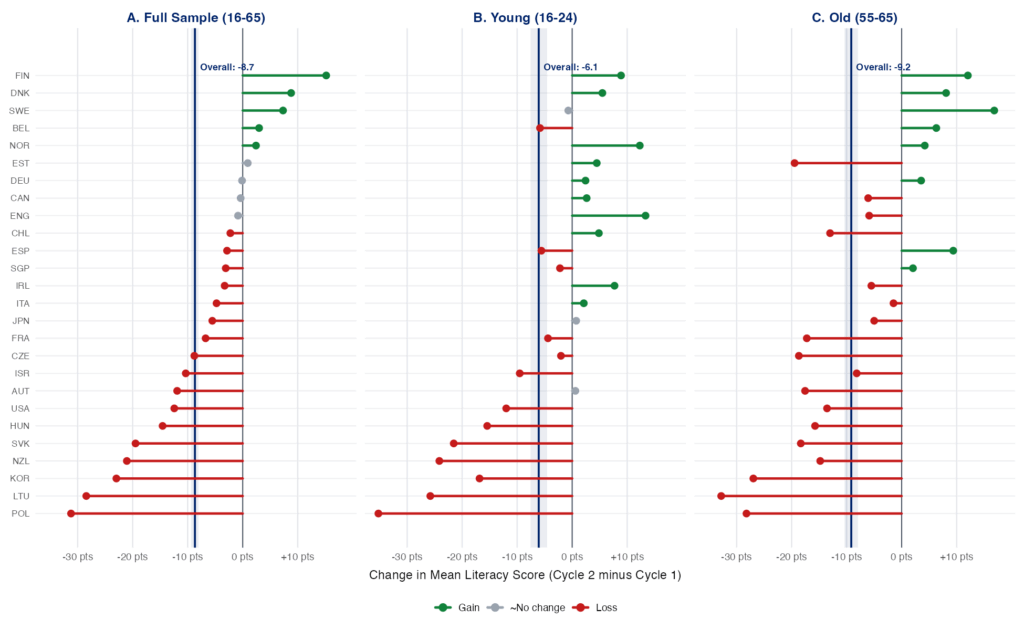
The figure below switches from threshold shares to mean literacy scores, which capture changes across the full distribution. It compares the change between the first and second PIAAC cycles for all adults, those aged 16–24 and those aged 55–65.
On a population-weighted basis, mean scores fell by 6.1 points among young adults and 9.2 points among older adults.
The pattern is difficult to reconcile with a story in which smartphone exposure or COVID-era school closures affected only adolescents. To the extent that the decline in functional literacy reflects these systemic changes, we need a broader explanation for why it has affected adults of many ages.
Change in Mean Literacy Score: Cycle 2 (2023) versus Cycle 1 (2012/17)
Fact #3: Countries have experienced very different patterns
The root causes of these declines are heavily debated and range from smartphones to COVID-19 to the declining benefits of cognitive skills in the workplace. Yet, we have not come across an explanation that can explain the variation across countries.
Why did literacy decline so sharply among young adults in New Zealand, while France largely protected the young but experienced large losses among older adults? Why were the losses among older Koreans so extreme?
Our sense is that focusing only on the U.S., as many studies have done, misses valuable opportunities to learn from a wider group of countries and potential explanations.
Our extended analysis shows, instead, that an age-period-cohort framework provides a useful way to organize these patterns. As people age, cognitive decline sets in. But it is also the case that different birth cohorts have had very different educational and labor market experiences, and these may affect their functional literacy scores. For instance, younger people in Chile are much more likely to have attended college than their elders. Finally, comparisons across rounds show that similarly aged adults performed worse in 2023, consistent with period effects.
Make no mistake – the decline of Western literacy is a tragedy for all humanity. And an urgent call to action for those who are listening.
These forces cannot be cleanly separated from two repeated cross-sections because age, survey year, and birth cohort are mechanically linked. But the framework disciplines explanations: Any proposed cause must fit the patterns across ages, birth cohorts, survey rounds, and countries.
Why these age, cohort, and period effects play out differently across countries is a key question we need to address; universal explanations in which smartphones or COVID-19 affect all groups and countries in the same way are insufficient.
Common shocks such as COVID-19 or smartphones may still matter, but only through mechanisms that produce very different effects across countries and age groups. Comparative research across multiple countries can help us understand which institutions and policies have either protected adult skills or accelerated these declines across different age groups.
A Call to Increase Global Capital
We trained as development economists who would learn the tools and methods to work with lower-income countries as they caught up to their higher-income counterparts. Never in our training or our education did we think that this catch-up would reflect simultaneous improvements in the countries we work in and rapid declines in today’s high-income countries.
There is no smugness here, just anguish.
In a world where we desperately need young people to drive innovation and change and where the demographics of decreasing populations are now working against us, unless we can massively increase global human capital, our shared humanity is in trouble.
Yet, we cannot innovate if we forget the basic ability to gather and process information.
Make no mistake – the decline of Western literacy is a tragedy for all humanity. And an urgent call to action for those who are listening.