Women deliver 70% of healthcare but hold only 25% of leadership roles in health.
For example, in over 200 global health organizations, 73% of CEOs and 68% of board chairs remain roles occupied by men. During COVID-19, more than 85% of expert task forces were men.
The collapse of international aid threatens to deepen these gender inequity fractures. At the same time, the question of who builds and leads health has never been more urgent.
The authority gap is not a failure of gender equality legislation.
The Philippines is a revealing test case. It ranked 20th globally and 1st in Asia in the 2025 Global Gender Gap Report, which measures overall parity across economic, educational, health and political dimensions. It also has one of the most feminized health workforces in the world.
Drawing on a review of policies and literature on the lived experiences of Filipino women health workers, we argue that the authority gap is not a failure of gender equality legislation. Rather, it is the outcome of a political and economic system organized to extract women’s labor without sharing power with them.
Women’s Work Holds Up Health Systems and Goes Unpaid
The foundation of most health systems are community health workers. They are also overwhelmingly women. Women in Global Health estimates that at least 6 million women are in community health positions that are either unpaid or underpaid. Unpaid care work is estimated to total to US$10.8 trillion annually.
This unpayment or underpayment is not an oversight but rather a structural arrangement that governments have chosen to sustain. It is rooted in what political economists describe as gendered capitalism’s reliance on women’s undervalued labor. In the Philippines, barangay (village) health workers (BHWs) receive a monthly allowance ranging from PHP 1,150 to PHP 3,000 (around US$20 to US$50), with some receiving as little as PHP 50 (US$0.80). BHWs incur work-related expenses that extend beyond this, and many take on additional part-time jobs to support themselves.
The system has been designed to rely on their moral commitment as a substitute for worker rights.
Up to 80% of Filipinos believe it is a man’s job to earn money and a woman’s job to stay at home. BHW work is framed as an extension of a woman’s mothering/caring role. A 2023 health labor market analysis suggested that increasing BHW allowance may attract more men to the role and fix shortages. This solution reflects the occupational segregation driven by the systemic devaluation of feminized care work. On its own, increasing wages has little effect on who enters care work when early exposure to traditional gender norms remains strong.
BHWs remain in their role because of their compassion and desire to serve communities. Whether consciously or not, the system has been designed to rely on their moral commitment as a substitute for worker rights.
During COVID-19, while working on the frontlines of pandemic response, they were disqualified from government financial assistance on the grounds of already receiving allowance. Considered allies of political figures due to their influential role in communities, more than 80,000 BHWs were dismissed following local elections in 2023.
Fixing this structural devaluation requires a restructuring of the current incentives that make undervalued labor the default.
The most direct intervention is first to transition BHWs from volunteers to a formal position that carries employment benefits. Ethiopia’s Health Extension Workers program has demonstrated that this transition is feasible. In Ethiopia, community health workers are described as salaried employees of the public health system. Similarly, Brazil’s Community Health Agents are a recognized occupational category, often with formal posts in cities.
The Philippines is moving in the right direction. The 2019 Universal Health Care law mandates competitive benefits and incentives for BHWs. The proposed Magna Carta for BHWs goes further by formalizing the role with standardized benefits, training opportunities and career pathways.
The same work is undervalued when it does not cross the border.
It also proposes a monthly allowance of up to PhP 5,000 (US$83) — an improvement, but still a payment that remains below what anyone needs to cover living costs.
In June 2025, after having been approved by the Senate earlier in the year, the bill was retracted by the Congress for unknown reasons.
Health Workforce Policy Needs Rebalancing Beyond Migration
Valuing care work isn’t all that matters. Caring for carers is also important. However, factors such as underfunded public health systems, hiring freezes and wage bill ceilings make health worker migration predictable. The push and pull factors of Filipino women health worker migration is widely studied and integrated into national economic planning.
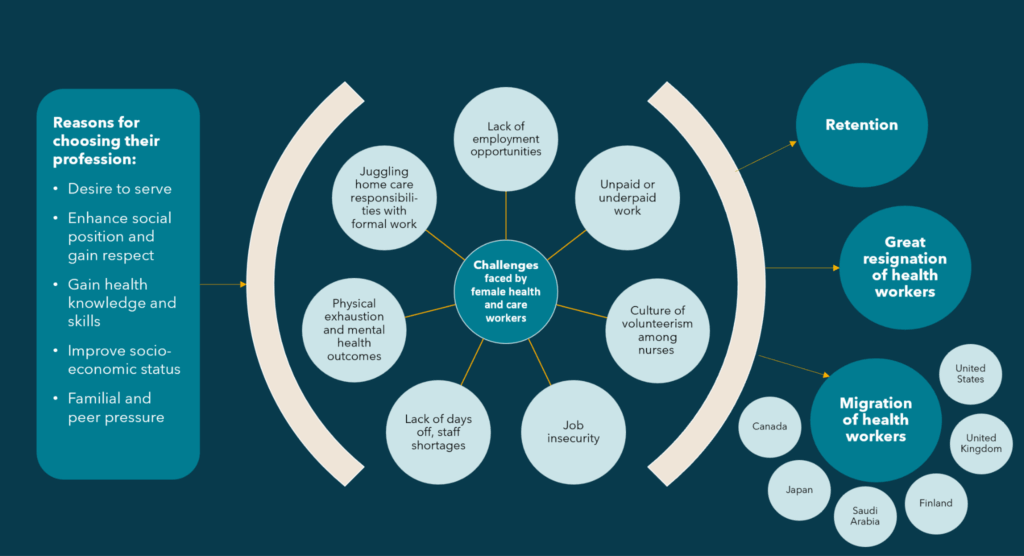
The Philippines was the first country in the Asia-Pacific to explicitly promote temporary labor migration policy as an economic strategy. Remittance has been a deliberate policy goal since the mid-1970s. The consistency of labor policies and diversifying destinations are thought to be intentional choices to sustain and stabilize remittance inflows, even during global crises. Just in January 2026, remittances surpassed US$3 billion.
Filipino migration has also historically been feminized. An early 1900s program trained Filipino women as nurses in the U.S. then returned them to high positions in Philippine hospitals. This history laid the foundation for a feminized care export strategy that would be formalized 70 years later.
Between 2022 and 2023, over 55% of overseas Filipino workers were women, concentrated in health and care work. The expectation that Filipino women health workers will emigrate has been thoroughly integrated in the system. Nurses upskill and earn credentials with future migration explicitly in mind. Hospital managers keep wages down because they expect many health workers to migrate. The Philippine Department of Health estimates that 51% of their licensed nurses are working overseas.
International recruitment is not a gender-neutral transaction.
The human cost extends beyond numbers. As senior nurses leave, newly trained nurses lose their mentors. Women face greater difficulty finding mentors than their male counterparts, and the scarcity of senior women in health roles creates a barrier to advancement. The presence of visible female leaders reduces gender bias and increases women’s leadership aspirations. Meaning, the export of experienced women health workers actively undermines the conditions for producing future women health leaders.
The contradiction here is that the state encourages women to work overseas while not contesting gender norms domestically. Migration has been culturally reframed as an act of good mothering where women leave to provide for their children. This interpretation makes women’s departure socially acceptable within existing gender roles rather than a challenge to them.
The system benefits twice from women’s care work and in both directions. It has value as a remittance-generating export, but the same work is undervalued when it does not cross the border. Perhaps unsurprisingly, one of the push factors for women health worker migration is that it’s viewed as a path to independence and liberation from gender constraints in the country.
Decoupling health workforce development from migration economics requires interventions that address both the economic and gendered dimensions of why women leave. Our review shows that low wages continue to be one of the most consistent push factors for migration. However, making more money is not enough for women who decide that the cost of staying is still higher than raised wages. The domestic strategy must also challenge the cultural construct that care is a woman’s natural role, otherwise wage suppression and leadership barriers will persist.
Gender transformation in health leadership cannot be tasked to women alone.
At the international level, the World Health Organization predicts a shortfall of at least 18 million health workers by 2030, primarily in developing countries. They recognize that health worker migration exacerbates existing inequities in labor-sending countries. Of course, health workers have a right to migrate should they decide to do so. But because Filipino migration is feminized and concentrated in care work, international recruitment is not a gender-neutral transaction. The triple win of migration — the premise that migration benefits origin countries, destination countries, and migrants — has empirically not been realized. It is an arrangement that destination countries have benefited from enormously, but benefits to origin countries and migrants are overstated.
One model attempting to change this is the Philippines-Germany Global Skill Partnership. In this arrangement, Germany funds nursing training in the Philippines with a “home” or “abroad” track. The partnership has also invested in nursing school infrastructures and faculty exchanges to strengthen the training system itself. For the Philippines, the cost of migration falls disproportionately on women health and care workers. This partnership restructures who bears the cost of migration but is not enough on its own.
For bilateral agreements to address the gendered dimensions of health worker migration, they should be evaluated on gender-disaggregated indicators. Are women advancing into leadership in source country health systems, or are they being trained for export while domestic power is consolidated elsewhere?
Redistributing Power in Health
We don’t actually know how many Filipino women hold leadership roles in health. The only widely cited figure is that 4 of the 29 Health Secretaries have been women. We find that the leadership question is, for the most part, understudied.
We know that the Philippines has minimal issues meeting gender parity targets, as evidenced by its high ranking in the 2025 Global Gender Gap Report. The Philippine Magna Carta of Women requires a 50-50 gender balance in government executive and management positions.
There are legal protections for women as full-time employees and mothers. But how these policies operate inside institutions to advance women’s careers is an evidence gap that needs to be closed. And without data on women in leadership roles, there is no way to hold governments accountable for implementing the law.
We have described solutions that policies can possibly address. Almost 100% of Filipinos hold a bias against women. We previously wrote about, and continued to emphasize in this article, how gender norms shape disparities in the health workforce. This is perhaps where legislation reaches its limit. Gender parity requirements alone cannot overcome deeply rooted beliefs and stereotypes on who can lead.
Evidence from gender transformative leadership offers directions toward change.
Gender equality legislation sets the terms on which women participate in the system, but it doesn’t change the system itself.
Across Asia-Pacific, women health leaders are institutionalizing leadership practices that actively challenge unequal power structures. But gender transformation in health leadership cannot be tasked to women alone. Assuming that the majority of leaders are men, change also requires those who benefit from existing power structures to actively participate in dismantling them.
This is not simply a matter of awareness-raising or implicit bias training, though both have a role. It means men in health leadership using their institutional power to support women for advancement, to challenge decisions that reflect bias, to model different ways of exercising authority, and to advocate publicly for the structural changes that their organizations are often resistant to making.
From Here
The Philippine case shows how the gender authority gap in health is not just a legislative failure. That’s because the three dynamics examined are not separate problems but are expressions of a single political economy. Gender equality legislation sets the terms on which women participate in the system, but it doesn’t change the system itself.
The evidence is growing to make different and better choices. Formalizing community health workers has proven feasible in Ethiopia and Brazil, and the Philippine Magna Carta for BHWs offers a starting point. The movement is especially powerful when grounded in the real-life experience of BHWs through civil society organizations like the National Federation of BHWs. The Philippines-Germany Global Skill Partnership is trying to change the model of migration. And there is a growing body of evidence around gender transformative leadership and how it can challenge the norms that legislation cannot reach.
When more women participate in health leadership, health outcomes improve, organizational effectiveness is strengthened, and workplaces become safer and fairer. Health systems have goals of equity, resilience and universal coverage. Until it values care work and shares power with the women who provide it, we cannot close the gap between who delivers health and who leads it.
For their helpful comments on the article, the authors would like to thank Jem Sigua and Gillian Garcia.