In “Project Hail Mary” — the best-selling book by Andy Weir, now a hit movie directed by Phil Lord and Christopher Miller — the Sun’s environment changes. It’s infected by an interstellar microbe, astrophage, that also spreads to every other star in our cosmic neighborhood.
Scientists predict that, in a few decades, the astrophage will eat so much of the Sun that the Earth will grow unbearably cold. Harvests will fail, governments will disintegrate, and humanity will follow most other species into extinction.
But in the story, the astrophage also promises salvation.
Because it converts much of its mass into energy, it can be a powerful propellant, capable of accelerating a spacecraft to relativistic speeds. It allows a small group of astronauts to travel to a nearby star, Tau Ceti, where the astrophage mysteriously hasn’t caused any harm.
Decades of cooling and drying may have led, in a roundabout way, to millions of deaths. It feels like an echo of exactly the kind of relationship between solar fading and human survival that’s at the heart of “Project Hail Mary.”
I won’t give away the rest of the plot, except to say that humanity’s last chance — its Hail Mary — is to find out what’s protecting Tau Ceti, bring it back to Earth, and use it to stop the destruction of the solar environment.
It’s wonderfully creative fiction. But it’s based on something real — something I describe in my new book, “Ripples on the Cosmic Ocean.”
The book argues that our solar system is full of connected environments, by which I mean dynamic physical systems that may or may not involve the added complexity of life.
The book shows that these environments constantly change, and that their changes have shaped history — often by revealing threats to Earth, sometimes by spurring political, economic, or technological developments that culminate in human-caused changes to environments in space.
Solar Fading and Climate Change
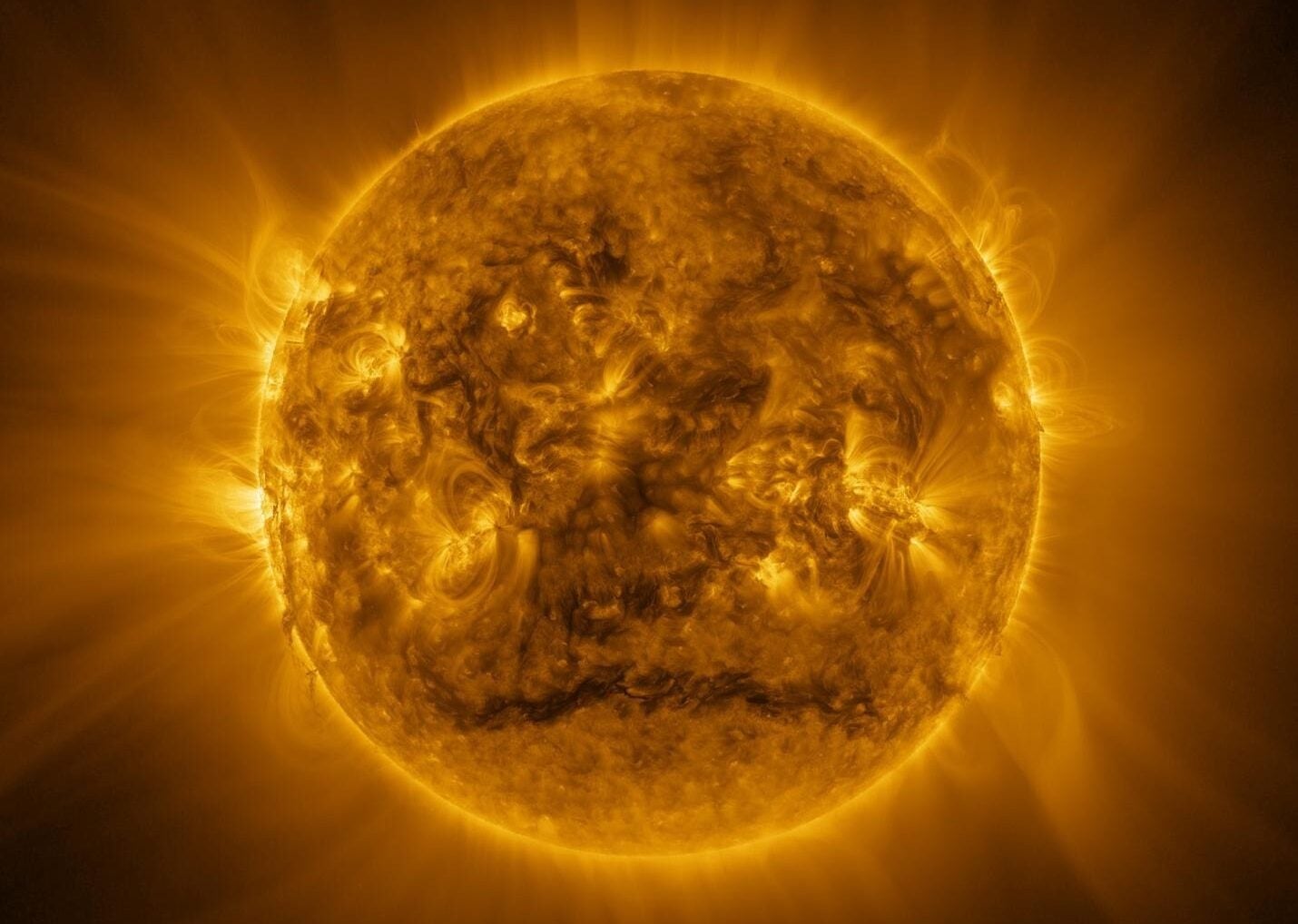
Take the environment of the Sun. For reasons that still aren’t fully understood, the Sun’s output can slump, ever so slightly, for decades at a time. Long before the onset of global warming, its “grand solar minima” helped cause periods of modest climatic cooling that altered patterns of precipitation on a continental scale.
Because preindustrial societies were, for the most part, even more vulnerable to climate change than those of today, the consequences of grand solar minima often appear to have been disastrous. Year after year of ruined harvests probably worsened malnutrition and unrest in empires where many depended on staple crops grown on marginal farmland.
Between the 14th and 19th centuries, decades of cooling and (in some places) drying may have led, in a roundabout way, to millions of deaths.
Both flares and CMEs had little impact on human history until the spread of electrification in the nineteenth century. Suddenly, the currents created by geomagnetic storms could disrupt human infrastructure.
It feels like an echo of exactly the kind of relationship between solar fading and human survival that’s at the heart of “Project Hail Mary.” And it even inspired theories of life on the Sun.
In the 18th century, William Herschel — the discoverer of a planet he named George’s Star, later renamed Uranus — first suggested that changes in the Sun’s brightness had altered Earth’s climate and imperiled its harvests.
Studying the Sun with revolutionary, homemade telescopes led him to suspect that solar environments harbored life. He believed that sunspots were holes in the solar atmosphere that revealed a dark surface.
To him, this surface was probably cold enough not just for simple life, like astrophage, but intelligent aliens. Herschel abandoned the idea only when he discovered infrared radiation, in an experiment demonstrating that Earth’s heat came from the Sun.
Solar Storms Across History
The Sun is more than a source of light and heat. It’s also an enormously complicated magnet— or more accurately, a tangle of magnetic fields that are powered by conductive plasma and loop out of the solar surface.
Because different parts of that surface rotate at different speeds, the fields twist and bend until some break in titanic explosions: solar flares. The radiation from flares reaches us at the speed of light and supercharges our ionosphere, the part of Earth’s upper atmosphere where solar radiation turns gas into charged particles.
The most serious vulnerability of human infrastructure to geomagnetic storms may involve the transformers in electrical grids.
If they’re under enough stress, the Sun’s magnetic field lines can actually bend in on themselves until they fully detach from the Sun. These gigantic magnetic bubbles, loaded with ionized particles, are called coronal mass ejections, or CMEs.
They barrel through space at thousands of times the speed of a commercial jet. If they strike Earth’s magnetic field, or magnetosphere, at just the right angle, the particles they’ve ripped free from the Sun saturate near-Earth space, spark vivid aurorae, and unleash rapidly fluctuating currents in Earth’s crust. This is called a geomagnetic storm.
Both flares and CMEs had little impact on human history until the spread of electrification in the nineteenth century. Suddenly, the currents created by geomagnetic storms could disrupt human infrastructure — first telegraph networks, later railroads, pipelines, and even electrical grids.
By the end of the twentieth century, a key source of vulnerability turned out to be transformers, giant and difficult-to-build machines that transfer electricity between circuits in an electrical grid. The fluctuating currents in geomagnetic storms repeatedly damaged these machines in the late 20th and early 21st centuries, occasionally causing widespread power outages.
Several decades after CMEs proved capable of disrupting electrified infrastructure, inventors learned how to bounce radio waves off the ionosphere to communicate across long distances.
Then, in World War II, they discovered how to use radio waves in radar, allowing militaries to track naval fleets or bomber squadrons at long distances.
Because they depended on the ionosphere, radio and radar were easily scrambled by powerful solar flares. After Cold War superpowers had built nuclear missile arsenals to deter one another, this vulnerability took on frightening new dimensions.
The well over 10,000 active satellites now in orbit can be damaged by the charged particles that saturate Earth’s magnetosphere in a geomagnetic storm.
In fact, in 1967 a radar blackout caused by powerful solar flares briefly convinced American Air Force officers that a Soviet nuclear attack was underway and nearly provoked a world-ending retaliation.
Today’s Solar Risks
The same rocket technology that made early warning radar necessary also launched the Space Age.
By the end of the 1960s, satellites were already integral to weather forecasting, telecommunications, and espionage. Within a few decades, they were also essential to navigation, remote sensing, military targeting, and internet connectivity.
Yet the well over 10,000 active satellites now in orbit can be damaged by the charged particles that saturate Earth’s magnetosphere in a geomagnetic storm.
When, in 1962, a nuclear test in outer space replicated some of the effects of a geomagnetic storm, a third of the satellites then in orbit were crippled. Since then, satellites have been routinely damaged by even small increases in the number of charged particles near Earth.
Because geomagnetic storms also heat up Earth’s atmosphere and cause it to expand, they moreover intensify drag on low-flying satellites, causing them to lose altitude. A series of storms led, in 1979, to the premature re-entry into Earth’s atmosphere of Skylab, the first American space station.
Just four years ago, 38 SpaceX Starlink satellites were lost when the sudden expansion of the atmosphere in a geomagnetic storm kept them from reaching higher altitudes.
Today, changes in solar environments therefore pose serious risks to modern life, just as they do in “Project Hail Mary.” But the magnitude of that risk is frustratingly difficult to pin down.
The most serious vulnerability of human infrastructure to geomagnetic storms may involve the transformers in electrical grids. If it happened today, the worst geomagnetic storm of the nineteenth century, the so-called Carrington Event, could damage hundreds of transformers across, say, the U.S. East Coast.
The region’s electrical grid would collapse, and because the transformers would take many months to replace, power outages could drag on for years. In a worst-case scenario, millions could die, and the global economy would plunge into a depression.
Today, greenhouse gas emissions are trapping more and more of the Sun’s energy in Earth’s atmosphere. Altering the space environment near Earth may, in time, slow it down.
What’s more, the Sun may be capable of far more powerful storms than any that have occurred since the advent of electrification nearly two centuries ago. Astronomers have found that “superflares” that explode with the power of a trillion thermonuclear bombs are relatively common on yellow dwarf stars that resemble the Sun. These superflares are much more powerful than any explosion that has been observed on the Sun.
Isotopes in the growth rings of ancient trees also suggest that geomagnetic storms of previously unimagined power have repeatedly engulfed the Earth — even in just the last 2,000 years.
If such a storm were to strike the Earth today, the result could be a calamity that fundamentally alters the course of history, just like the astrophage infection in “Project Hail Mary.”
Changing Near-Earth Space
Still, there are some ways in which technology has reduced human vulnerabilities to changes in solar environments.
Solar telescopes and satellites now keep the Sun under constant watch, observing CMEs in real time. Spacecraft positioned at Lagrange Point 1 (L1) —1.5 million kilometers upstream in the flow of charged particles from the Sun — can provide about an hour’s warning of an incoming CME likely to trigger a powerful geomagnetic storm. That may provide enough time for utility companies to take action by, for example, shutting down electrical grids.
Bizarrely, the world’s navies may have also inadvertently altered the space environment near Earth.
Already in World War I, navies began to use low-frequency radio transmissions to contact sailors in submarines, because these transmissions penetrate seawater. In the Cold War, submarines were armed with nuclear missiles and designed to lurk far beneath the sea surface.
Now, navies needed even lower frequency transmissions to contact them. They built colossal transmitting stations to broadcast extremely low-frequency (ELF) transmissions in all directions. When they reached outer space, these broadcasts appear to have interacted with magnetic belts surrounding the Earth that trap ionized particles.
Our past, present, and future resembles the plot of “Project Hail Mary” — more, perhaps, than even its creators intended.
Under pressure from ELF transmissions meant for mariners in the deep sea, the belts may have moved a bit further from Earth, and further from Earth-orbiting satellites. Now, in a geomagnetic storm, some of these satellites might have fewer particles to contend with.
As in “Project Hail Mary,” the world’s governments seem to have changed an environment beyond Earth, in ways that could protect many of us from natural changes in the Sun’s environment.
Today, greenhouse gas emissions are trapping more and more of the Sun’s energy in Earth’s atmosphere. That is, of course, the cause of global warming.
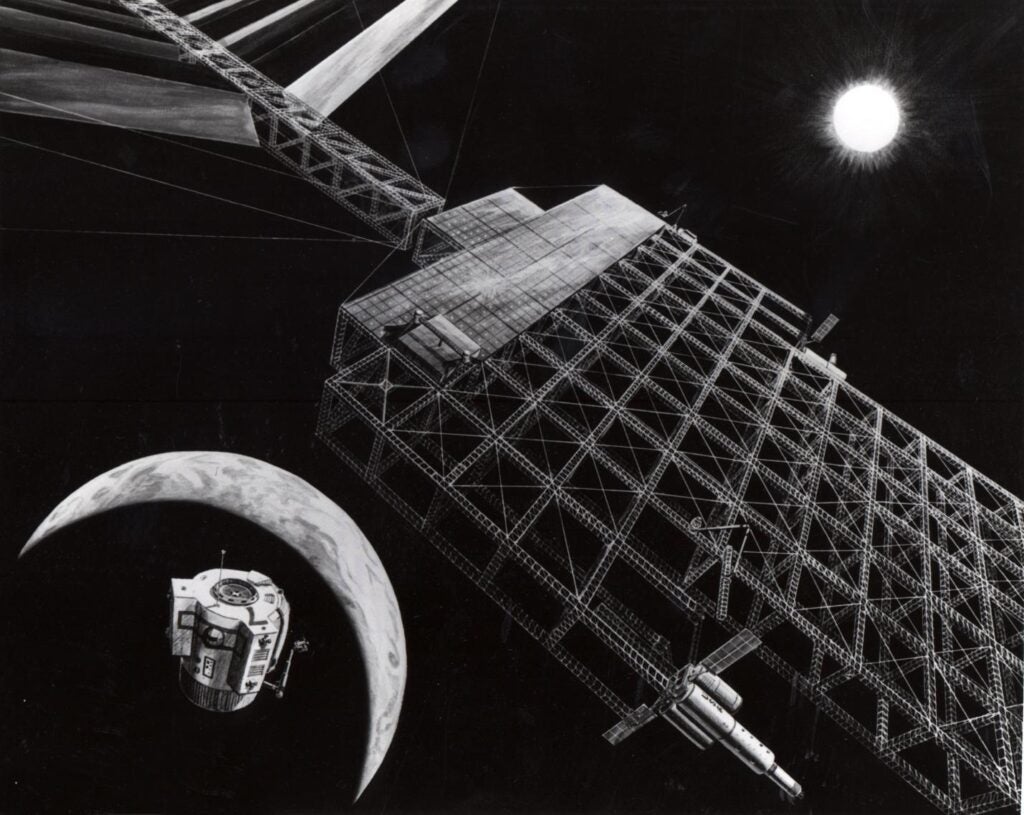
Altering the space environment near Earth may, in time, slow it down. Solar power plants in orbit, for example, could collect solar energy with unearthly efficiency and beam it down as microwave radiation to terrestrial receivers. A swarm of tiny spacecraft — or wafer-thin filaments, or perhaps an asteroid — could, when parked at L1, block a tiny percentage of incoming solar radiation.
That could buy us a little more time to decarbonize — time we might need to avoid triggering irreversible tipping points in Earth’s climate.
Changing Stars and Alien Engineers
Changes in stars like the Sun may also reveal the presence of extraterrestrial life — again, in an echo of the story in “Project Hail Mary.” Scientists and science fiction authors have long speculated that a truly advanced civilization would harness all or most of the energy of its star (humanity currently captures a measly 0.01% of the energy that reaches just our Earth).
A high-tech civilization could surround its star with a series of megastructures, or perhaps a single, vast, inside-out planet, known as a Dyson Sphere.
Viewed from Earth, the construction of a Dyson Sphere or swarm of megastructures would seem to dim a star in visible light but give off otherwise inexplicable infrared radiation. By scanning the galaxy, astronomers have now found a number of potential candidates for these colossal construction projects.
Do they suggest that we’re not alone? Or do they have another, less exotic and purely natural explanation?
Perhaps we’ll last long enough to build our own Dyson Sphere around the Sun. Whether you view that as a utopian or dystopian future is up to you — but there’s no doubt that, to get there, we’ll need to survive changes in our relationship with the Sun, and perhaps be more intentional about how we make them.
Our past, present, and future, in other words, resembles the plot of “Project Hail Mary” — more, perhaps, than even its creators intended.