The Middle East is, once again, the center of a global crisis. Why does this part of the world seem so uniquely plagued by war?
There are many potential answers.
In the wake of World War II, the arbitrary borders drawn by Europe’s retreating empires — uniting communities divided by sectarian interpretations of Islam, separating populations bound together by ethnicity — all but guaranteed conflict.
The related creation of Israel, and with it, the displacement of Palestinians, repeatedly spurred violence, culminating in the ongoing catastrophe in Gaza.
So did efforts by the region’s would-be hegemons, including Iran, to destabilize and dominate their neighbors.
But one potential cause of war appears to distinguish the Middle East from other regions. It’s a cause that may make the region uniquely dangerous to the rest of the world. And it is, of course, oil. If oil is indeed partly responsible for the violence that plagues the Middle East, then there’s a ready-made solution: decarbonization.
Does Oil Directly Encourage Conflict?
Political scientists, historians, and economists have long argued that oil greases the wheels of conflict in the Middle East. There are a number of reasons why.
First, oil reserves seem to enable and encourage a change in the nature of the state.
Oil extraction is lucrative and depends more on capital-intensive infrastructure than domestic labor. This infrastructure provides a source of immense and easily controllable wealth, a bonanza that doesn’t depend on the labor of ordinary people.
Oil therefore appears to provide fuel for authoritarianism. The wealth provided by oil buys off elites, placates popular opposition, and finances the powerful militaries and intelligence services that characterize many Middle Eastern states.
These institutions can form because oil production rarely creates broad benefits for everyone in a society. Not only do the bulk of profits go to elites, but the majority of jobs go to men, worsening gender inequality within nations. Grievances can fuel protests that become dangerous for authoritarian states, which tend to respond with armed repression. Powerful militaries and militias also create opportunities for one country to meddle in the affairs of neighboring states.
Revolutionary petrostates, like the Islamic Republic, seem more conflict-prone because the profits of oil exploitation free them to pursue extreme domestic and foreign policies.
Indeed, second, oil extraction also seems to create systematic vulnerabilities. It requires wells, pipelines, pumping stations, refineries, and export terminals: costly infrastructure that crisscrosses entire countries and can’t be easily defended.
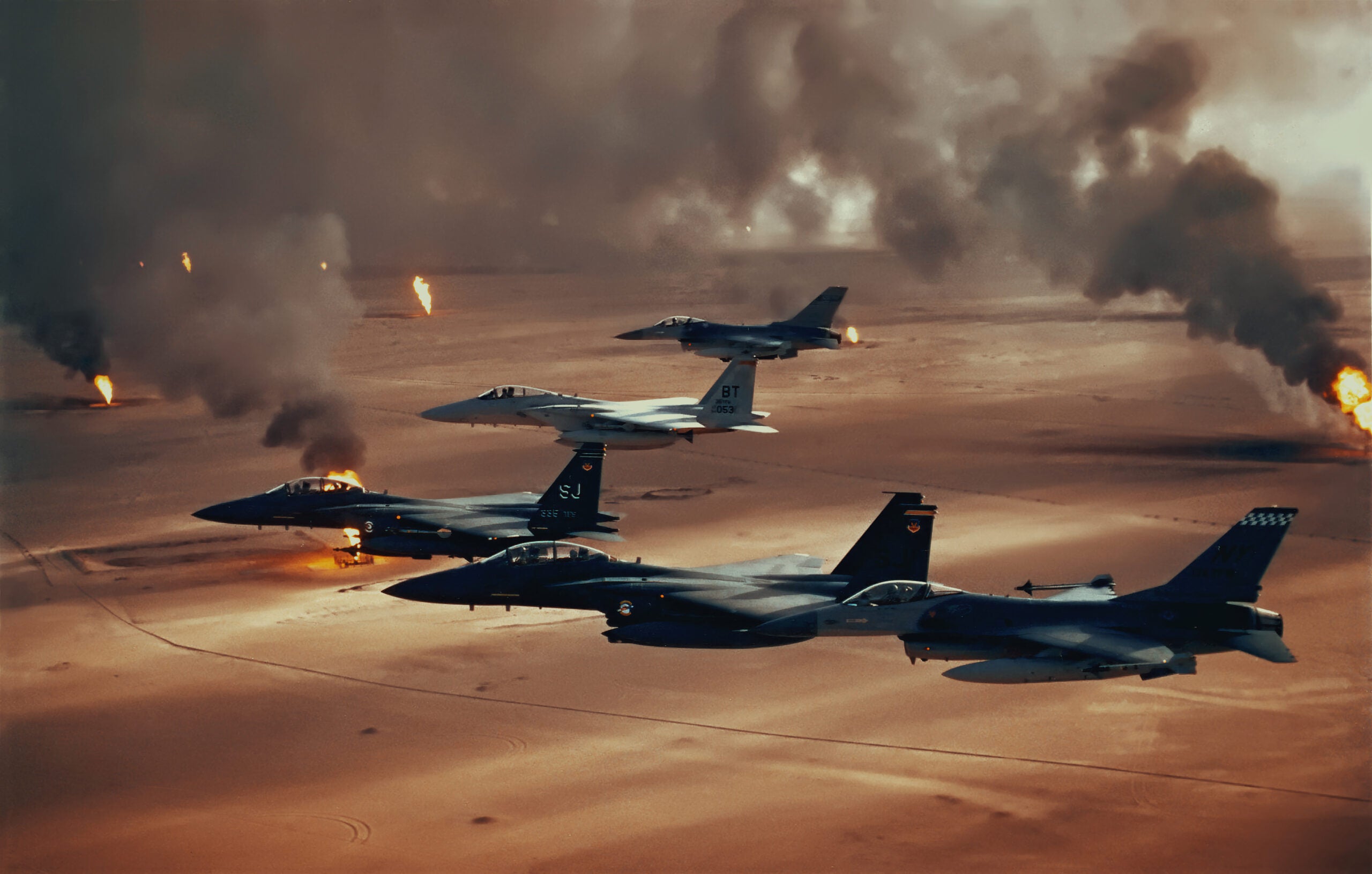
Oil infrastructure makes for tempting targets for non-state actors, whose resentments can grow because of inequalities and repression created or worsened by oil exploitation. Oil infrastructure also increases the potential profits of wars between states, either because the components can be taken over (allowing a war to pay for itself), or because they can be destroyed (forcing an enemy to concede).
In Iran, the Shi’ite regime — until recently ruled by Ayatollah Ali Khamenei — used the profits of its sanctioned oil industry to create a brutally effective police state, and a network of paramilitary forces that forged a shadow Iranian empire across the Middle East. Oil money allowed the regime to position itself as the leader of resistance to Israel and the United States, and to check the ambitions of a rival Sunni petrostate: Saudi Arabia.
Yet because the Islamic Republic’s legitimacy stemmed from opposition to the U.S., its long-term survival seemed to depend on the acquisition of nuclear weapons. It was a powder keg that was always likely to explode.
But reality may be messier than this simple story.
Oil may, at times, facilitate conflict in the Middle East, but it clearly isn’t the only cause of it, and it may not be the most important.
Revisionist analyses of the link between petroleum wealth and authoritarianism — not to mention conflict — suggest that much depends on local politics, culture, and geography.
Oil production certainly did not always create or empower authoritarian states, nor did it make all forms of conflict more likely. Increases in the global price of oil could spur conflict by increasing the resources available to petrostates or the potential profits of fighting, but decreases could make war less likely.
Revolutionary petrostates, like the Islamic Republic, seem more conflict-prone because the profits of oil exploitation free them to pursue extreme domestic and foreign policies.
One could therefore easily conclude that oil exploitation enables today’s war in Iran only because the U.S. overthrew the democratically elected Iranian government of Mohammad Mosaddegh in 1953, then installed Mohammad Reza Pahlavi as shah (or king) of Iran. It was the Shah’s brutal rule that incited the Iranian Revolution in 1979, which in turn led to the creation of the Islamic Republic.
Oil may, at times, facilitate conflict in the Middle East, but it clearly isn’t the only cause of it, and it may not be the most important.
Does Oil Indirectly Cause Conflict?
Still, there’s one other potential link between oil and violence, and this one is just as complicated and contested.
Fossil fuels are responsible for about 70% of all greenhouse gas emissions, and oil accounts for roughly a third of that total (coal and natural gas stand at about 40% and 20%, respectively). These emissions have now warmed the Earth by nearly 1.5 °C since the late nineteenth century.
Global temperature changes have altered the movement of air, the rate of evaporation, and the amount of water the atmosphere can hold, so that in some regions droughts appear to be growing more severe or long-lasting, or both.
One of those regions seems to be the Middle East.
It does seem plausible that petrostates, in the Middle East and elsewhere, are beginning to jeopardize their existence by releasing greenhouse gases into the atmosphere that may, in a roundabout way, imperil their supply of water.
Some scientists have theorized that warming — and especially drying — trends have destabilized countries in the Middle East and Africa, which then helped cause regional wars. The link between global warming, drought, and war once seemed especially clear in Syria.
Influential scientists argued that, first, the agricultural policies of the Assad regime depleted groundwater in Syria as precipitation gradually declined across the Fertile Crescent. Then, in 2007, a truly landmark drought devastated agricultural production in Syria, leading to mass migration from the countryside to the outskirts of cities that were already overcrowded by refugees from the 2003 US invasion of Iraq.
Since the Assad regime could not provide basic services for the new migrants, the outskirts of cities were hotbeds of protest in 2011, when the Arab Spring swept across the Middle East. Owing to the regime’s brutal repression, protests soon metastasized into rebellion, and one of the most ruinous civil wars in modern history.
It seemed like a compelling chain of causal connections. But in the year since this theory on the link between global warming and the onset of the Syrian crisis was proposed, each link in the chain appeared to break down under further scrutiny.
The purported trend towards lower rainfall in the Fertile Crescent, for example, actually depended on a rainfall anomaly — the drought — that began in 2007; otherwise, precipitation had been fairly consistent in the region over the past century.
The Assad regime’s elimination of fuel and fertilizer subsidies also seems much more responsible than drought for internal migration, while migration from agricultural regions appears to have been grossly overestimated.
What’s more, the outskirts of cities no longer looked like the locus of Syrian protests in the early Arab Spring.
Yet although there may no longer be a clear link between global warming, drought, and the Syrian Civil War, warming could be implicated in the current weakness of the Iranian regime.
The transition to renewable energy, which is accelerating globally even as it stalls in the U.S., will transform the Middle East.
Many parts of Iran are now in the midst of their worst drought in decades, and early evidence suggests that global warming may be partly responsible. Iran’s nearly 200 reservoirs now sit about two-thirds empty, with some supplying Tehran just 10% full. As in Syria, unsustainable exploitation of groundwater has badly depleted underground aquifers, and in some cases led to their collapse.
Last year, severe shortages of drinking water and running water — not to mention electricity, in areas depending on hydroelectric power — spurred widespread demonstrations against Iranian authorities. It’s hard to know for sure, but water shortages may have played an important role in worsening popular anger at the Iranian regime.
By December, worsening inflation and soaring food prices led to a wave of mass protests. The regime’s security forces responded, killing thousands, perhaps tens of thousands of protesters. It seems to have been a trigger — or perhaps an excuse — for the present war in Iran.
Today, it does seem plausible that petrostates, in the Middle East and elsewhere, are beginning to jeopardize their existence by releasing greenhouse gases into the atmosphere that may, in a roundabout way, imperil their supply of water.
And the worst is yet to come.
In time, the green economy could create more opportunities for sustaining peace in the Middle East.
The Middle East is expected to warm dramatically in coming decades, until it reaches temperatures unseen in hundreds of thousands, perhaps millions of years. It’s difficult to know exactly how precipitation patterns will respond, but it’s likely that droughts will grow even longer and more severe. Because some 70% of the region’s agriculture depends on rain, the consequences could be ruinous.
Will water shortages undermine fossil-fueled states across the Middle East of the not-so-distant future?
Will this threat to their existence strengthen other potential connections between oil and conflict?
Will petrostates further strengthen their security services — aided, perhaps, by artificial intelligence — to even more effectively repress protests?
Fueled by grievance, will nonstate actors grow in power, and will states consider more wars of opportunity against their neighbors?
The risks seem real, if profoundly uncertain.
Fortunately, the transition to renewable energy, which is accelerating globally even as it stalls in the U.S., will transform the Middle East. In time, it could undermine the foundations of the region’s most repressive and aggressive regimes. If pursued with greater urgency, it can still slash the likelihood of a dystopian future distinguished by scarcity and conflict.
In time, the green economy could create more opportunities for sustaining peace in the Middle East.