
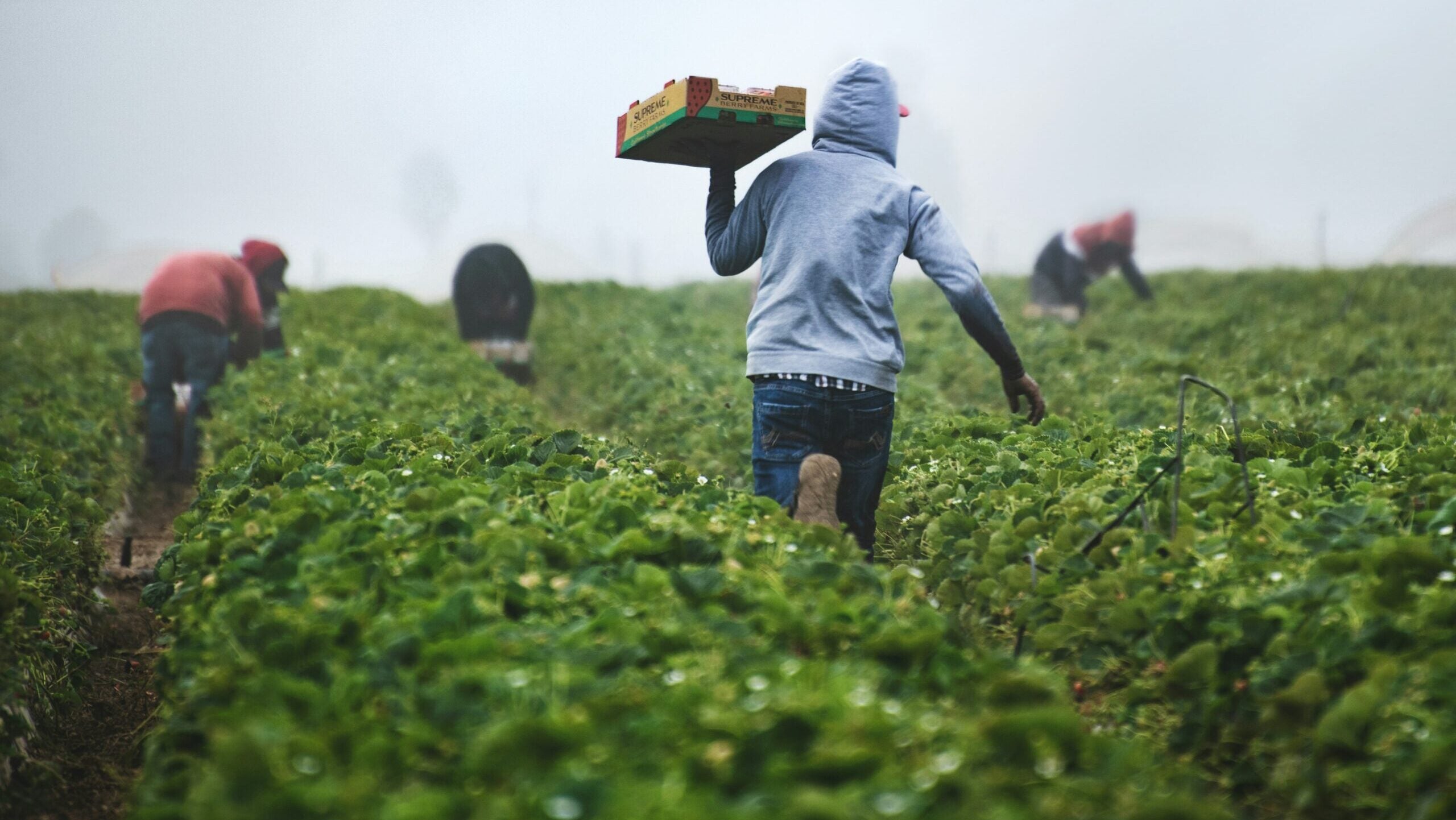
Samuel is an Indigenous Mexican migrant farmworker harvesting fruits and vegetables in the western United States. Year after year, he has planted, harvested, pruned, packed, and transported strawberries, grapes, bell peppers, hot peppers and much more.
He is one of over 70% of farm workers who were born outside the country, most of them in Mexico, whose hands sustain an agricultural industry valued at $1.264 trillion.
Samuel and his wife, Sara, have been in the U.S. more than 15 years. They left their homes in the Mexican state of Oaxaca after exhausting the opportunities to earn a living there. They came to the conclusion that there was no option left but to migrate to work so their family might survive.
Several years ago he asked one of us to accompany his children on a visit to Mexico to meet his father, their grandfather. Some weeks before, Samuel’s father unexpectedly lost his ability to speak normally. The family became deeply worried. Samuel and Sara wanted their children to visit their grandfather, fearing he might die before ever meeting them in person.
The food circuit regulates the flow of people, fruits and vegetables, and capital.
Yet, lacking the proper documentation to re-enter the U.S., Samuel couldn’t return to Mexico himself to see his father for what might be the last time.
It’s easy to see how the work that Samuel and Sara do is part of the food supply chain. Their hands touch the crops that people across the world then get to eat. But their extended family also forms an important part of this complex socioeconomic dynamic, despite being physically excluded from it.
To recognize how families become embedded in the global agricultural industry it may help to use a term that we would like to suggest is especially useful for food studies: the idea of a “food circuit.”
From Food Supply Chain to Food Circuit
When thinking about how food reaches us, the phrase “farm to fork” smuggles in a faulty metaphor. It focuses attention on the produce and its journey from seed to harvest, carefully picked and handed from farm gate to freight to supermarket, marked by a series of exchanges along the way. COVID-19 — and more recently the war in Iran — have been an education in supply chains; price spikes have a way of making metaphors stick.
Supply chains are, however, an imperfect way of understanding how food systems work. In order for the food to be propelled down the line, you need the controlled application of land, labor and capital. The land stays put, though ownership and control may shift. Everything else moves in circuits.
The concept of the food circuit helps us understand the multiple cross-border flows that are always already part of the systems that bring food to our tables. We define a food circuit as the transnational assemblage of people, chemicals, seeds, land, practices, and policies by which food is produced, transported, and consumed.
At the same time, a food circuit is also a regime for distributing mobility and immobility — often worsening existing steep inequities.
The food circuit frame helps us understand which people can move freely, which are forced to move, and which are forced to stay put. The food circuit regulates the flow of people, fruits and vegetables, and capital.
The key input into food production is labor, and workers’ bodies are a key site for the accumulation of agricultural injury.
It’s how the harvesting of fruit in California’s Central Valley is able to feed families in the U.S. and many other countries, including Mexico. In the very same process, the food circuit limits the movement of workers like Samuel and Sara and their extended family. We might think about it this way: Controlling the mobility of laborers enables fruit, money and workers to flow.
In this case, Samuel and Sara experienced being forced to migrate across an international border in order to support their own family’s survival, while they also supported the wealth of U.S. agroindustries and the nutrition and health of U.S. society.
At the same time, Samuel’s father experienced being forced to stay, not able to visit relatives on the other side of the border for more than a decade — and, in turn, not being able to be visited when he might need it most.
Yet, the fruits and vegetables planted, cared for, and harvested by Samuel and his family cross many borders, including the one across which they were forced to move and which their relatives are compelled to avoid. And the transnational capital built from their strenuous labor has also been free to cross borders through transnational companies as debt and repayment to intermediaries in the supply chain and their banks.
If Samuel’s father had an income stream in the bank that could reassure a consular official that he’d return to Mexico, thousands of dollars deposited over months in a formal bank account, then he’d have the same mobility as elites in Mexico City.
Food Circuits Exploit Workers’ Health
For the food to grow, companies buy oil that is turned into fertilizer. Some of that oil is turned into pesticide, which clears fields of the life against which it is targeted. These pesticides also circulate further in the bloodstream of the workers whose hands touch the leaves days later.
The proliferation of pesticides in the global agricultural industry is, incidentally, why the world’s most widely used pesticide, glyphosate, was detected in the urine of 99% of the French population, and in 87% of U.S. children. The circuits that produce our food have effects far beyond the arrival of food at the supermarket.
The key input into food production is labor, and workers’ bodies are a key site for the accumulation of agricultural injury. Well over half of older farmworkers and youth laborers in the U.S. live with a musculoskeletal injury serious enough that the pain never entirely leaves.
The severe health effects of workers in this system seem like collateral damage in an otherwise functioning system. Yet, health effects are actually expected in and inherent to that system.
The injury can be microscopic too.
Workers are poisoned by pesticides. They work through heat that is now regularly lethal in and of itself, made yet more dangerous by wildfire smoke, and which is projected to only get worse. Diabetes is experienced at rates above the national average.
Sara’s own injury illustrates not only the cost of hard labor in the U.S. agricultural fields, but also the difficulty workers have in securing redress for it. In 2019, a large harvester working the bell pepper field swung its heavy metal arm into her right thigh, injuring muscle and ligament.
She was luckier than most injured farmworkers because a Federally Qualified Health Center, a clinic funded by the federal government to treat patients whatever they can pay, was near enough to see her. But she could not get reimbursement for an injury that happened at work, blocked by bureaucratic and institutional obstacles (from language barriers to threats to report undocumented workers and even local policy prohibitions) that almost no injured worker can clear alone. Years later, standing for long stretches still hurts, pain that makes her ongoing work harder to do.
Samuel’s illness shows how the burden of costs can change dramatically just by crossing state lines. In 2013, working in the state of Washington, he began urinating more often than usual and feeling lightheaded during ordinary tasks. Lab work at another federally funded clinic ended up leading to a diagnosis of type 2 diabetes. The physician there managed to keep him supplied with medication and taught him how to live with the disease.
Farm work took Samuel to Oregon and then California, where he no longer had access to the medication. Type 2 diabetes is among the most treatable of chronic conditions. Untreated, however, it took the sight in both of Samuel’s eyes and shut down his kidneys. When he reached California years later, he qualified for Medicaid and received needed eye surgery and primary care. His health improved enough to work and support his family.
The severe health effects of workers in this system seem like collateral damage in an otherwise functioning system. Yet, health effects are actually expected in and inherent to that system.
Workers in the food industry are pinned into circuits that allow for limited and specified mobility of people, and unfettered mobility for capital.
A Rockefeller Foundation study carried out by McKinsey found that food systems externalize over two dollars of social cost for every dollar they generate in revenue. This means that every dollar we spend on food requires an additional dollar to cover the diet-related disease treatment for someone like Samuel or Sara, for example. And any business that has to internalize these costs would go bankrupt.
Circuits take those costs and push them outside the accounting of the supply chain — across borders, through families, into bodies.
In California’s Central Valley, we can see the sedimentation of those circuits in the bodies not only of Samuel and Sara but also in the bodies of their children. Children of workers in Salinas, California, have been monitored since 1999 by Brenda Eskenazi and her team at the University of California, Berkeley. For example, studies have reported a high prevalence of depressive symptoms among Latina mothers in farmworker families, while mothers in migrant farmworker families have reported more symptoms than those in seasonal farmworker families. Independent prospective birth cohorts have associated higher prenatal pesticide exposure with lower childhood IQ scores. Human observational studies have also associated glyphosate– and AMPA-related exposure measures with elevated liver enzymes and metabolic syndrome.
If the industry had to pay for the lifetime costs of any of the health conditions that their labor practices provoke, it would be unable to operate. But the food industry’s superpower is precisely pushing these costs far from the bottom line.
Migrant Food Worker Families, Multiple Forms of Labor
Workers in the food system in the U.S. are tightly connected to their families, communities, and the Mexican state. Recognizing that these ties are intimately embedded in the U.S. food system is imperative to recognize what costs exist and who bears the burden.
However, it’s not only migrant farmworkers like Samuel and Sara who pay a high cost. These labor relations reach across the food system — from warehouse workers, to those working for transportation companies, to the outsourced cleaning staff at grocery stores, to the back of house at restaurant kitchens, to domestic workers and carers.
Workers in the food industry are pinned into circuits that allow for limited and specified mobility of people, and unfettered mobility for capital.
The food circuit is the capitalist food system that thrives within the U.S. but outsources the costs of this labor to Mexico and especially to families often considered left behind.
Many families — like Samuel and Sara’s — are divided across national borders. They keep in touch and care for one another through phone calls, social media chats and videos, remittances of money, organizing of home repairs; yet, they are separated physically by borders. The physical separation of the border does not stop the labor of the family. Rather, it distributes multiple forms of labor across family members and locations.
The migrant workers and the family forced to stay behind should not be treated as separate subjects. Together, they constitute a transnational laboring household on which contemporary cheap food depends. Hidden reproductive labor, or domestic work, is the greatest subsidy offered by the food system.
Every day, Sara prepares meals for herself and her husband as well as their children before the sun rises and she leaves for the harvest. After returning home, she washes her, Samuel’s, and their older children’s work clothes, as well as the younger children’s school clothes, and prepares the evening meal. She and Samuel respond to messages and requests from their children’s schools and complete the necessary labor for the family like fixing the family car they need to get to work and attending to any urgent medical issues in the family.
Their family members in Oaxaca, Mexico, also engage in important reproductive labor that supports and can be seen as a core part of the food circuit. The food circuit is the capitalist food system that thrives within the U.S. but outsources the costs of this labor to Mexico and especially to families often considered left behind.
In this sense, we might consider how these family members and the Mexican government and society provide the labor to raise, educate, clothe and feed the workers while they are children. They provide labor to care for farmworkers after they are injured and return to Mexico, are deported, or simply stop working due to the all-too-common musculoskeletal aches and pains that accumulate over years of work.
Social and Policy Implications: Transnational Families and Food Circuits
We propose three specific remedies to this crisis.
First, Medicaid expansion is imperative so that medical care doesn’t stop at a state border and doesn’t depend on one’s paperwork to ensure their injuries from their work in the U.S. food system do not cause their health to deteriorate further. For migrant farmworkers, the move from California to Washington can be a death sentence.
Second, clinics serving farmworkers need medical-legal partnerships. In a single payer system, of course, such concerns would be moot. But in the U.S., legal care is healthcare.
Mexico is leading the way in providing healthcare at the border, but the real transformations will arrive when workers enjoy the right to move, and the right not to migrate in the first place.
When health clinics for undocumented farmworkers also provide legal protection, farmworkers’ health can improve significantly in multiple domains. When crossing a state line means losing diabetes medication, or when an injury needs to be contested through court in order to claim related medical treatment, these partnerships are invaluable.
Third, policies to protect the immigration status, the labor rights, and health rights of farmworkers must be supported, from The Farmworker Modernization Act and far more. Programs like the H-2A Visa Program, for example, pit guestworkers against workers in the U.S. in a vicious cycle that keep farmworker wages low and farm profits high. Yet, comprehensive immigration reform is not on the agenda of either political party, and it urgently needs attention.
The reason that Sara and Samuel had to leave Oaxaca was because of a lack of opportunity. The structure of that lack is part of a longer and older food circuit, one made possible through the North American Free Trade Agreement (NAFTA) and then the subsequent U.S.-Mexico-Canada Agreement (USMCA), in which farm products from the U.S. were dumped in Mexico below the cost of production, cheapened by U.S. farm subsidies, driving corn-growing subsistence farmers off their land. This was a decision dropped onto the peasantry by Mexico’s own government, who conceded agriculture in the NAFTA negotiations even though the U.S. hadn’t asked them to.
Broader policy goals include fairer and more accessible paths to citizenship in the U.S., binational health coverage, and the ability for migrant workers to access the social security system into which, in 2002, they paid $96 billion, but to which they have no access.
Mexico is leading the way in providing healthcare at the border, but the real transformations will arrive when workers enjoy the right to move, and the right not to migrate in the first place.
* Some details, including names, have been changed to protect privacy.