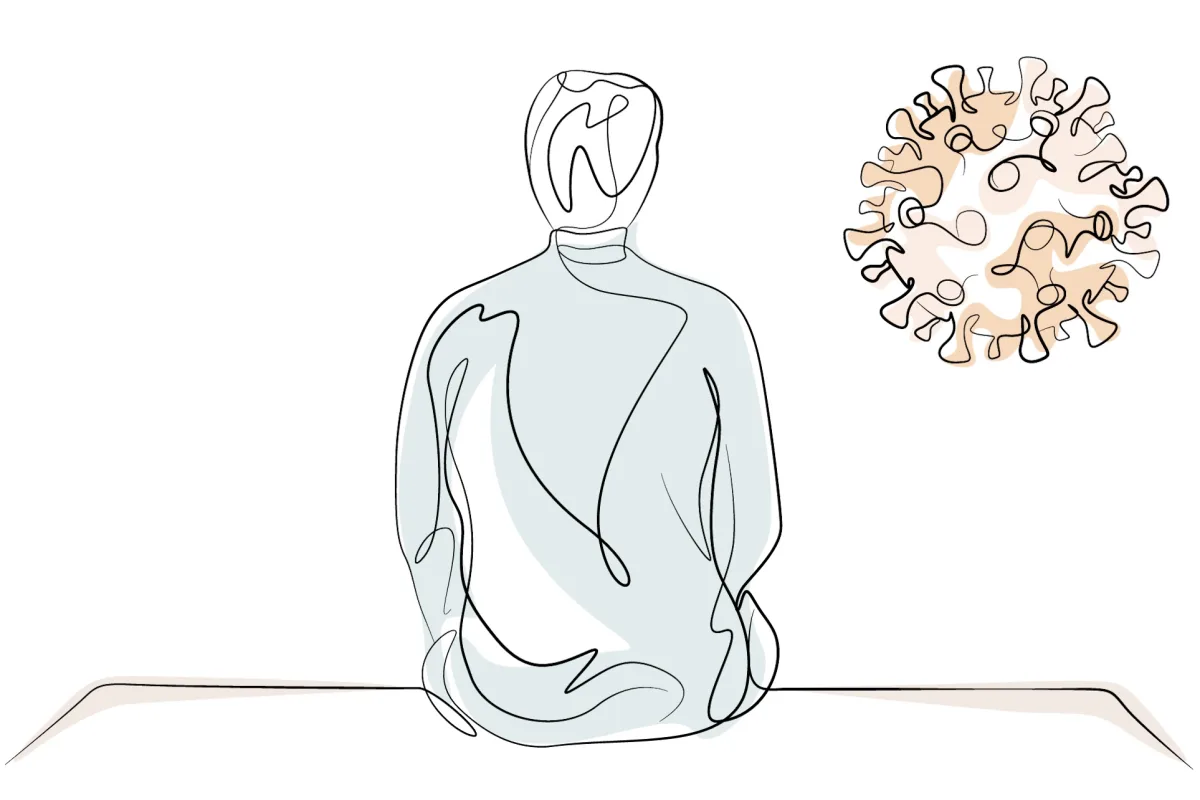
A long COVID patient, a compulsive ChatGPT user, and a doomscrolling teenager walk into a bar. The punchline? Well, that’s just it: There isn’t one. No punch thrown, no knockout, no dramatic sign suggesting something’s wrong. Yet all three sip from the same poisoned tap, each slowly but surely succumbing to a kind of sickness that the country has failed to recognize as little more than individualized struggle. Even as the pattern plays out across millions of lives, we seem intent on ignoring a sinister shift in America’s cumulative condition.
If 9/11 taught us to prepare for sudden shocks, the decades since have shown how much more subtly a society can crumble. Today’s most consequential threats may be arriving not as abrupt attacks but as drawn-out symptoms — infirmity, ineptitude, isolation, distraction, distrust, outrage. Such symptoms constitute disability in the broadest sense: a gradual though ever-growing reduction in the population’s physical, cognitive, and social capacity. We still have the opportunity to reverse this trend, but only if we learn to identify the poison and begin instituting policies that cut it off at the source.
Today’s most consequential threats may be arriving not as abrupt attacks but as drawn-out symptoms.
Chronic illness, AI, and social media represent a type of threat that security frameworks aren’t currently built to detect. Their amorphous quality, however, doesn’t make them any less of a national security concern. Rather, it should highlight the urgent need for rethinking the very contours of security itself, so as to safeguard and promote healthy living, especially when we consider that the dynamics surrounding these issues are exploitable by our enemies; that, and just the sheer scale.
Long COVID’s Long Reach
Long COVID alone affects an estimated 6–11% of U.S. adults (a 2025 study pinpoints it at 7.2%). Based on calculations cited by the Centers for Disease Control and Prevention, over 1 million Americans are missing from the workforce because of it, a gap that contributed to $218 billion in lost earnings in 2023. Globally, researchers approximate 400 million cases of long COVID with an annual economic impact of $1 trillion — roughly 1% of the world economy.
The inconspicuousness — stemming largely from the lack of lethality — is what makes threats like long COVID so dangerous.
These losses don’t command headlines like the death waves at the height of the pandemic, yet such an inconspicuously compounding toll could cause even greater societal harm. More than 1 million Americans have died from acute COVID-19 since it emerged in early 2020, but at least the dead don’t file for disability insurance or require ongoing medical intervention. Indeed, the inconspicuousness — stemming largely from the lack of lethality — is what makes threats like long COVID so dangerous.
America’s youth are particularly vulnerable. Not only are 6 million children likely living with various degrees of long COVID — they’re also getting sucked into their screens and spit out as lonely, propagandized addicts, a fraction of their potential selves. An entire generation at risk of being cognitively compromised; if that’s not a national security threat, what is?
An entire generation at risk of being cognitively compromised; if that’s not a national security threat, what is?
Socially Engineered Disorder
According to the former U.S. surgeon general, the mental health of young Americans has deteriorated at a pace unprecedented in the modern era. Depression and anxiety disorders have surged since the pandemic. Sleep quality has collapsed. Nearly one in three teenage girls now reports having seriously considered suicide, up 60% over the past decade. Clinical research has found that excessive screen time is associated with mental health issues and ADHD. Social media may deserve the lion’s share of the blame, but video games, streaming, online gambling, and porn are also undeniable forms of digital withdrawal prone to addiction.
It’s not simply that attention spans are shrinking as we retreat into unreality; it’s that attention is being rewired altogether. Neuroimaging studies suggest that algorithmic content feeds into our reward circuitry in ways akin to drugs. TikTok’s auto-play design, for example, delivers a rapid flow of personalized stimuli that consistently activate the brain’s dopamine pathways. In China, where the app originated, the Douyin version served to users emphasizes educational content and imposes firm usage limits on minors. In the U.S., brain-rotting, time-wasting entertainment and contrived agitation reign irrespective of age. That asymmetry is likely no accident.
Social disconnection in the U.S. is what logically follows. Professor Scott Galloway notes that one in seven young men have no close friends, and one in three haven’t had a romantic partner in the past year. Boys are falling behind when it comes to school, employment, and relationships. Loneliness — already linked to a 26% increase in premature mortality — is thus well on its way to becoming more of a generational baseline than a personal aberration.
Co-Opting Chronic Disability
From a national security standpoint, this isn’t an abstract cultural dilemma. Research on mass-shooters and lone-actor terrorists repeatedly identifies social isolation and grievance as common predictors of violence. The same cohort of young men who are lonelier, less attached to school and work, and more disposed toward despair is also the pool from which the U.S. military and other institutions draw their recruits. A generation that’s simultaneously less ready to serve and more susceptible to radicalization is a massive structural vulnerability.
Much of the public debate around foreign interference focuses on disinformation campaigns through the likes of bots, deepfakes, and propaganda. These are real problems, as we quite literally watch truth lose its salience. But such campaigns are (at least in theory) attributable, and therefore defendable. What should really terrify us is a more insidious form of interference: a long-game aimed not at swaying votes or even sowing division but at degenerating our overall cognition; a cyber-cognitive cold war fought through the dumbing down of entire populations.
What should really terrify us is a long-game aimed not at swaying votes, but at degenerating our overall cognition.
State actors and terrorists don’t need bombs or planes, only algorithms that hijack our attention and precipitate our alienation. Russia’s Internet Research Agency, for instance, constantly demonstrates how cheap and effective social-media manipulation can be by dividing Americans into micro-audiences, flooding them with polarizing content, troll-farming memes fine-tuned to interest groups rather than to the broader public, and then sitting back to watch us tear ourselves apart from within enraged echo chambers.
Unchecked Creative Destruction
Our adversaries aren’t solely responsible. America’s undoing is being reinforced daily by our own technologies and habits, predominantly dictated by Silicon Valley. Beyond social media, there’s AI — often discussed among defense circles as a future risk arising from an arms race and/or a runaway superintelligence. As catastrophic as that might be, the near-term threat could be almost as devastating despite its mundanity: widespread “cognitive atrophy.” Increasing dependence on generative-AI tools is already correlated with declines in critical thinking, memory retention, math skills, and the general quality of independent judgment.
AI may be a sort of competence trap, where the more we rely on it, the less we exercise the mental muscles needed when AI is unavailable or maliciously co-opted. This “trap” would replicate catastrophically on the societal scale, even if in a delayed-onset fashion. What’s more, AI isn’t just compromising individual competency; it’s amplifying all existing vulnerabilities — health decline, social isolation, media addiction — and tethering them to powerful, inscrutable platforms beyond democratic control.
A 2024 security-studies paper explicitly warns that AI is rapidly becoming central to global influence operations, information warfare, and statecraft in major-power competition. China’s People’s Liberation Army has formalized this strategy under the doctrine of “Three Warfares” — public opinion, psychological, and legal — precisely the kind of attrition long envisioned by Sun Tzu: “supreme excellence consists in breaking the enemy’s resistance without fighting.”
The U.S. has created the most dopamine-crazed, cognitively corrosive information ecosystem in human history, and then handed foreign adversaries the keys. The buckling liberal international order had assumed openness would breed democracy around the world. Yet unlimited connectivity, access to information, and market-driven innovation now enable hostile states to steer its decline from within the very architecture that once ensured American dominance.
As expected from a poisoned tap, such irony tastes bitter.
An Alarming Blind Spot
Attacks that unfold slowly evade every security tripwire we have. A society weakened quietly doesn’t perceive itself at war. Havana Syndrome is a case in point — highly localized neurological harm, hard to attribute, politically deniable. Whether the result of new-age energy devices or something way more banal, its significance lies in the ambiguity; a nefarious act that can’t be nailed down is a nefarious act that won’t be punished.
The same logic applies to chronic illness and cognitive decay. When damage is distributed across millions in small increments, responsibility disappears into statistical noise. There’s no culprit to strike back at, nor any so-called attack to deter in the first place. The harm accumulates invisibly until resilience implodes and the decline appears self-inflicted. We’re unwittingly disabling ourselves with AI, social media, and unhealthy lifestyles (not to mention how unprepared we are for another pandemic), but an age is fast-approaching where creeping, surreptitious assaults — both already initiated and forthcoming — will begin bearing fruit.
Just as long COVID may eventually prove to be the prodromal stages of Parkinson’s disease or another incurable neurological disorder, it’s entirely conceivable that similar biological and chemical pathogens, newly engineered with the aid of AI, will fall into the hands of truly apocalyptic actors. Advances in AI will mean the democratization of access. The crisis won’t be a nuclear standoff between superpowers like the original Cold War; one bad but patient individual may soon gain the ability to change the course of humanity forever without so much as setting off an alarm.
Disability isn’t securitized like death. That makes it the ideal objective for anyone with time to kill (no pun intended). Death by a thousand cuts. The frog in boiling water. This concept is as old as time. Yet time somehow remains our blind spot. To die in slow motion is still to die. A gradual extinction masquerading as survival is a problem of perspective, a failure of imagination, a shallow understanding of mortality.
To die in slow motion is still to die.
Lesson Not Learned
Misjudging the exponential power of time has been the essence of our shortcomings in dealing with climate change. And it’s the basis of contemporary asymmetric strategy. You don’t confront the hegemon head-on; you accelerate its existing trajectory downward. You let polarization metastasize. You let isolation deepen. You let attention erode. You let illness disable. You wait. And when the moment comes to challenge its leadership of the world, you discover a former empire ignorant of its readiness to relinquish the crown. Sun Tzu would be proud — not of us, but of those who conspire to usurp us.
America doesn’t need to be conquered. It only needs to be weakened.
America doesn’t need to be conquered. It only needs to be weakened enough that it can no longer marshal the will or the unity required to defend its position. Our national security establishment isn’t prepared for this reality because it violates a critical assumption baked into the post-9/11 worldview. Yes, we realized that a threat that impersonates normalcy can be particularly perilous; those planes were just that — the weaponization of everyday life. The difference between that paradigm-upending day and the present moment lies not in normalcy, per se, but in spectacle. A costlier toll stretched out less dramatically over time is a disaster normalized as the status quo.
Critical Perspectives
The danger goes well beyond these mass-disabling forces being exploited by adversaries. Our concern is warranted regardless of the catalyst. As long as the line between foreign interference and homegrown degradation remains blurry, addressing the challenge will be complicated. If we exclusively place blame on external enemies, we risk neglecting deeper domestic deficiencies: business incentives, political dysfunctions, healthcare setbacks, and personal habits that are both harming us directly and exposing us to manufactured decline, whether now or in the future.
There are also serious risks that come with framing slow-moving social and health problems as national security emergencies. Securitization, after all, is a politics of exception, where bypassing typical democratic processes is justified in the name of urgency. When mistrust is already on the rise, securitization presents a slippery slope; cries of “information warfare” could all too easily be commandeered by those eager to restrict freedoms under the banner of protecting them.
Another aspect worth pondering is to what extent, if at all, these mass-disabling dynamics could, naturally or by design, benefit U.S. rivals in relative terms. Long COVID isn’t solely an American problem; it debilitates populations everywhere. Social media’s only border is the screen. AI-induced cognitive atrophy is as ostensibly likely to hit Shanghai as Chicago. Disability is contagious; like climate change, decline may be global.
Maybe the real crisis, then, isn’t just about national security, but global security. The entire security environment has concentrated on thwarting enemies, not conditions. Viewed through this more cosmopolitan lens, a fixation on national advantage misses the point. A disabled planet isn’t one country’s win and another’s loss — it’s a collective step toward civilizational frailty. Even if long COVID, algorithmic addiction, and AI overreliance aren’t purely the symptoms of geopolitical competition, they may indeed be signs of a species short-circuiting its own progress.
The Antidote
So, back to that bar — the long COVID patient, the compulsive ChatGPT user, the doomscrolling teenager, and many other patrons plagued by delayed-onset sicknesses of myriad variety. Still no punchline. No explosion. No wake-up call. Just a room full of people slowly losing the capacity to notice what’s happening to them. And if we wait for a traditional moment of clarity to step in — a siren, a mushroom cloud, some spectacle of shared recognition — we may miss the window to constructively intervene.
Public pressure is the solution to government inaction. With enhanced awareness and scrutiny, our security apparatus can adapt to detect those threats that are less visible. Otherwise, with eyes wide shut, the mass-disabling of America won’t feel like a crisis until the crisis is irreversibly underway. By then, the joke — and the world order it dismantled — will be on us.