In 2010, a U.S. citizen named Richard Lee Desautel was arrested for shooting a cow-elk in British Columbia. In the Provincial Court, Desautel claimed that, as a Sinixt ceremonial hunter, he had a right to hunt in his ancestral lands of the upper Columbia watershed.
He won.
In 2021, the Supreme Court of Canada upheld the favorable ruling, further recognizing that non-Canadian residents and citizens can be claimants of Aboriginal rights. For the Sinixt people, whose ancestral lands in the upper Columbia watershed stretches across the border of Canada and the United States, this victory was decades, if not centuries in the making, a long overdue step towards repairing the damage done by drawing lines on a map.
Today, Desautel’s court case is playing a crucial role in another fight for indigenous self-determination. Based in the U.S. state of Washington, the Lummi Nation is challenging the proposed Robert Banks Terminal 2 at the Port of Vancouver in Canada, demanding a seat at the consultatory table. The nation argues that the terminal and its long trail of environmental impacts will encroach upon the tribe’s ancestral fishing grounds, since the borders mean little to the downstream effects of the project.
While the tribe’s right to fish on ancestral grounds is legally protected by US law, owing to a century of indigenous activism, the tribe argues that due to the transboundary nature of the issue, Canada must also respond to its demands to protect ancestral lands and the ecosystems they are part of.
The Vancouver Fraser Court Authority points out that the 100-hectare state-of-the-art marine container terminal will add $3 billion to Canada’s GDP and generate 35,000 construction jobs. Shipping routes from this hub of global commerce will reach 170 countries, crossing an elaborate map of invisible lines demarcating exclusive economic zones and national borders. This case asks the Canadian courts, once again, to decide which logic will prevail – the logic of law, borders, and treaties, or the logic of watersheds, water, and life.
Where do the salmon go?
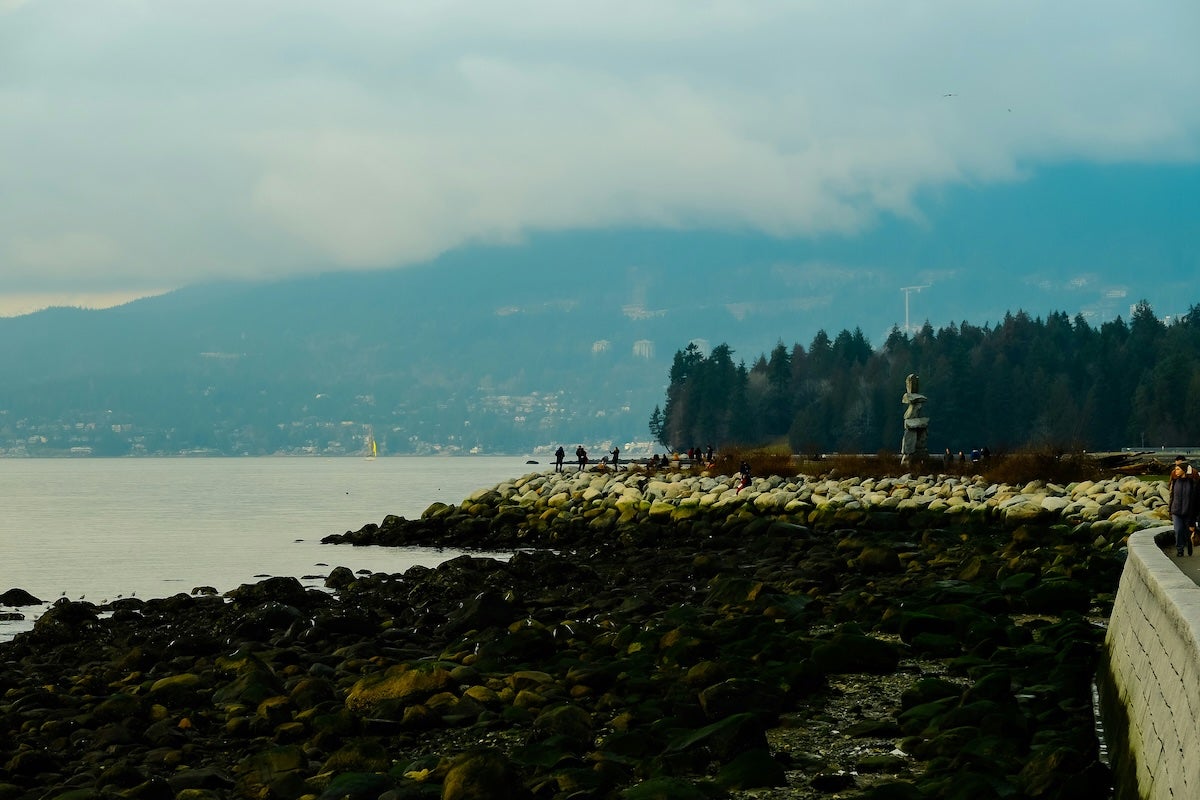
The Port of Vancouver, where the terminal is projected to be built, is situated in the waters between Vancouver Island and the North American mainland. These waters are referred to as Puget Sound as well as the Salish Sea, after the region’s original inhabitants, the Coast Salish people.
The Salish Sea is a transboundary waterbody, lapping against the coasts of Canada, the U.S., and several sovereign tribal nations, subject to numerous nested, overlapping, and complicated jurisdictions.
But independent of this complex web of legal and policy instruments is the dynamic, resilient, and ancient fact of the water itself. In the estuary where the second Robert Banks terminal would go, fresh water from the Fraser River and salt water from the Strait of Georgia meet, creating the unique brackish conditions necessary for a host of life.
This is where young salmon travel. As they swim from their rivers of birth toward the sea, increasing salinity provides a gradually changing environment. In other words, the phenomenal physiological transition the young fish undergo is not a sudden adaptation from freshwater to saltwater, but a slow acclimation to their dynamic environment. The gradient of fresh to saltwater holds within it the incredible complexity of incremental change, each step offering something unique to the life that depends on it.
The nuance of how river and sea meet is essential not only for salmon development, but for the overall health of the river. The Fraser runs from the highlands of the Rocky Mountains to the lowlands of the Salish Sea, bringing with it silt, sediment, and nutrients. Sediment moving downstream is then deposited at the mouth and along the river to create landforms. These landforms shift as sediment builds and create intertidal zones and wetlands that provide refuge for incredible biodiversity.
In their award-winning environmental plan, the Vancouver Fraser Court Authority claims to offset the environmental damage of the new terminal with 86 hectares of habitat mitigation upstream of the Fraser River.
But the terminal’s 100 hectares of landmass and 35 hectares of causeway cannot replace 86 hectares of wetland restoration somewhere else. And turning an estuary into concrete is not mitigated by creating mud flats. The salmon must still contend with the terminal and its effluents, its noise, and ship propellers.
Environmental Effects of the Robert Banks Terminal
The relationship among salmon, sediment, and salt is defined by their dependence on the water, the land, and each other. The new Robert Banks Terminal will be defined by its relationship not with the land and water, but with its shipping routes, Canada’s trade relations, and dependence on global commerce.
The Terminal won’t move with moving water and land. It will be fixed in place. But the environmental effects of the terminal will spread, threatening the Lummi people’s usual and accustomed fishing grounds.
R v Desautel provided precedent for the Lummi Tribe to assert their right to consult on the Roberts Bank Terminal project. But the Canadian government responded that the consultation process for U.S. tribal nations is distinct from that of Canadian tribal nations. The move demonstrated that the state did not envision transnational stewards of the same land and water to be legitimate stakeholders in this development project.
With the new Robert Banks terminal comes threats to the water and the life that depends on it. With increased traffic there will be more noise, more effluent, and more propellers slicing through the water. This is the loud, obvious violence. But the slow violence — of fewer orcas, fewer salmon, and worse water — will ripple through time and space, continuing to eat away at the environment and severing relationships between people and the land.
By prioritizing biodiversity and the natural environment in the long term, we may need to forego by prioritizing economic growth in the short term.
By centering interdependence in decisions like these, states can amplify respect in multiple directions. On the one hand, a relationship can be cultivated between private and public entities by recognizing ancestral lands and respecting the dynamic ecosystems that it is part of. This requires the state to invite indigenous stewards of the land to the discussion table to find a way forward that does not compound centuries of mistreatment of the land and its people. On the other hand, local ecosystems can be protected by putting the natural environment at the center of discussions of development, which are often instead focused on production and efficiency. By prioritizing biodiversity and the natural environment in the long term, we may need to forego by prioritizing economic growth in the short term.
This requires that we employ the ancient logic of interdependence of water, land and people, as opposed to recent logics of production.
We need to invest in the salmon, not just the port.