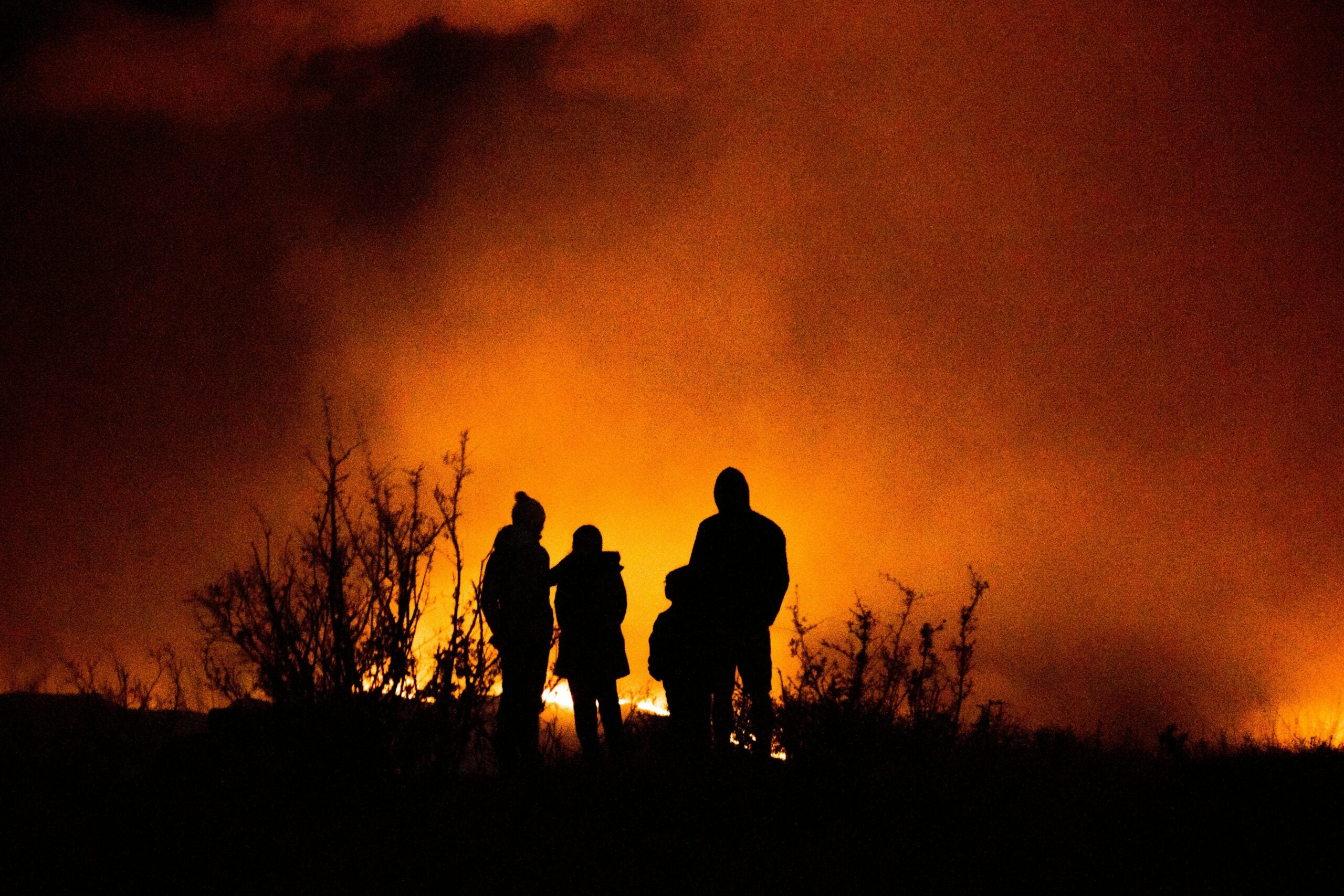
What would you do if your house was on fire and there was no one to call?
Here in the United States — and particularly my home state of California — many of us are used to our government showing up for us. When our house is ablaze, the fire department comes and puts out the fire. In California, we’re working with a $4 billion annual firefighting budget.
But that’s not the case everywhere, like Argentina, where underresourced fire departments are no match for yearly blazes that consume the country’s native forests and wetlands by the millions of acres – and whose government leaders are often (and sometimes rightly) accused of corruption and face public mistrust at every turn.
This year, even California’s near-militarized firefighting force was no match for the Los Angeles fires, where devastating fires overwhelmed the city and state’s resources to burn 16,000 homes.
When the state is maxed out in its ability to help, other sectors must step in. A leading example of this is in Argentina, where the federal government has been hamstrung to act against fires, necessitating the leadership of others.
In 2020, 200,000 acres burned in Argentina’s Paraná Delta as a result of around 8,000 individual fires. The 2022 fires were even worse. It’s an area that was previously thought to be “unburnable,” but burn it did — nearly a million acres all told — igniting not just the precious wetlands but also a fresh fight between the country’s urban and rural cultures.
And the national government’s response, too, has been underwhelming.
Argentina’s economy is largely reliant on agricultural exports, but its major cities are full of left-leaning environmentalists. In the delta region, the divide is particularly acute: On one side of the river sits leftist Rosario in the well-resourced Santa Fe Province. Across the way is the province of Entre Rios, much poorer, and sparsely populated save the ranchers who work and live on the land. Each blames the other for causing the fires — for the most part, they’re set intentionally — and the governments of the two provinces have yet to be able to fund a full-scale intervention.
And the national government’s response, too, has been underwhelming. Rosarinos would often tell me that it was only once the smoke from the fires in the islands reached the capital of Buenos Aires that the nation’s leadership began to pay attention to the crisis — but their efforts were uncoordinated, and for the ranchers who lost their lands to the blazes, would come too late.
First introduced to Argentina’s Congress in 2012, the Wetlands Law sought to protect the delta and wetlands across the country from fires and other types of ecological damage, which many attribute to the profitable expansion of agriculture and real estate development. The proposed law has been extremely controversial in Argentina since its introduction, and decades later, it has yet to make it out of the legislature, in part because of the sheer amount of land it would affect (one-fifth of the entire country) and the influence of powerful soybean, cattle ranching and mining lobbies.
In the absence of policy solutions, and during the worst of the smoke crisis in 2022, Rosarinos began to take to the streets, protesting and drawing national attention to the issue, paving the way for the courts to intervene. Protest is part of the Argentine ethos, I would quickly find out during my nine months spent interviewing hundreds of people about what to do about their wildfires. But it was far from the only example of effective hyperlocal action in the country that I would find.
When Government Fails, Who Fills the Void?
It was 2022, and smoke from nearby wildfires had begun, once again, to blanket the city. Atmospheric physicist Adriana Ipiña Hernandez was in her lab monitoring her instruments, the building’s rooftop overlooking the Paraná River whose islands were being slowly eaten by flames, when she saw something terrifying. The levels of particulate matter in the air that her instruments were picking up were enormous: 880 micrograms per cubic meter. The maximum level considered tolerable for humans by the World Health Organization is just 5 micrograms per cubic meter per year, or 15 over the course of 24 hours.
Why didn’t that raise alarms for everyone? When the direction of the wind would change and the smoke would disappear, Ipiña Hernandez said, local sensors wouldn’t pick up any air contamination at all for hours on end. That kept the 24-hour level below the WHO’s recommended level, so almost no one, aside from Ipiña Hernandez, was understanding what was really happening.
So she wrote a report for the university website — and it was soon picked up by local media outlets.
For the coming weeks throughout the smoke crisis, her warnings and calls to action would be published by local newspapers, and she would book media appearances, raising alarms about the potentially serious health effects from the smoke.
Then she got a call from a city prosecutor.
Her data, alongside satellite imagery from NOAA and NASA, was going to be used in a high-profile case against 19 people who owned land on the islands to determine their liability for indirect damage to the health of the people of Rosario, launching the first-ever full-scale legal investigation into who is responsible for millions of acres burned in the region, which is currently underway.
Ipiña Hernandez’s quick action — well outside the bounds of her role as a researcher — gave early warning to the citizens of Rosario that their health was at risk, and may have long-lasting consequences. It’s also proof that to combat the existential threat of climate change, we cannot wait around.
Or as Ipiña Hernandez put it: “We can forecast the climatic future we want to avoid.”
She’s far from alone in her efforts. With government action on fires stalled (and getting worse: Immediately upon taking office in 2024, President Javier Milei cut the National Fire Management System’s budget by more than 80%), nongovernmental groups, and even individuals — like Ipiña Hernandez — are speaking out and stepping up.
I got to see many of these efforts firsthand during my time in Argentina. In the agricultural region of Córdoba, neighbors are banding together to form their own, often illegal, firefighting forces, risking their own lives to fight fires out in the wilderness where no one else would go.
It was a reflection of a phenomenon I had observed earlier in my career, when reporting in coastal California during a once-in-a-century blaze in 2020. There I would find the very same thing: Volunteer firefighter Chris Conner manning the Loma Mar fire station overnight promising to save his community; small business owner Beth Pielert leading mass-scale livestock evacuations; local nonprofit leader Rita Mancera dipping into emergency funds to plug holes in Red Cross aid.
Over the course of 2023, as I uncovered dozens of examples just like Ipiña Hernandez’s, it would build a case that the strength of the community I found in coastal California not only has the power to save lives, but is just a small slice of what is possible.
Wildfires are a symptom of the climate crisis, and they require an all-hands-on-deck solution. Today, as the crisis worsens and fires start to threaten new areas across the United States and abroad, community resilience like I saw in Argentina will have to be built from the ground up, and must span geographies and cultures.
We should not see community organizing as just a Band-Aid to government failure. Instead, it can form the foundation of a solution.