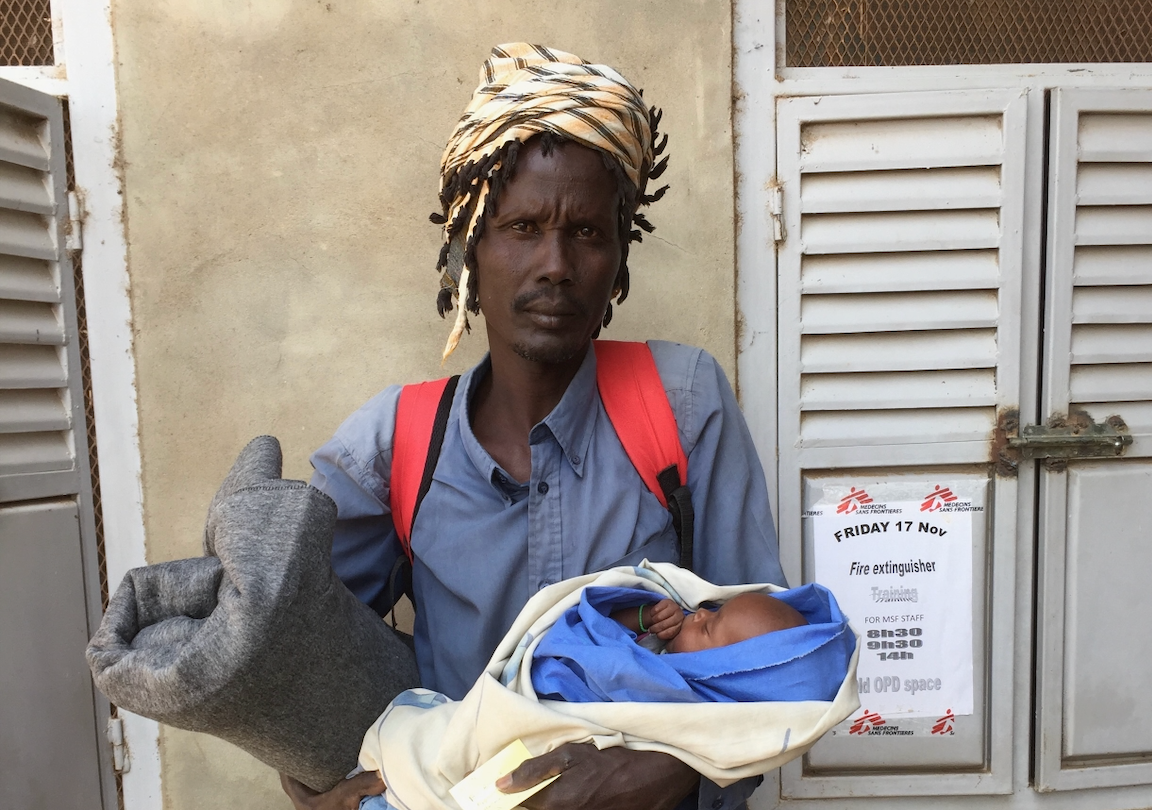
In the late 2010s, I was a midwife for Doctors Without Borders (Médecins Sans Frontières/MSF) in Agok, South Sudan. We worked in a hospital supporting a large area where people displaced by conflict in Sudan had been forced to resettle temporarily. “Temporarily” is a loose term, as many people had been living for years in the round, earthen huts, awaiting a safer situation so they could return to their true homes.
What’s crossed my mind this last year after U.S. global support has willingly ruptured is the story of a young father I knew during my time in South Sudan. This father would walk for four hours each week to come to the MSF hospital to receive formula for his newborn daughter. He would carry his carefully wrapped baby with him on this journey, as well as the weight of his grief after losing his wife during childbirth.
In a culture that in many ways embraces traditional gender roles, the dedication, tenderness, and love this father had for his baby was heartbreaking and raw. He had already lost his wife — she likely birthed without any trained attendant present in a place where perinatal mortality ranks near the highest in the world. Statistics were not in favor of his daughter surviving either, yet he persisted walking miles across the cracked, dusty land because he knew there was help available through international aid.
U.S. used to be seen as a nation that expressed care for others through institutions like USAID.
These days, whether in high-speed Zoom rooms or at softly lit dinner parties laid with abundant food, it has become almost routine to mourn the state of our country: shifting policies, fraying norms, a perceived loss of character and integrity. From my place of privilege I’ve lost sleep, awake and worrying between my moderately priced linen sheets. It’s an act of cognitive dissonance really to consider these two worlds occupying the same planet. My fear is that to survive the constant churn of turmoil and political violence, the public will grow numb, and with that numbness forget what it once meant for the U.S. to be seen as a nation that expressed care for others through institutions like USAID.
In large government programs there’s likely always room for improvement — such was the case for USAID. Perhaps with a more restrained, clear-headed approach, realignment of priorities and strategy could have dramatically reshaped U.S. global engagement without an abrupt end to critical care and assistance. Instead, the severing of lifesaving aid is leaving a wake of millions of preventable deaths.
Deprioritizing global health may put our country’s own health at risk, too. Since we are all familiar with pandemics I won’t belabor the usefulness of having skilled clinicians spread across the globe monitoring for the next virus and identifying and treating outbreaks before spread is uncontainable. Viruses unfortunately do not respect borders. This long known fact is something that my southeast region of the country has tested once again; preliminary reports indicate measles isn’t stopping at the South Carolina state border.
When a family’s nutrition comes from a 50kg bag of rice stamped with “USAID: A gift from the American people,” seeds of goodwill may take root.
U.S. global health engagement also protected the safety of U.S. citizens abroad and at home. When a family’s nutrition comes from a 50kg bag of rice stamped with “USAID: A gift from the American people,” seeds of goodwill may take root. Our supportive presence may have been most impactful in places where a dire future leads individuals down a path of religious radicalization and violent extremism.
USAID-supported projects reflected our country’s generosity while also building lasting foundations — literally through clinics and schools, and figuratively by fostering hope and creating conditions for greater stability and peace. Notably it was in South Sudan, a place where many USAID projects once occurred, that I met a chubby, bright-eyed baby proudly named George W. Bush.
As in many chapters in history, it is the women and children who are most impacted by last year’s cut in funding. In Africa alone, after USAID money was halted an estimated 11.7 women and girls no longer have access to contraception. Contraception can be life saving in a place where dying from childbirth is a real risk. Estimates for unintended pregnancies resulting from the abrupt absence of contraception may result in 8340 preventable maternal deaths this year.
And so let us return now to the South Sudanese father from a decade ago who lost his wife during childbirth. I don’t know what happened to this family, but I’d like to imagine the dad continued to have access to infant formula and saw his baby get stronger and grow bigger. Maybe the daughter is now a ten-year-old — perhaps she attends primary school and has enough to eat, access to basic medical care, and a safe place to call home. These things are all possible; however, realistically, for the next widowed parent seeking food for a newborn, it’s much less likely the formula will be there.
If the U.S. aims to build strategic alliances, detect and respond to health threats, protect national security, and lead globally, it must reverse the withdrawal of USAID funding (1% of the national budget) to remain visibly and consistently engaged in global health aid. During a time when the deluge of news stories and waves of shocking headlines can make keeping one’s head above water hard, it’s important to remember we don’t have to react to chaos with fear.
But we do have to act.