
In September 2025, the United Nations announced a groundbreaking, multimillion dollar plan to increase mental health support for people affected by humanitarian crises. The Greentree Acceleration Plan will deliver care ranging from psychological first aid to clinical support for people experiencing large-scale disasters or conflicts, as well as for frontline workers dealing with intense stress and trauma.
The initiative — which will begin in Chad and Lebanon — addresses just the tip of the iceberg. An estimated 300 million people around the world need humanitarian assistance, and 66 million experience mental health conditions.
If aid efforts don’t start in the hands of local actors, chances are they will never end there.
We recognize that providing mental health support in crises is critical, and the Greentree Acceleration Plan is a vital step forward. However, we caution that money alone cannot succeed if the delivery model remains broken. Decades of research and experience demonstrate that the greatest obstacle to meeting mental health needs isn’t a lack of evidence-based interventions, but a dysfunctional, top-down humanitarian system that creates dependency rather than sustainability.
To change this broken system, we urge the plan’s leaders to flip the humanitarian pipeline: Invert the aid hierarchy by trusting local partners with direct financial control.
The Myth of Localization
We have worked both as scholars and as nongovernmental organization co-founders, leaders, and employees. We have witnessed the urgent need to reimagine humanitarian funding dynamics — or risk replicating parallel systems that undermine local care.
What we have long observed is a problem that we call “the myth of localization.”
Localization is the reasonable-sounding goal of transferring ownership of aid initiatives from large international organizations to local actors over time. Mental health aid is uniquely suited for this approach. Psychological support must be deeply rooted in local culture and language to be most effective, which means it is best delivered by the people who call that context home.
The international order cannot deliver even a fraction of the needed mental health support.
But this transfer rarely happens as intended. Instead, local staff face interminable capacity-building cycles, which are funded by international grants, where they are never deemed capacitated enough to fully manage the programs in question.
We have received (and facilitated) these trainings in mental health care and psychosocial support. We have seen colleagues repeatedly capacity-built, up-skilled, and re-skilled, yet never graduate from cycles of seasonal turnover and short-term project contracts.
Crucially, we are not aware of any historical example of what successful localization efforts aim to accomplish. By this we mean that we know of no instance where an international actor has initiated a program with full managerial, administrative, and financial oversight, and subsequently transferred all those functions to a local organization (or even a national government).
It begs the question: Did international donors ever intend for aid workers to let local actors take the reins?
If aid efforts don’t start in the hands of local actors, chances are they will never end there.
Donors have another way that will put the myth of localization to rest in favor of local ownership: Fund local actors from the start. Only local communities are ever truly situated to manage these efforts over the long term.
Investing Catalytically — Not Comprehensively
The U.N.’s system for responding to emergencies is overwhelmed. Resources and staff needed to deliver care on the ground are rapidly draining away , even as global conflicts escalate in flagrant violations of international humanitarian law. The international order cannot deliver even a fraction of the needed mental health support.
In low-resource settings such as Chad and Lebanon, the World Health Organization estimates the treatment gap to be around 75%, which leaves the vast majority of the estimated 66 million people in need with no professional care at all. As such, the moment calls for international funders to make catalytic rather than comprehensive investments.
In other words, instead of funding a broad scattershot of mental health program implementation projects, initiatives like the Greentree Acceleration Plan should fund whatever is specifically needed to help local actors provide sustainable mental health support.
Experts have identified many effective mental health interventions for humanitarian settings, including ongoing work on supporting humanitarian staff. How mental health support is delivered matters at least as much as what the interventions involve, and that is where modern financing should focus.
Donors are uniquely situated to shape the horizons of possibility in the humanitarian sphere — they define what is expected versus what is unthinkable.
Scholars from affected contexts have eloquently articulated their needs — asserting that Chad, for example, “does not need another assessment; it needs political will, policy reform and sustained investment” to avoid donor-led mental health efforts that “remain sporadic, partner-driven and unsustainable.”
Local scholars prefer to work toward embedding these efforts in national programs with government oversight by building these services directly into their own country’s permanent public health system rather than relying on temporary funding mechanisms.
We believe donors still have a role here — but it needs to be creative and catalytic, investing in local actors to do whatever’s needed to build sustainable initiatives in their own countries. The scale of the need is too vast to justify doing otherwise.
Resetting Humanitarian Horizons
Directly funding local actors is a sharp departure from common practice in the humanitarian sector — and it brings real challenges.
Our own NGOs experienced significant financial loss after partnering with poorly equipped local organizations in our home countries. However, the solution is not to curtail local opportunity, but to invest in the capacity-building process itself as the funding initiative’s primary goal.
We recognize donors may be reluctant to turn over control of their investments to local NGOs. Yes, corruption and mismanagement are always salient concerns — but these are symptoms of systemic inadequacy across many contexts, rather than inherent shortcomings of local aid actors in crisis zones. Problems should be addressed, as anywhere, with thoughtful shared accountability measures and incremental support that builds independence over time.
The Greentree Acceleration Plan, as well as the future of global mental health aid, stands at a definitive crossroads.
Donors are uniquely situated to shape the horizons of possibility in the humanitarian sphere — they define what is expected versus what is unthinkable.
The Wellcome Trust — a U.K.-based foundation that is a significant player in scaling up mental health initiatives around the globe — has a significant opportunity to reset these horizons as a key sponsor of the U.N.’s Greentree Acceleration Plan. We urge Wellcome Trust to fund local actors directly, supporting them to deliver services, build capacity, and subcontract international partners according to their own priorities.
Our local colleagues remain in their own communities without the incentives of rest and recuperation and hardship posting benefits that foreign career humanitarians receive — and they are the ones who will remain in these contexts after the crisis fades. Co-creating governance capacity as a core (funded) deliverable ignites genuine local ownership that is necessary for lasting impact.
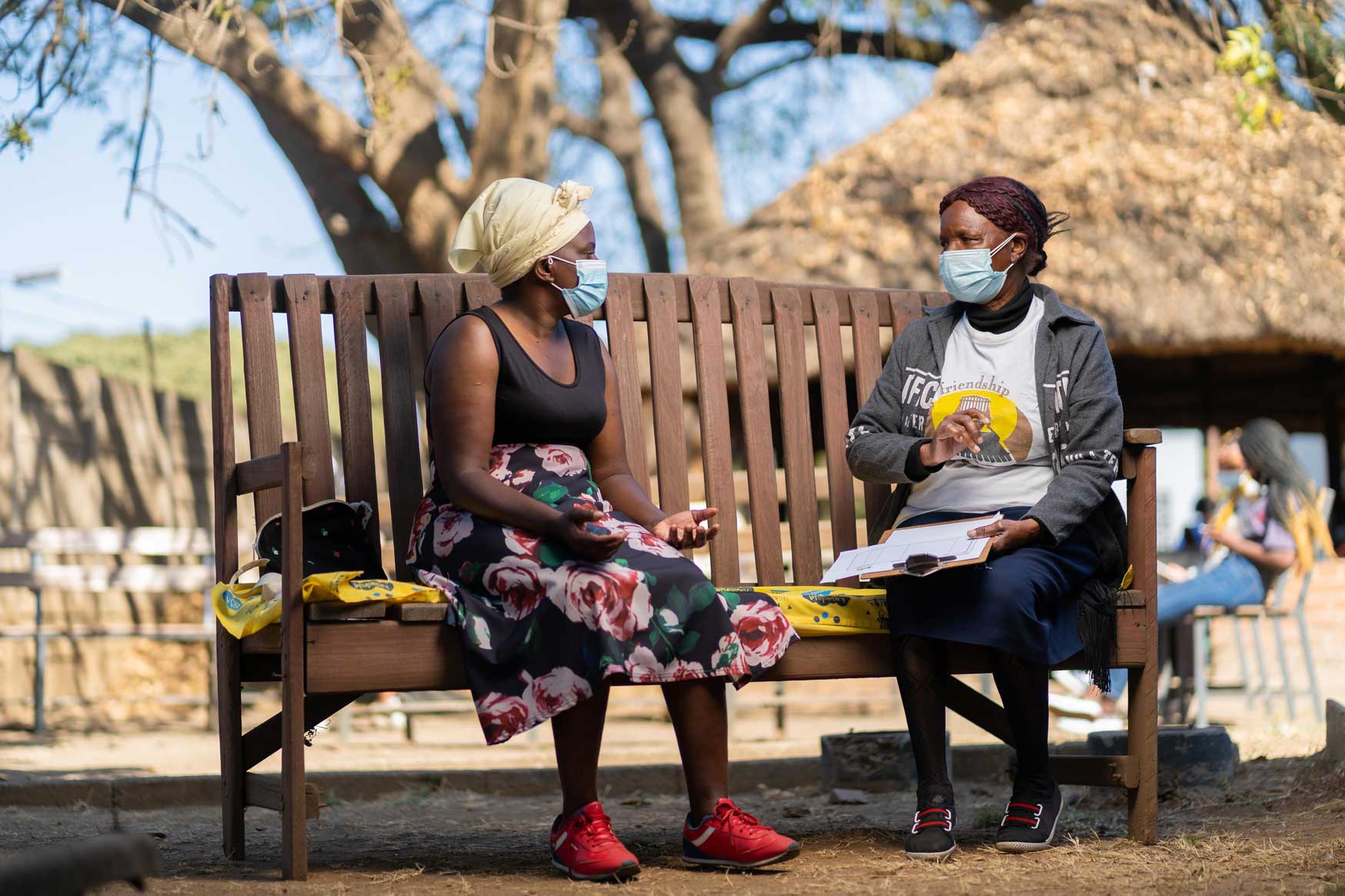
We see positive local ownership examples in models like the Friendship Bench in Zimbabwe, a brief psychological intervention delivered by trained health workers that effectively improves mental disorder symptoms when compared to standard care. Its success stems from being embedded in local community structures from the start, allowing it to scale sustainably where imported models often fade.
The Greentree Acceleration Plan, as well as the future of global mental health aid, stands at a definitive crossroads. It can choose to perpetuate the trickle-down aid model that has historically fostered dependency, or it can seize this moment to move toward structuralizing equity.
This piece is a collective work by Lauren Yan, Sebastian Peña-Vargas, Yesenia Garcia, Saba Chowdhury, Baffour Boaten Boahen-Boaten, and Stephanie Haddad of the Johns Hopkins Department of Mental Health.